
◎
Get clear
Get clarity on what matters most right now.

Are eggs rich in iron is up 150 percent in search this week. What food is highest in iron and does oatmeal have iron are each up 90 percent, iron rich meals is up 50 percent, and foods rich in iron for adults is up 40 percent. Underneath all of that, foods rich in iron is sitting at a volume score of 100, with iron rich foods list at 31, what foods are iron rich and foods with iron both at 27, and high iron foods at 21.
That is a lot of people standing in a kitchen asking one question in ten different ways. Right beside them in the same data are searches about blood tests and low iron. Those are questions for a qualified healthcare professional rather than for a company that sells an iron supplement, so we leave them with the professionals.
What we can do is show you how to read the list itself. Nearly every iron-rich food list you will find is built from a food-composition database. Once you know how that database counts, the egg question, the oatmeal question and the which-food-tops-the-list question all get much easier to read.
In the United States, the reference most lists trace back to is USDA FoodData Central, the Department of Agriculture's public food-composition database. Its long-running Standard Reference data reports each nutrient as a mean value per 100 grams of the edible portion of a food. Iron shows up as a single line, "Iron, Fe," in milligrams.
That per-100-gram basis is the most important thing to know about any list of foods with iron. It makes foods comparable by weight. It says nothing about how much of a food anybody eats, and it is the reason some very odd things float to the top of a ranked list.
The word "rich" also has a second, formal meaning, and it lives on packaging. Under the FDA's nutrient content rules in 21 CFR 101.54, the terms "high," "rich in" and "excellent source of" may appear on a label only when a food contains 20 percent or more of the reference daily intake per reference amount customarily consumed. "Good source" covers 10 to 19 percent.
So a food list online and a "rich in iron" line on a box are two different kinds of statement. One is a ranking pulled from a database. The other is a regulated label term with a threshold behind it.
Read enough high iron foods lists and you will notice they fall into two columns, animal foods and plant foods. The vocabulary behind that split is heme and non-heme.
Heme is an iron-containing structure built into proteins such as hemoglobin and myoglobin. Oregon State University's Micronutrient Information Center describes heme iron as coming from the hemoglobin and myoglobin in animal foods, and non-heme iron as the form found in both plant and animal foods. Meat, poultry and seafood carry both kinds. Plant foods carry the non-heme kind only. The same reference notes that most grain products in the US are fortified with non-heme iron.
Here is the catch for anyone reading a list. FoodData Central reports one total iron figure for each food. It does not split that number into heme and non-heme, so a list built from the database cannot tell you which kind a food carries. The number tells you how much. The vocabulary tells you which column.
Eggs come from an animal, so most people expect them to sit next to the meats. The database is more interesting than that. FoodData Central lists a whole raw egg at 1.75 milligrams of iron per 100 grams.
Now split the egg. The raw yolk is listed at 2.73 milligrams per 100 grams. The raw white is listed at 0.08. Nearly all of the iron in an egg sits in the yolk, which means an egg-white omelet and a whole-egg omelet are, on this one line of the database, very different foods.
For comparison on the same basis, raw 85 percent lean ground beef is listed at 2.09 milligrams, raw skinless chicken breast at 0.37 and raw beef liver at 4.9. A whole egg lands closer to ground beef than to chicken breast.
So is an egg rich in iron? On a database ranking, it sits in the middle of the animal column, well above chicken breast and well below liver. On a package, "rich in" is the regulated 20 percent line, and that is settled by the food's own label, not by a list somebody built.
Yes, and oats are the clearest example of why you read the food description before the number. FoodData Central lists regular and quick oats, not fortified, dry, at 4.25 milligrams of iron per 100 grams. The same oats cooked with water are listed at 0.9 milligrams per 100 grams.
The explanation is water. The database lists the dry oats at 10.8 grams of water per 100 grams and the cooked oats at 83.6 grams. Cooked oatmeal is mostly water, and a per-100-gram figure counts that water as part of the food. Any list that quotes dry oats beside a cooked dish is comparing an ingredient with a finished bowl.
Then there is fortification. The database lists plain instant oats that are fortified, dry, at 24.7 milligrams per 100 grams, several times the unfortified figure. That iron was added during manufacturing. So the honest answer to does oatmeal have iron depends on two words on the box: "fortified" and "dry."
This is the question that produces the strangest results. Among the entries we pulled from FoodData Central, dried thyme is listed at 124 milligrams of iron per 100 grams. Fresh thyme is listed at 17.4. Dried pumpkin and squash seed kernels come in at 8.82, cooked lentils at 3.33, raw spinach at 2.71 and raw clams at 1.62.
The thyme gap is the same water story as the oats, run in reverse. Fresh thyme is listed at 65.1 grams of water per 100 grams, dried thyme at 7.79. Drying takes the water out, and the iron that stays behind is counted against far fewer grams. Nobody eats 100 grams of dried thyme, but a chart ranked by weight will still put it at the top.
A list ranked by typical serving would look completely different. A list of iron rich meals is a different exercise again, because a meal is a portion decision, and portions belong in a conversation with a registered dietitian or clinician. The same goes for foods rich in iron for adults. The database does not sort foods by who is eating them, and anything that depends on the person is a question for a professional.
We think "iron-rich" is one of the most overloaded phrases in food writing. On a list it means a spot in a per-100-gram ranking. On a package it means a regulated percentage. In conversation it usually means neither, just "the red meat and spinach column."
The fix is not a better list. It is reading three things every good list should show you: the exact food description, including raw, dry or cooked; the basis the number is quoted on; and whether the food was fortified. A list that hides those three things is a ranking of guesses.
And learn heme and non-heme as words. They will not change a single number in the database, but they explain why every list you find splits into two columns, and they make the next label you pick up a lot easier to read.
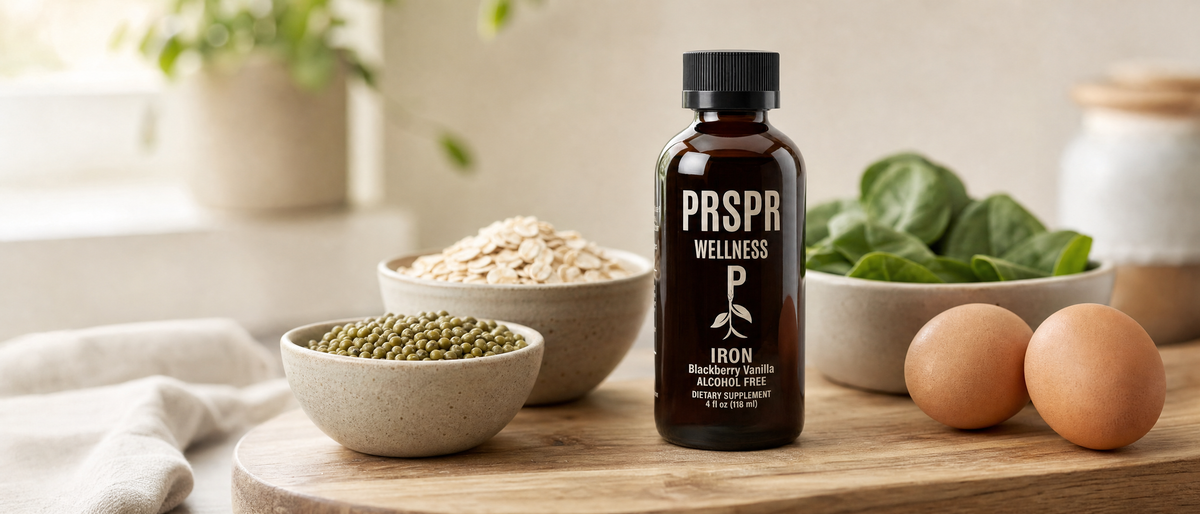
Food is where this whole article lives, and the bottle only comes in at the end. Our Liquid Iron is a dietary supplement containing iron in the form of ferrous bisglycinate chelate, combined with wild harvested yellow dock root. That is the composition as the live listing states it.
It is made in a GMP-certified facility and third-party batch tested, so what is on the label is what is in the bottle.
If the chemistry words on that label are your next question, our decoder for ferrous bisglycinate chelate covers them, and the piece on the four iron salts covers the rest of the shelf. Otherwise open the Liquid Iron page and read the panel, browse the vitamins and supplements collection, or take the build-your-stack quiz.
Answer all five questions to unlock a clear wellness plan made around your goal, schedule, preferred supplement format, and biggest roadblock.
Get clarity on what matters most right now.
See the product and routine connected to your goal.
Simple next steps you can use right away.
Pick the one you would fix first if you could.
This helps us make the guide easier to follow.
Consistency beats the “perfect” routine you never follow.
Be honest. We’re building something you’ll actually use.
Your guide will include one simple way around it.
Answer two more questions to unlock your product starting point, five-step plan, two-week routine, and one practical tip for your biggest roadblock.
Enter your details to open your five-step plan.
Verified PRSPR customer reviews
Expires when you close this page
*Your personal credit for completing the quiz. It's applied automatically at checkout on one-time purchases and expires when the timer runs out.
View full product detailsEverything in your plan, together — one add to cart.
Expires when you close this page
*Your personal credit for completing the quiz. It's applied automatically at checkout on one-time purchases and expires when the timer runs out.
View full product details Mind vocabulary
What is cognition? You have probably seen the word "cognitive" printed on a label, in a headline, or in a product name, and kept scrolling. It is o...
 Biology vocabulary
What is metabolism? You see the word on labels, in gym talk and in nutrition headlines, almost always used as if it were a single setting. Read eno...
 Sleep vocabulary
What are sleep cycles? You hear the phrase on podcasts, see it on sleep trackers, and read it in articles that assume you already know what it mean...