
◎
Get clear
Get clarity on what matters most right now.

What is testosterone? That exact question carries a volume score of 88 this week, which makes it the biggest term in a very busy search. Around it sit "testosterone in women" at 37, "male testosterone" at 33 and "free testosterone" at 32. Lower down, "what does testosterone do" scores 17 and "total testosterone" scores 16.
Look at that list closely and you will notice something. Half of it is vocabulary. People are not only asking what the hormone is. They are asking what the words around it mean, especially the two small adjectives that show up on lab paperwork: total and free.
That is the part we are going to cover: the definition, where the name came from, and what "total" and "free" describe. Questions about your own body, your own test results, or any treatment are questions for a qualified healthcare professional. We are not going to answer them here, in either direction.
Start with the textbook definition. Cleveland Clinic describes testosterone as a hormone produced by the testicles and ovaries, and calls it a sex hormone because it plays a part in developing male or female traits and in things like puberty and libido.
A hormone is a chemical messenger, and hormones come in chemical families. Testosterone belongs to the steroid family. A review in the International Journal of Molecular Sciences describes androgens as a diverse group of steroid hormones, names testosterone as the main and best-known androgen, and says androgens are synthesized from cholesterol. So the full name tag reads: steroid hormone, androgen group, made from cholesterol.
"Steroid" here is a chemistry word, not a gym word. It names a shape of molecule built on a particular ring structure, and cholesterol is the starting material for the whole family. When you see "steroid hormone" in a reference book, that is all it means.
The word is younger than most people assume. According to the Online Etymology Dictionary, "testosterone" dates to 1935, from the German Testosteron, coined from the Latin testis ("testicle"), plus the first syllable of "sterol," plus the chemical ending "-one."
So the name is a three-part label: where it was found, what chemical family it belongs to, and a suffix chemists use for a particular kind of molecule. It is less a name than a short description.
The word "androgen" is only a year younger. The Online Etymology Dictionary dates it to 1936, from "andro-," meaning "man, male," plus "-gen," meaning a thing that produces or causes.
The history lines up with the dictionary. A history of testosterone presented at a Society for Endocrinology meeting says the name was coined in 1935, when Ernst Laqueur isolated the hormone from bull testes, and that it was chemically synthesized independently the same year by Adolf Butenandt and Leopold Ruzicka. NobelPrize.org records that the 1939 Nobel Prize in Chemistry was divided between Butenandt, "for his work on sex hormones," and Ruzicka, for his work on polymethylenes and higher terpenes.
Search splits this hormone by sex, with "male testosterone" and "testosterone in women" both on the list. The vocabulary answer is that it is the same molecule in both. There is no separate male version and female version of the chemical.
What differs is where it is made. MedlinePlus says the testicles are the main producers of testosterone in males, and that in females it is produced by the ovaries. Cleveland Clinic adds that the adrenal glands also produce small amounts in both sexes, and states plainly that women make testosterone too.
That is the whole reference-book answer to "testosterone in women": yes, women make it, and here is where. Anything past that, such as what a particular result means for a particular person, belongs with a clinician.
This is a biology question with a textbook answer, and we will give it as one, attributed and without applying it to anyone.
Cleveland Clinic lists several roles for the hormone: forming male reproductive organs before birth, driving the physical changes of puberty in boys, sperm production, and signaling the body to make new red blood cells. It also describes a role in sex drive in both men and women.
Notice what that list is. It is a description of a hormone's jobs, the way an anatomy text would describe what a kidney does. It is not a statement about any product, food or habit, and nothing later in this article connects it to one.
Now the two words that bring a lot of people to this search.
Testosterone does not travel through the blood entirely on its own. MedlinePlus explains that much of it is attached to proteins, naming sex-hormone-binding globulin (usually shortened to SHBG) and albumin. The International Journal of Molecular Sciences review describes the same arrangement: the main androgens are transported in blood partly by SHBG and also by albumin and other proteins.
So at any moment, some testosterone is bound to a carrier protein and some is not. The two lab words simply name which portion is being counted.
According to MedlinePlus, a total testosterone test measures both bound and free testosterone, and it is the most common type of test. "Total" means exactly what it says: everything, bound and unbound, added together.
Free testosterone is the portion that is not attached to a protein. MedlinePlus describes it as the unattached form, and notes that when testosterone is bound, the body cannot use it as easily.
You may also run into a third term. MedlinePlus describes a bioavailable testosterone test as measuring free testosterone plus testosterone attached to proteins other than SHBG, and notes it is uncommon.
That is the whole vocabulary lesson: total is everything, free is unattached, bioavailable is free plus the loosely carried portion. What any number on a report means for you is a conversation with the clinician who ordered it.
Here is the bridge to the shelf. Plenty of people meet this vocabulary while browsing the men's aisle rather than reading a biology text. That is exactly why the words are worth getting straight first.
Knowing the vocabulary lets you read a men's product page for what it actually lists. A stack is a set of separate products sold together, and its label is a list of those products' names. We compared that format with a single daily pill in our piece on a men's multivitamin versus a men's stack, and looked at why the men's shelf keeps returning to the same few items in our guide to the men's supplement category.
The habit we would suggest is simple: read the ingredient names as names. A hormone is one thing. A product name is another. Keeping them in separate boxes is most of what good label reading is.
Testosterone is a steroid hormone in the androgen group, made from cholesterol, present in men and women, and named in 1935 with a word that literally spells out where it was found and what family it belongs to.
"Total" and "free" are not competing kinds of testosterone. They are two ways of counting the same molecule: everything in the sample, or only the part not attached to a carrier protein.
We think that is the most useful thing a reader can take from this search. The words are precise, and once you know them, a lab sheet or a product page is easier to read on its own terms. The personal questions go to the professional who knows your history.
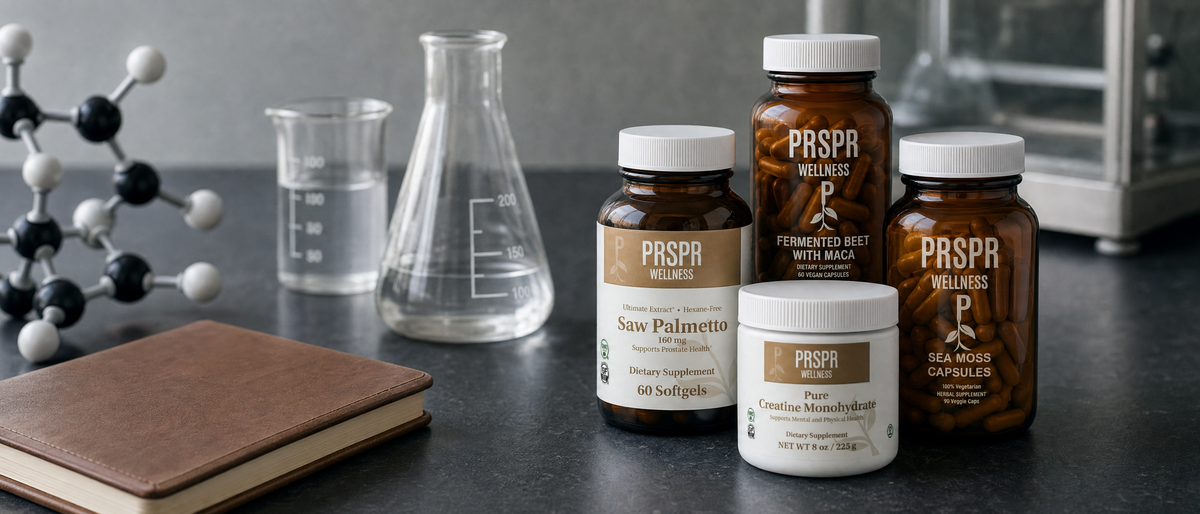
The Men's Vitality Stack - Men's Essentials is one of our stacks. The listing's "What's Included" section names four products: Pure Creatine Monohydrate, Saw Palmetto Capsules, Beet + Maca Capsules and Seamoss Capsules. The word testosterone is not the name of any of those four, and nothing in this article is a statement about what any of them does.
What we will add in our own voice is how it is made. It is manufactured in a GMP-certified facility and third-party batch tested, so what's on the label is what's in the bottle.
To read the full listing for yourself, open the Men's Essentials stack page, browse the vitamins and supplements collection, or take the build-your-stack quiz to see where it fits alongside everything else we carry.
Answer all five questions to unlock a clear wellness plan made around your goal, schedule, preferred supplement format, and biggest roadblock.
Get clarity on what matters most right now.
See the product and routine connected to your goal.
Simple next steps you can use right away.
Pick the one you would fix first if you could.
This helps us make the guide easier to follow.
Consistency beats the “perfect” routine you never follow.
Be honest. We’re building something you’ll actually use.
Your guide will include one simple way around it.
Answer two more questions to unlock your product starting point, five-step plan, two-week routine, and one practical tip for your biggest roadblock.
Enter your details to open your five-step plan.
Verified PRSPR customer reviews
Expires when you close this page
*Your personal credit for completing the quiz. It's applied automatically at checkout on one-time purchases and expires when the timer runs out.
View full product detailsEverything in your plan, together — one add to cart.
Expires when you close this page
*Your personal credit for completing the quiz. It's applied automatically at checkout on one-time purchases and expires when the timer runs out.
View full product details Mind vocabulary
What is cognition? You have probably seen the word "cognitive" printed on a label, in a headline, or in a product name, and kept scrolling. It is o...
 Biology vocabulary
What is metabolism? You see the word on labels, in gym talk and in nutrition headlines, almost always used as if it were a single setting. Read eno...
 Sleep vocabulary
What are sleep cycles? You hear the phrase on podcasts, see it on sleep trackers, and read it in articles that assume you already know what it mean...