
◎
Get clear
Get clarity on what matters most right now.

Where does seaweed come from is up 80 percent in search this week. Right beside it, three searches share a volume score of 100: what is seaweed, type of red algae, and chondrus crispus sea moss. Further down the list sit nori seaweed at 27, kelp seaweed at 25, and red seaweed at 24.
Look at how those terms fit together. One person wants to know what seaweed even is. Another wants to know where it grows. A third has typed the scientific name of Irish moss next to its shop name. And three of the searches carry a colour or a specific seaweed in them: red, nori, kelp.
That is not a random pile. It is people trying to sort seaweed, and the tool botanists use to sort it is exactly the one hiding in those searches. Seaweed is grouped by colour.
We are going to stay on the botany and the naming, because that is what this week's searches are actually asking about and because it is answerable from the scientific record. What any seaweed does in a body is a question for a qualified healthcare professional, and we are not going to answer it in either direction.
Start with the plain question. Seaweed is a common name, not a scientific one. It is the everyday word for the large algae that grow in the sea: the kinds you can pick up on a beach, see waving under a pier, or buy dried in a sheet. Biologists call these macroalgae, meaning algae big enough to see without a microscope.
So the next word to pin down is algae. Merriam-Webster traces it to Latin, where alga simply meant seaweed. Algae is the plural. The word covers a huge range of living things that make their own food from sunlight, live mostly in water, and do not have the roots, stems, leaves and flowers of a land plant.
Here is the part most people never hear. Algae is not one family. It is an umbrella word, like "tree" or "shrub," that describes a way of living rather than a single line of descent. Organisms get called algae because of what they have in common in practice, not because they all share a close common ancestor.
A seaweed also has its own anatomy vocabulary, which you will see on any botany page. The whole body is called a thallus. The flat, leaf-like parts are blades. The stalk is a stipe. And the root-like base that grips a rock is a holdfast.
Botanists sort seaweed into three broad groups, and each group is named for a colour.
So when someone searches type of red algae, the honest answer is that it means any seaweed in the Rhodophyta group, and that group is defined by its pigments and its lineage, not by how red it looks on the day you find it. Red seaweed is the everyday version of the same idea.
That last point is where most of the confusion comes from. The colour names describe the chemistry, and the chemistry does not always show. Some red algae look nearly black. Some look purple, olive or even greenish, especially after they have dried in the sun. The group name tells you which pigments the seaweed carries. It does not promise a colour you can match against a paint chart.
Now the umbrella point from the last section pays off. These three groups are not three branches of one seaweed family. Red and green algae sit on the same broad branch of life as land plants. Brown algae sit on a separate branch entirely.
With the three groups in place, the rest of this week's search terms slot in cleanly.
Irish moss is a red alga. Its scientific name is Chondrus crispus, which is what the search chondrus crispus sea moss is pairing with the shop name. The first word is the genus, the second is the species, and together they point to one seaweed and no other. It is a small, bushy, branching seaweed that grows on rocky shores of the North Atlantic, and it sits squarely in the Rhodophyta group. The "moss" in its name is a folk label. It is not a moss at all, since mosses are land plants. We covered the naming in our piece on why Irish moss and sea moss are the same seaweed, and this is the other half of that story: where that one seaweed sits among all the others.
Nori is also a red alga. Nori seaweed is the dark sheet wrapped around sushi, and the seaweed behind it comes from the genus Porphyra and its close relatives. The sheets are made by chopping the seaweed and drying it in thin layers, much like making paper. Dried nori looks dark green or nearly black, which is a good example of colour and group parting ways. By group, nori sits in the same broad red algae family as Irish moss.
Kelp is a brown alga. Kelp seaweed refers to the large brown seaweeds of the order Laminariales, the ones that can grow tall enough to form underwater forests in cold coastal water. Kelp has the clearest version of that anatomy vocabulary: a big holdfast, a long stipe, and broad blades. And by lineage, it is on the separate brown branch, not the red one.
Put those three side by side and the colour system does its job. Irish moss and nori are cousins. Kelp is a much more distant relative that happens to share the same beach and the same common name.
The rising search deserves a direct answer, and the answer is geography plus sunlight.
Seaweed makes its food from light, so it grows where light reaches. That means coastlines and shallow water, not the open deep ocean. Most seaweeds anchor to something solid with their holdfast, usually rock, so rocky shores are where you find the most of them.
Botanists describe the shore in zones. The intertidal zone is the strip that is underwater at high tide and exposed at low tide. The subtidal zone starts below that and stays covered. Irish moss is a classic lower-shore seaweed on rocky Atlantic coasts. Kelp generally sits a bit deeper, in the subtidal zone, where its forests can stay submerged.
The other half of the answer is farming. A lot of the seaweed sold commercially is cultivated rather than gathered from the wild, grown on ropes or nets in coastal water. Nori has a long farming tradition in East Asia. So "where does seaweed come from" has two honest answers: a shoreline, or a seaweed farm on a shoreline.
If you want the version of this story that ends in a kitchen instead of a textbook, our piece on how sea moss became a fridge item picks up from here. And if you want to see how one of the most common food additives got its name from this exact seaweed, read carrageenan got its name from Irish moss.
Seaweed labels should print the scientific name. Every time.
This week's searches show why. The word seaweed covers three groups that do not even share one branch of life. "Sea moss" is a folk name for a seaweed that is not a moss. Colour is a reliable way to sort seaweed only once you know it refers to pigment and lineage, not appearance. Every common name in this space leaves a gap, and the binomial closes it.
When a label says Chondrus crispus, you know exactly which seaweed you are looking at, which group it belongs to, and what to search if you want to read more. When a label says only "sea moss" or "seaweed," you know the category and nothing else. That is not enough.
So read the label at its actual size. Look for the two-word Latin name. If it is there, you can place the seaweed yourself using everything above. If it is not, you are being asked to guess, and guessing is exactly what a label is supposed to prevent.
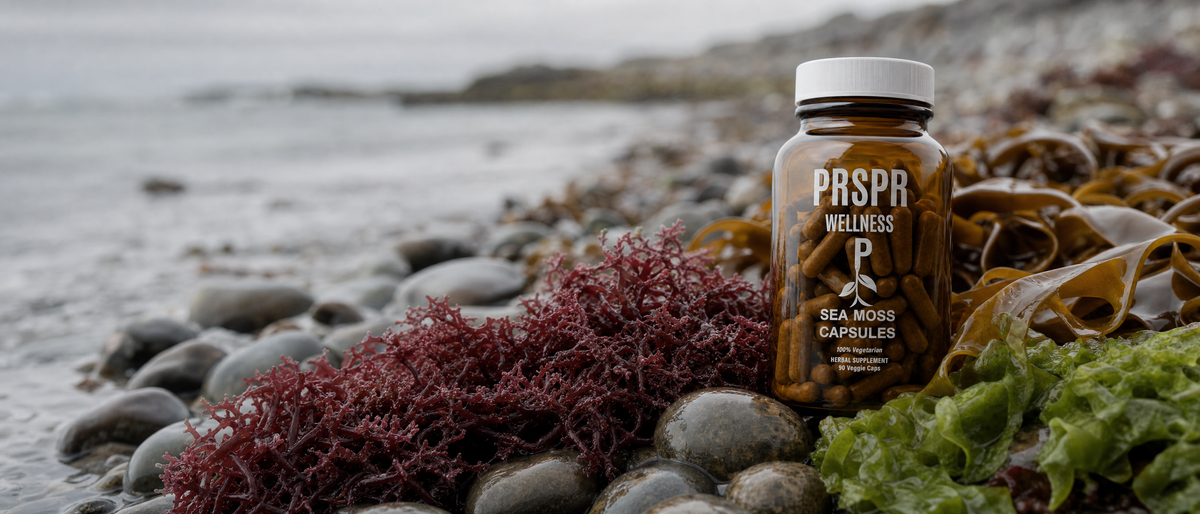
Seamoss Capsules: Irish Moss Superfood is a dietary supplement made with organic Irish moss (Chondrus crispus), designed for daily use. That is the listing's own description, and it is the whole of what we say the product is. Notice that it prints the binomial. By everything in this article, that places the seaweed inside it firmly in the red algae group.
What we will add in our own voice is how it is made. It is manufactured in a GMP-certified facility and third-party batch tested, so what is on the label is what is in the bottle. No guessing, no filler, no cutting corners.
If you want to check the naming for yourself, go to the source. Open the Seamoss Capsules page and read the listing as it is written, browse the full vitamins and supplements collection, or take the build-your-stack quiz to see where it fits alongside the rest of the range. For anything about what a seaweed does or whether it belongs in your routine, ask a qualified healthcare professional.
Answer all five questions to unlock a clear wellness plan made around your goal, schedule, preferred supplement format, and biggest roadblock.
Get clarity on what matters most right now.
See the product and routine connected to your goal.
Simple next steps you can use right away.
Pick the one you would fix first if you could.
This helps us make the guide easier to follow.
Consistency beats the “perfect” routine you never follow.
Be honest. We’re building something you’ll actually use.
Your guide will include one simple way around it.
Answer two more questions to unlock your product starting point, five-step plan, two-week routine, and one practical tip for your biggest roadblock.
Enter your details to open your five-step plan.
Verified PRSPR customer reviews
Expires when you close this page
*Your personal credit for completing the quiz. It's applied automatically at checkout on one-time purchases and expires when the timer runs out.
View full product detailsEverything in your plan, together — one add to cart.
Expires when you close this page
*Your personal credit for completing the quiz. It's applied automatically at checkout on one-time purchases and expires when the timer runs out.
View full product details Mind vocabulary
What is cognition? You have probably seen the word "cognitive" printed on a label, in a headline, or in a product name, and kept scrolling. It is o...
 Biology vocabulary
What is metabolism? You see the word on labels, in gym talk and in nutrition headlines, almost always used as if it were a single setting. Read eno...
 Sleep vocabulary
What are sleep cycles? You hear the phrase on podcasts, see it on sleep trackers, and read it in articles that assume you already know what it mean...