
◎
Get clear
Get clarity on what matters most right now.

Two botanical names are climbing fast in the same small cluster this week. Serenoa repens is up about 100 percent and sabal palm is up about 80. Underneath them, saw palmetto oil holds a relative interest score of 100, saw palmetto berries and palmetto berries both sit at 66, what is saw palmetto at 41, and saw palmetto berries benefits at 22.
Three different names for one plant, all rising or holding at once. That happens when people are cross-checking: they have seen a second name somewhere, and they are trying to work out whether it refers to the same thing they were already looking at.
So this article is about the plant itself. What it is botanically, where it grows, what the binomial and the confusable common name actually refer to, and how a wild berry becomes an extract in a capsule. It makes no claim about hair, prostate or hormones. The benefit-shaped search in this set is named as a search, and questions about what the plant does belong with a qualified healthcare professional.
Saw palmetto is a palm. Specifically it is a fan palm, meaning its leaves are shaped like a hand or a fan with the segments radiating from a central point, as against the feather-shaped leaves of a date or coconut palm.
It is a low-growing, shrubby palm rather than a tree. In most of its range it forms dense thickets a couple of meters high, with the stems often creeping along or just under the ground rather than rising into a trunk. A mature clump can be very old; these are slow-growing plants and individual colonies are thought to persist for a long time.
The name comes from the leaf stalks. The petioles carry sharp teeth along their edges, and running a hand down one is exactly as unpleasant as that implies. Saw palmetto: the palmetto with a saw on it.
Its range is the southeastern United States. It is abundant across Florida and extends along the coastal plain into Georgia, South Carolina, Alabama and Mississippi. It is a characteristic understory plant of pine flatwoods and scrub, and it is genuinely common there rather than rare or exotic.
Serenoa repens is the accepted scientific name for the species, and it is worth unpacking because both halves are descriptive.
Serenoa is the genus, named for Sereno Watson, a nineteenth-century American botanist. The genus contains this one species and no others, which is unusual and makes the name unambiguous. Repens is Latin for creeping, and it refers to the growth habit described above: stems that run along the ground rather than standing up.
Sabal palm is the name that causes trouble, and the trouble is legitimate rather than careless. Sabal is a different genus of fan palms native to the same region. Sabal palmetto, the cabbage palm, is the state tree of both Florida and South Carolina, and it is a tall, single-trunked tree that looks quite unlike a saw palmetto thicket. The two plants are related, they share habitat, and the word palmetto appears in both common names.
Historically saw palmetto was itself classified in Sabal, under the name Sabal serrulata, and that older name still circulates. So a shopper searching sabal palm is not confused so much as caught in a genuine tangle of overlapping common names and outdated synonyms. The binomial Serenoa repens is what resolves it.
Saw palmetto berries at 66 and palmetto berries at 66 are the part of the plant that everything else depends on.
The plant flowers and then produces a drupe, a fleshy fruit with a single seed, sometimes called a berry in ordinary usage. The fruits are oval, roughly the size of a large olive, and they ripen from green through yellow-orange to a deep blue-black.
Harvest is what makes this plant unusual as a commercial crop, because it largely is not one. The berries are gathered from wild stands rather than from plantations, by hand, during a ripening season that runs through the late summer and autumn. This is genuine wild harvesting at commercial scale, which is rare in the supplement industry, and it has consequences: yields vary with the season, the harvest is labor-intensive, and access to wild stands is regulated in Florida, where permits are required to collect on many lands.
Once picked, the fruits are dried. The dried berries are the raw material that everything downstream is made from.
Saw palmetto oil at 100 is the largest term in this whole cluster, and it names the processed form rather than the plant. Here is the route from one to the other, described as manufacturing.
The dried berries are milled, and then the lipid fraction is extracted from the milled material using a solvent. Different solvents are used industrially, including hexane, ethanol and supercritical carbon dioxide, and the choice affects both the yield and the composition of what comes out. Supercritical CO2 extraction, where carbon dioxide is held under pressure in a state between liquid and gas, is a common route in this category because the solvent evaporates away completely at the end.
What results is an oily extract, and this is what goes into softgels. It is not a pressed oil in the way olive oil is pressed, and it is not the whole berry. It is one fraction of the fruit, separated out by a chemical process.
That is why hexane-free appears as a label phrase in this category: it is a statement about which extraction solvent was used, which is a manufacturing fact you can check rather than a claim about the finished product. We looked at how shoppers narrow a search on this exact product in how shoppers narrow a saw palmetto search.
The thing we find genuinely worth knowing here is that this is a wild plant, harvested by hand, from thickets in the Florida scrub.
Most of what sits on a supplement shelf comes from cultivation or from a chemical reactor. This one comes from people walking into palmetto stands in the heat and picking fruit off spiny plants during a season that lasts a few weeks. That is an unusual supply chain, and it explains things that otherwise look arbitrary, including why supply and pricing move around from year to year.
It is also why the naming matters more here than in most categories. When a raw material is wild-harvested rather than cultivated to a specification, being certain which species you have is the first quality question, not a botanical footnote. Serenoa repens is the answer to that question and Sabal is not.
So our suggestion is the same one we make across the botanical aisle: find the binomial. If a product names only a common name, and the common name is one that overlaps with another genus, you have less information than you think. We explained what the DHT label phrase on this product's own category means in the plain version of DHT blockers, and looked at why this plant and pumpkin seed oil keep appearing together in the co-search piece.
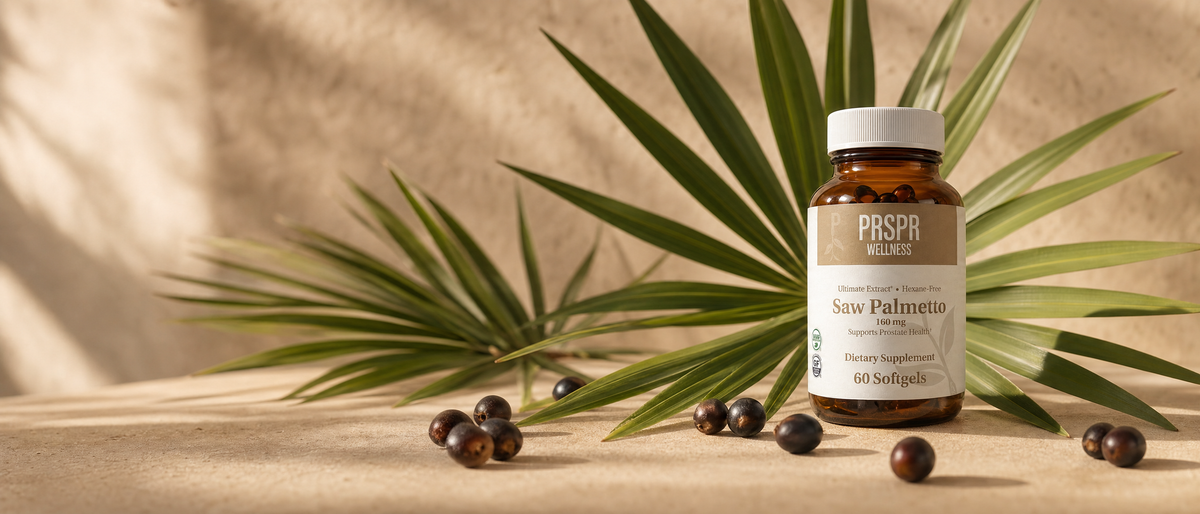
Our Saw Palmetto is a plant-based supplement made with saw palmetto extract. Extract, per everything above, means the lipid fraction taken from the dried berries rather than the berries themselves, and that is the form this product is in.
The species behind it is Serenoa repens, the creeping fan palm of the southeastern United States, harvested as a wild fruit and processed into an extract. Naming that plainly is worth more than any adjective we could put in front of it.
On manufacturing, in our own voice: GMP-certified facility, third-party batch tested, so the panel and the capsule agree.
If the botany was the interesting part, take it further. The Saw Palmetto page is there, the men's health collection has the rest of that shelf, and the build-your-stack quiz is there if you would rather start from a routine.
Answer all five questions to unlock a clear wellness plan made around your goal, schedule, preferred supplement format, and biggest roadblock.
Get clarity on what matters most right now.
See the product and routine connected to your goal.
Simple next steps you can use right away.
Pick the one you would fix first if you could.
This helps us make the guide easier to follow.
Consistency beats the “perfect” routine you never follow.
Be honest. We’re building something you’ll actually use.
Your guide will include one simple way around it.
Answer two more questions to unlock your product starting point, five-step plan, two-week routine, and one practical tip for your biggest roadblock.
Enter your details to open your five-step plan.
Verified PRSPR customer reviews
Expires when you close this page
*Your personal credit for completing the quiz. It's applied automatically at checkout on one-time purchases and expires when the timer runs out.
View full product detailsEverything in your plan, together — one add to cart.
Expires when you close this page
*Your personal credit for completing the quiz. It's applied automatically at checkout on one-time purchases and expires when the timer runs out.
View full product details Mind vocabulary
What is cognition? You have probably seen the word "cognitive" printed on a label, in a headline, or in a product name, and kept scrolling. It is o...
 Biology vocabulary
What is metabolism? You see the word on labels, in gym talk and in nutrition headlines, almost always used as if it were a single setting. Read eno...
 Sleep vocabulary
What are sleep cycles? You hear the phrase on podcasts, see it on sleep trackers, and read it in articles that assume you already know what it mean...