
◎
Get clear
Get clarity on what matters most right now.

What is stress? It sounds like a question with an obvious answer, and yet it tops this week's search list. "What is stress" carries a volume score of 100, and right behind it, "what is cortisol" sits at 72. Further down, "chronic stress" and "cortisol hormone" both come in at 14, "stress definition" at 9, "acute stress" at 7, "shear stress" at 6 and "definition of stress" at 5.
One term on that list gives the game away. "Shear stress" has nothing to do with feelings. It is an engineering phrase, and it is sitting in the same search list as cortisol.
That is not an accident. Stress was a word about force and materials long before it was a word about a hard week. So this piece is about the word itself: what it means in physics, how it moved into biology and everyday speech, what "acute" and "chronic" mean as words about time, and what cortisol is by name. It is vocabulary and history, not advice. Anything about your own health belongs in a conversation with a qualified healthcare professional.
Start with the oldest meanings, because they are not the ones most people expect. According to the Online Etymology Dictionary, the noun stress dates to around 1300, when it meant "hardship, adversity" and "constraining or compelling force or pressure, coercion." The same source traces it partly to a shortening of "distress" and partly to Old French estrece, ultimately from the Latin strictus, "tight, compressed," from stringere, "draw tight."
Dictionary.com agrees on the age, recording the noun as first appearing between 1275 and 1325, as an aphetic variant of "distress." In plain terms, the front of "distress" dropped off and "stress" was left standing on its own.
So the root image is tightness. Something drawn tight, pressed, squeezed. Hold on to that picture, because every later meaning of the word grows out of it, from the engineer's definition of stress to the one people type into a search bar.
Here is the meaning the engineers use. Dictionary.com's scientific entry defines stress as "the force per unit area applied to an object," and notes that objects under stress tend to become distorted or deformed. Its mechanics sense adds "the ratio of force to area."
Boston University's Mechanics of Slender Structures lab puts it the same way: "Stress is the measure of an external force acting over the cross sectional area of an object." The units follow directly from that definition. Force divided by area gives newtons per square meter in SI units, or pounds per square inch in US units, and the lab notes these are commonly referred to as pascals.
That is the whole idea in one line: push on something, divide by the area you are pushing on, and the number you get is stress.
Engineers split stress by direction. Boston University's lab explains that when a force acts perpendicular, or "normal," to a surface, it exerts a normal stress. When a force acts parallel to the surface, it exerts a shear stress.
Dictionary.com defines shear stress as "the external force acting on an object or surface parallel to the slope or plane in which it lies," and records the term from 1870 to 1875. Its scientific entry gives a tidy example: fix one end of a block of wood, push the other end sideways, and the rectangle leans into a parallelogram. Britannica's entry on stress offers another: twisting a metal bar about its long axis, as in tightening a screw.
The word did not jump straight from bridges to biology. It took a few steps.
According to the Online Etymology Dictionary, the sense of "physical strain on a material object" was in use by the mid-15th century, and the technical mechanics sense, a "force acting on or within a body and tending to deform it," was in place by 1855. Along the way the word picked up a linguistic meaning too: the same source dates the figurative sense of "weight, importance, emphasis" to the 1650s, and the sense of relative loudness in spoken syllables to 1749. That is the stress in "the stress falls on the first syllable."
The biological sense came from the physics. The Centre for Studies on Human Stress, a research center in Montreal, states that the term "was borrowed from the field of physics" by one of the early figures in stress research, and explains the physics meaning as the force that produces strain on a physical body. The Online Etymology Dictionary then dates "the purely psychological sense" of the word to 1955.
So the modern everyday meaning is the newest layer on a very old word. Underneath it is still the same image: something being pressed on.
Two of this week's searches, "acute stress" and "chronic stress," pair the word with adjectives. Those adjectives are worth reading on their own, because they are not about intensity. They are about time.
According to the Online Etymology Dictionary, acute entered English in the late 14th century, originally describing fevers and diseases "coming quickly to a crisis," in contrast to chronic. It comes from the Latin acutus, "sharp, pointed," from acuere, "to sharpen." The same source notes the word was also used, by around 1600, for the acute accent mark.
Chronic comes from the other direction. The Online Etymology Dictionary traces it to the Greek khronos, "time," through khronikos, "of time, concerning time," and dates its early 15th century use to diseases "lasting a long time."
So as plain vocabulary, acute means sharp and sudden, and chronic means drawn out over time. What either phrase means for a particular person is a medical question, and we are leaving it there.
The second-biggest search on the list is a name, so here is the name, defined plainly. The Cleveland Clinic describes cortisol as "a hormone your adrenal glands make and release," and adds that it is a glucocorticoid, a type of steroid hormone. That is the one-line definition, and it answers the "cortisol hormone" search directly: yes, it is a hormone.
MedlinePlus describes the adrenal glands as "two small organs that sit on top of each kidney," and lists cortisol among the hormones they make. MedlinePlus also explains that each gland has two parts: the outer part, called the cortex, produces steroid hormones such as cortisol, and the inner part, called the medulla, produces epinephrine and norepinephrine.
The name carries its own anatomy. The Online Etymology Dictionary dates cortisol to 1953, formed from cortisone plus the chemical suffix -ol, and chosen as a shorter alternative to "hydrocortisone." Cortisone, in turn, is traced to the Latin cortex, which the same source defines as "bark of a tree." And adrenal, it says, dates to 1866 and means "of or near the kidneys," from ad-, "to, near," plus renalis, "of the kidneys."
Put together, the name reads almost like a map: a compound named for the bark-like outer layer of the glands that sit near the kidneys.
We like words that carry their history with them, and stress is a great one. It started as tightness and hardship, became a precise engineering measurement, lent its name to syllables, and then got borrowed again for the living body. The engineers still use it exactly the way they did, which is why "shear stress" turns up next to "what is cortisol" in the same week.
We also think the definition of stress deserves to be used carefully. Acute and chronic describe time. Cortisol is a named hormone from a named gland. None of those words need hype attached to them to be interesting. Explaining them plainly is more useful than dressing them up.
For more on the word doing double duty, our piece on "oxidative stress" and "stress" covers the other scientific use, and our explainer on what the nervous system words actually mean keeps the vocabulary going.
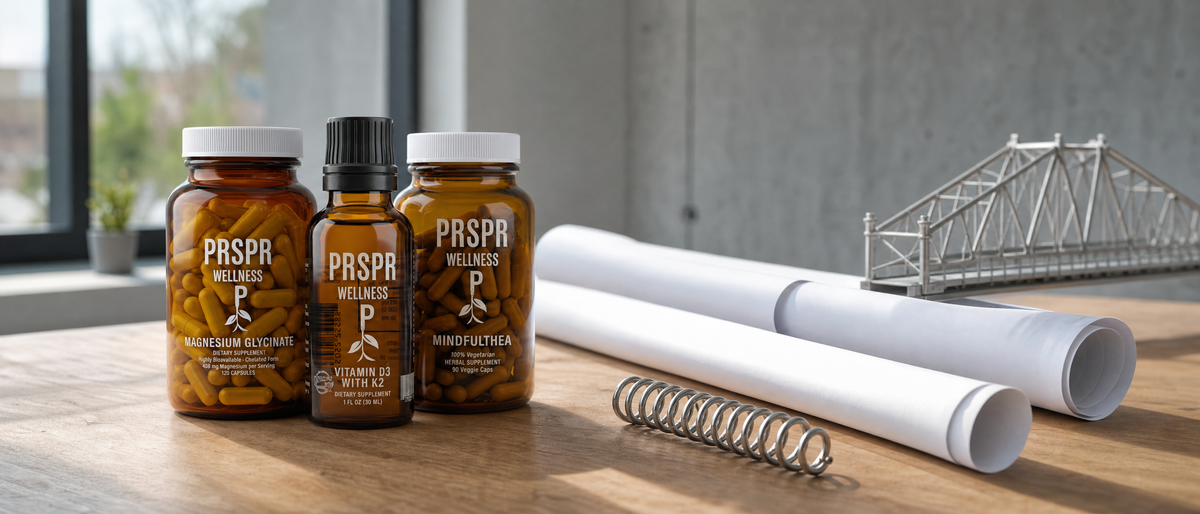
That brings us to this three-bottle bundle. It is a bundle of Magnesium Glycinate, L-Theanine and Vitamin D3 + K2. That is how the listing describes it, and that is the description we stand behind: three products, sold together, each with its own label you can read line by line.
If you want the backstory on one of those bottles, our explainer on where L-theanine comes from starts in a teacup, long before it ever reached a label.
What we will add in our own voice is how it is made. Each product in the bundle is manufactured in a GMP-certified facility and third-party batch tested, so what's on the label is what's in the bottle.
To read every label in the set, open the bundle's product page, browse the rest of our bundles, or take the build-your-stack quiz to see how everything we carry fits together.
Answer all five questions to unlock a clear wellness plan made around your goal, schedule, preferred supplement format, and biggest roadblock.
Get clarity on what matters most right now.
See the product and routine connected to your goal.
Simple next steps you can use right away.
Pick the one you would fix first if you could.
This helps us make the guide easier to follow.
Consistency beats the “perfect” routine you never follow.
Be honest. We’re building something you’ll actually use.
Your guide will include one simple way around it.
Answer two more questions to unlock your product starting point, five-step plan, two-week routine, and one practical tip for your biggest roadblock.
Enter your details to open your five-step plan.
Verified PRSPR customer reviews
Expires when you close this page
*Your personal credit for completing the quiz. It's applied automatically at checkout on one-time purchases and expires when the timer runs out.
View full product detailsEverything in your plan, together — one add to cart.
Expires when you close this page
*Your personal credit for completing the quiz. It's applied automatically at checkout on one-time purchases and expires when the timer runs out.
View full product details Mind vocabulary
What is cognition? You have probably seen the word "cognitive" printed on a label, in a headline, or in a product name, and kept scrolling. It is o...
 Biology vocabulary
What is metabolism? You see the word on labels, in gym talk and in nutrition headlines, almost always used as if it were a single setting. Read eno...
 Sleep vocabulary
What are sleep cycles? You hear the phrase on podcasts, see it on sleep trackers, and read it in articles that assume you already know what it mean...