
◎
Get clear
Get clarity on what matters most right now.

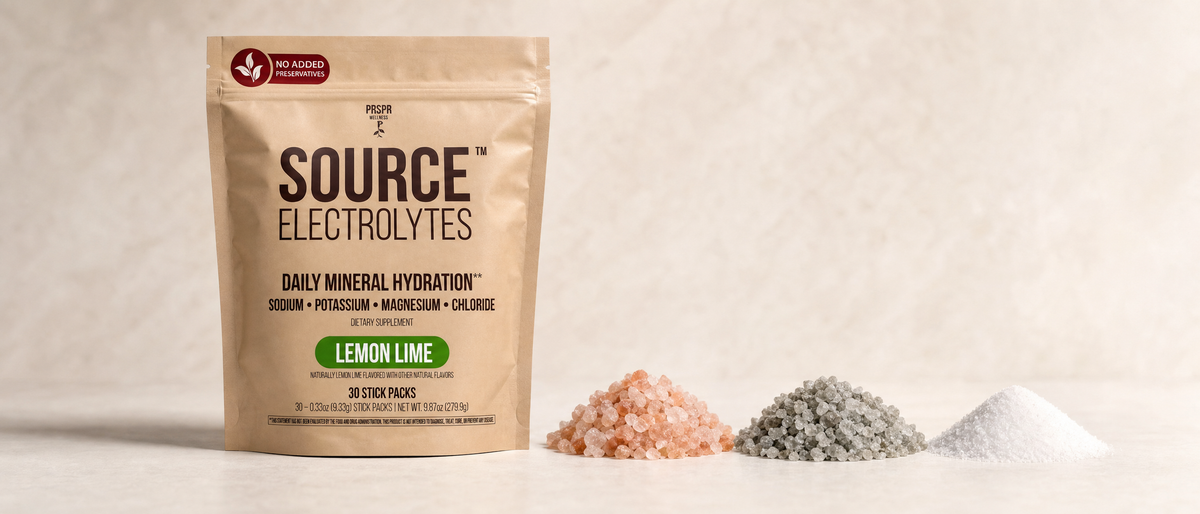
Salt is having a comparison week. Searches for celtic sea salt vs himalayan pink salt are up about 70 percent, pink himalayan salt vs table salt is climbing about 40 percent, and what is himalayan pink salt is holding a volume score of 55. People are standing in the seasoning aisle, and in the supplement aisle, trying to work out whether four names for salt are four different substances or one substance in four costumes.
It is a fair question with a real answer. The names describe where a salt comes from and what is left in it after harvesting, not four different chemicals. Every salt in this article is mostly the same compound, sodium chloride. What changes is the origin, the color, the grain, and the short list of other minerals that ride along. This piece walks through the three salts people keep comparing, plus the coarse grey one from France that started the spike, and then reads the salt line on our own electrolyte label the same way.
One thing before we start. This is an article about rocks, seawater, and labels. It says nothing about what any salt does in a body. Pink himalayan salt benefits is one of the bigger searches in this cluster, and it is an outcome question, so we are not going to answer it here. If you are asking it, the right person is a qualified healthcare professional who knows your situation, not a supplement brand's blog.
Himalayan pink salt is rock salt. Geologists call the mineral halite, and the deposits it is mined from sit in the Salt Range of Punjab, Pakistan, most famously around the Khewra mine. Those deposits are the leftovers of a sea that evaporated long before anyone was around to season anything with it, then got buried and compressed into rock.
Because it is mined rather than evaporated from today's ocean, it arrives as hard, dry crystals, and it gets sold in every grind from coarse chunks to fine powder. The pink is not a flavor and not an additive. It comes from trace iron compounds locked inside the crystal, and the shade runs from nearly white to deep rose depending on how much iron a given piece carries. The rest of the trace mineral list is small in quantity and varies piece by piece, which is why the label word here is trace.
The comparison driving this week's spike is celtic sea salt vs himalayan pink salt, and it is really a comparison of two harvest stories. Celtic sea salt is the trade name for sel gris, the grey salt raked by hand from clay-lined evaporation ponds on the coast of Brittany, France. Today's seawater flows into shallow ponds, the sun and wind take the water away, and what is raked out is a coarse, visibly moist salt. The grey comes from the clay the crystals rest on while they form.
Himalayan pink salt is the opposite story in almost every physical detail. It is dry, not moist. It is mined from rock, not raked from a pond. Its color rides inside the crystal, while sel gris wears its color on the outside, picked up from the clay. One is an ancient ocean, one is roughly yesterday's ocean. Chemically, both are still mostly sodium chloride.
The broader himalayan pink salt vs sea salt question, and its mirror twin sea salt vs pink himalayan salt, resolves the same way. Generic sea salt is any salt evaporated from modern seawater, from flaky finishing salts to everyday crystals, and pink salt is one specific rock salt with a passport. Origin and texture differ. The base chemistry barely does.
Table salt is the most processed of the three. It starts as mined rock salt or evaporated brine, then gets refined until nearly everything except sodium chloride is gone, ground to a fine even grain, and usually finished with an anti-caking agent so it pours in humid kitchens. When the label says iodized, that means iodine was added at the factory, which is a labeling fact you can check on the ingredient line, not something the salt picked up in nature. Grain size matters for measuring, too. Fine, even crystals pack a spoon more densely than coarse, irregular ones, so a teaspoon of table salt and a teaspoon of coarse pink crystals do not carry the same weight of salt. That is arithmetic about crystals in a spoon, not a statement about either salt in a body.
So pink himalayan salt vs table salt is really a question about refinement and grain size. One keeps its trace minerals and its color and comes in irregular crystals. The other trades those away for uniformity and flow. We are not telling you one of them is better for you. That would be an outcome claim, and outcome questions about salt belong with a professional, not a product page.
A salt name on a label is an origin story, not a rank. When a front panel says Himalayan pink salt instead of just salt, you have learned where the ingredient came from and roughly what it looks like before grinding, and that is all you have learned. We think that is still worth something. Named sources can be looked up, compared, and questioned, and an ingredient you can interrogate beats an ingredient you have to take on faith.
Our advice for any label in this category is the same method we used on this page. Find the salt line. Ask which salt it names. Then ask what else is in the formula, in what amounts, and whether the panel tells you plainly. If you want the same exercise run on a full mineral panel, we already did it in our walkthrough of the electrolyte label, and the same label-reading habit applies to magnesium forms.
Our Source Electrolytes is a stick-pack drink mix, and Himalayan pink salt is one named line in its formula, sitting alongside vitamin C, calcium, magnesium, zinc, chloride, sodium, potassium, D-Ribose, taurine, L-theanine, and ConcenTrace concentrated seawater. No added sugar, and it comes in Lemon Lime and Pink Lemonade. Those are composition facts from the live listing, stated here exactly as the label states them.
The quality story is the only other thing we will say in our own voice. It is made in a GMP-certified facility and third-party batch tested, so what is on the label is what is in the stick pack. No guessing, no filler.
If this sent you label reading, good. Start with the Source Electrolytes page and read the panel yourself, browse the rest of the vitamins and supplements collection the same way, or take the build-your-stack quiz and see what routine it hands you.
What is Himalayan pink salt?
It is rock salt, the mineral halite, mined from ancient sea-bed deposits in the Salt Range of Punjab, Pakistan. It is mostly sodium chloride, with small and variable amounts of other minerals, and it is sold in grinds from coarse crystal to fine powder.
Why is Himalayan salt pink?
Trace iron compounds inside the crystal. More iron reads as deeper rose, less reads as pale pink or nearly white. The color is part of the rock itself, not a coating and not an additive.
Answer all five questions to unlock a clear wellness plan made around your goal, schedule, preferred supplement format, and biggest roadblock.
Get clarity on what matters most right now.
See the product and routine connected to your goal.
Simple next steps you can use right away.
Pick the one you would fix first if you could.
This helps us make the guide easier to follow.
Consistency beats the “perfect” routine you never follow.
Be honest. We’re building something you’ll actually use.
Your guide will include one simple way around it.
Answer two more questions to unlock your product starting point, five-step plan, two-week routine, and one practical tip for your biggest roadblock.
Enter your details to open your five-step plan.
Verified PRSPR customer reviews
Expires when you close this page
*Your personal credit for completing the quiz. It's applied automatically at checkout on one-time purchases and expires when the timer runs out.
View full product detailsEverything in your plan, together — one add to cart.
Expires when you close this page
*Your personal credit for completing the quiz. It's applied automatically at checkout on one-time purchases and expires when the timer runs out.
View full product details Kids
KidsPick up a box of children's snacks and somewhere on the front there is a number with the letter g after it, next to the word fiber. It looks like o...
 Label Reading
It is printed on the front of a lot of mineral bottles and it is one of the least understood words in the supplement business. Chelated. Search int...
 Botanicals
Beet root powder is holding a volume score of 37 this week. Maca powder and maca root powder are both at 29. Beetroot on its own leads the group at...