
◎
Get clear
Get clarity on what matters most right now.

Creatine monohydrate capsules is maxed out at a relative interest score of 100 this week. Best creatine capsules sits at 79, micronized creatine capsules at 28, creatine pills at 17, and the comparison query itself, creatine powder vs capsules, at 32. Climbing on the same seed, up about 60 percent, is creatine side effects.
That last one is a safety question and we are not going to answer it. It is recorded here because it is genuinely what people are searching, and the honest place for it is a qualified healthcare professional who knows your situation. Everything else in this article is about physical formats and the numbers printed next to them.
Because the format decision is where most of the confusion in this category lives. A tub and a bottle sit side by side on the same shelf, both say creatine, and the numbers on their front panels are not comparable in the way people assume they are.
Powder is the raw material with nothing done to it. Creatine monohydrate is manufactured as a crystalline solid, and powder is simply that solid, milled to a chosen particle size and packed in a tub. There is no shell, no binder and no carrier. What is in the tub is the ingredient.
A capsule is the same powder, portioned and enclosed. The standard is a two-piece hard capsule, usually gelatin or a plant-derived alternative such as hypromellose, filled by machine and closed. Some capsule products also contain small amounts of flow agents so the filling machinery runs cleanly, and those appear as other ingredients on the panel.
Creatine pills, at 17, is worth a note because the word is imprecise. A pill in the strict sense is a compressed tablet, held together by binders under pressure. A capsule is a shell containing loose powder. Most products people call creatine pills are actually capsules, and the label will say which. If it says tablet, expect binders in the ingredient list. If it says capsule, expect the shell material named instead.
This is the part that trips people up, and it is pure arithmetic.
A powder tub is sold by total mass. Sixteen ounces, 500 grams, a kilogram. The front number tells you how much substance is in the container, and the panel tells you how big one serving is, usually expressed in grams with a scoop as the measuring tool.
A capsule bottle is sold by count. Ninety capsules, 120 capsules, 240 capsules. The front number tells you how many objects are in the bottle, and it tells you nothing at all about how much is in each one. That figure lives in the panel, as milligrams or grams per capsule, along with how many capsules constitute a serving.
So a 90 count and a 500 gram tub are not two sizes of one thing. They are two different measurements. To compare them you have to do one conversion: multiply the per-capsule amount by the count to get total grams in the bottle, then compare that against the tub. People routinely skip this step and conclude the capsules are wildly expensive, when what has actually happened is that they compared a count to a mass.
The second half of that arithmetic is servings per container, which is the only figure that makes two products in different formats genuinely comparable. Total amount divided by serving size. That number is on both panels and it is the one worth writing down.
Micronized creatine capsules at 28 brings in a processing word that appears in both formats, so it is worth defining once.
Micronization is milling. The crystals are ground to a smaller average particle size, which increases the total surface area of a given mass of powder. The molecule is unchanged. It is still creatine monohydrate, with the same chemistry and the same water bound into the crystal.
What smaller particles change is handling. Finer powder disperses more readily in liquid and tends to settle more slowly, which is a texture and convenience matter rather than a composition one. In a capsule, micronization mostly affects how the powder flows through the filling machinery and how densely it packs, which can influence how much fits in a given capsule size.
So when micronized appears on a label it is describing the grind, not a different ingredient. Two products can both be creatine monohydrate and differ only in how finely the crystals were milled.
Neither format is better. They are different objects with different practical properties, and here is the honest list.
Powder requires a scoop, a liquid and something to stir with. It is measured by the user, which means the serving is only as accurate as the scoop is level. It travels badly. It is bought in larger amounts at a time.
Capsules are pre-measured, which removes the scooping step and the accuracy question along with it. They travel in a pocket. They require swallowing several objects rather than one drink, since a serving expressed in grams becomes multiple capsules once you divide by what fits in one. They involve a shell, which is an additional material and a consideration for anyone avoiding gelatin.
Which of those matters is a question about your day, not about creatine. We are not going to tell you one works better, because that is an outcome comparison and it is not ours to make.
Format is the most underrated decision in this aisle, and it is the one people make last, usually by accident, based on whichever product they happened to be looking at.
We would flip the order. Decide first whether you are a person who will reliably stir something into a drink every day, or a person who needs the thing to be pre-portioned and portable. That is a question about your habits and you already know the answer. Once it is settled, half the shelf disappears and you can read the remaining panels properly.
Then do the arithmetic. Convert count to total grams, find servings per container on both, and compare like with like. We ran the same exercise across pack sizes in how to read a creatine label, and made the identical powder-versus-capsule comparison for a different ingredient in same two roots, powder or capsule.
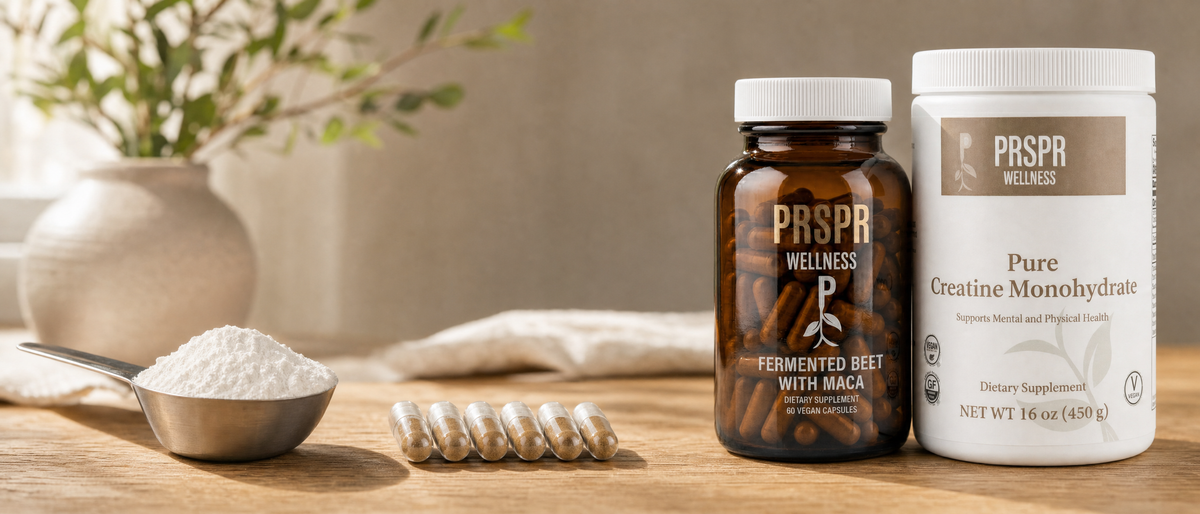
Our Nature's BBL Deluxe pairs Pure Creatine Monohydrate in a 90 count with Fermented Beet and Maca capsules. Both parts are capsules, which is a deliberate consistency: one format across the set, so the routine is a single action rather than a drink plus a capsule.
The 90 in the name is a count, and by everything above that means the per-capsule figure in the panel is the number that actually tells you the amount. We would rather point that out than let a big number on a front panel do work it has not earned.
On quality, in our own voice: GMP-certified facility, third-party batch tested. The panel and the capsule agree.
If you want to run the comparison yourself, read the Nature's BBL Deluxe page and find servings per container before anything else, look across the rest of the bundles collection the same way, or take the build-your-stack quiz.
Answer all five questions to unlock a clear wellness plan made around your goal, schedule, preferred supplement format, and biggest roadblock.
Get clarity on what matters most right now.
See the product and routine connected to your goal.
Simple next steps you can use right away.
Pick the one you would fix first if you could.
This helps us make the guide easier to follow.
Consistency beats the “perfect” routine you never follow.
Be honest. We’re building something you’ll actually use.
Your guide will include one simple way around it.
Answer two more questions to unlock your product starting point, five-step plan, two-week routine, and one practical tip for your biggest roadblock.
Enter your details to open your five-step plan.
Verified PRSPR customer reviews
Expires when you close this page
*Your personal credit for completing the quiz. It's applied automatically at checkout on one-time purchases and expires when the timer runs out.
View full product detailsEverything in your plan, together — one add to cart.
Expires when you close this page
*Your personal credit for completing the quiz. It's applied automatically at checkout on one-time purchases and expires when the timer runs out.
View full product details Mind vocabulary
What is cognition? You have probably seen the word "cognitive" printed on a label, in a headline, or in a product name, and kept scrolling. It is o...
 Biology vocabulary
What is metabolism? You see the word on labels, in gym talk and in nutrition headlines, almost always used as if it were a single setting. Read eno...
 Sleep vocabulary
What are sleep cycles? You hear the phrase on podcasts, see it on sleep trackers, and read it in articles that assume you already know what it mean...