
◎
Get clear
Get clarity on what matters most right now.

Beet root powder is holding a volume score of 37 this week. Maca powder and maca root powder are both at 29. Beetroot on its own leads the group at 64, and beet root benefits sits at 36.
Four of those five terms carry the word powder. That is the whole shape of this cluster: when people search these two roots, they search them as powders, because powder is how both have been sold for most of their history on a supplement shelf. Our bottle is capsules.
That mismatch is worth an article. Not what the roots are, and not what fermented means on a label, both of which we covered in an earlier piece. This one is about what actually changes between a scoop of loose powder and a counted capsule.
Both of these roots arrived on the supplement shelf as powders, and for good reasons that have nothing to do with marketing.
Beetroot is a dense, watery root vegetable. Drying and grinding it is the oldest and simplest way to make it storable and portable, and the result is a fine, intensely coloured powder that mixes into liquid. Maca has an even stronger claim to the format: it is traditionally dried after harvest in the Andean highlands where it grows, and grinding dried maca root into flour is a preparation that long predates any supplement industry. Maca powder is closer to a traditional foodstuff than to a modern format decision.
Powder also suits how people wanted to use both. Beet root powder goes into water, juice or a smoothie. Maca powder goes into food, and it is used in baking and in drinks in exactly the way a flour or a cocoa powder would be. Neither is asking to be a pill.
That history is why the search data looks the way it does, and why anyone shopping this shelf meets the powder version first.
It is worth noticing that the search data separates maca powder and maca root powder as two terms with identical volume. Those are the same product described at two levels of precision, and the fact that both are searched equally suggests a shopper population that is not yet sure whether the extra word matters. It does, slightly: root specifies the plant part, and maca is grown for its root, so a product describing itself as maca root powder has named the part rather than leaving it implied.
Three things change when the same two roots arrive in a 60 capsule bottle instead of a bag.
The first is measurement. A powder is measured by scoop, and a scoop is a volume while the label states a mass. Those two agree only when the powder is level and settled, so a heaped scoop and a level one are genuinely different servings. A capsule removes the question entirely. The amount was measured during manufacturing and the unit is now the capsule, which is why a capsule label counts servings rather than describing a scoop.
The second is taste, and with these two roots that is not a minor point. Beet root powder tastes strongly of beetroot, earthy and sweet in a way that dominates anything you mix it into. Maca is more divisive still: distinctly malty, nutty and slightly bitter, and people who dislike it tend to dislike it firmly. A capsule is swallowed whole and tastes of nothing. For a great many people that single fact decides the format.
The third is portability and mess. Beet powder in particular stains, thoroughly and immediately, and a bag of it in a gym bag is a decision you make once. A capsule bottle travels without incident and needs no liquid, no shaker and no washing up.
What you give up is flexibility. A powder can be divided, doubled, cooked with, or stirred into something you were making anyway. A capsule is a fixed unit and cannot be adjusted. If you want these roots as an ingredient rather than as a supplement, the powder is the format that does that and the capsule is not.
Here is the bridge, and it is a point about density that catches people out when they compare the two formats on price.
A capsule holds a small mass. Capsule shells come in standard sizes and each holds a limited volume of material, so the amount of root in one capsule is measured in fractions of a gram, while a powder serving is typically measured by the scoop in whole grams. That is not a trick. It is a physical limit of the container.
The practical consequence is that the two formats are not comparable by looking at the front of the pack. To compare them honestly you have to read the serving size on each and work out the amount per serving, which is the only figure that puts a scoop and a capsule on the same scale. A bag that looks enormous next to a small bottle may or may not represent more material per serving, and the label is the only place that resolves it.
The other thing worth saying plainly: beet root benefits is a live search this week and it is an outcome question. We are not answering it. What either root does for any individual person is a question for a qualified healthcare professional who knows their situation. Format we can talk about. Effects we cannot.
There is a shelf-life angle too, and it favours the capsule more than most people expect. A bag of powder is opened repeatedly, exposed to kitchen air and humidity every time, and scooped with whatever is to hand. A capsule bottle is opened just as often, but the material inside each capsule stays sealed until it is taken. That is not a claim about quality, it is just a property of the packaging, and it is the sort of practical difference that rarely makes it onto either label.
Format is the most underrated decision on a supplement shelf and it is usually the one that determines whether a product gets finished. A powder someone hates the taste of ends up at the back of a cupboard, and an unused product does nothing for anyone regardless of what is in it.
So it is worth being honest with yourself before you buy. Do you want to taste this. Will you actually get a shaker out. Does it need to travel. Those questions are about your kitchen and your week rather than about the roots, and they predict what happens next better than any comparison of ingredients does.
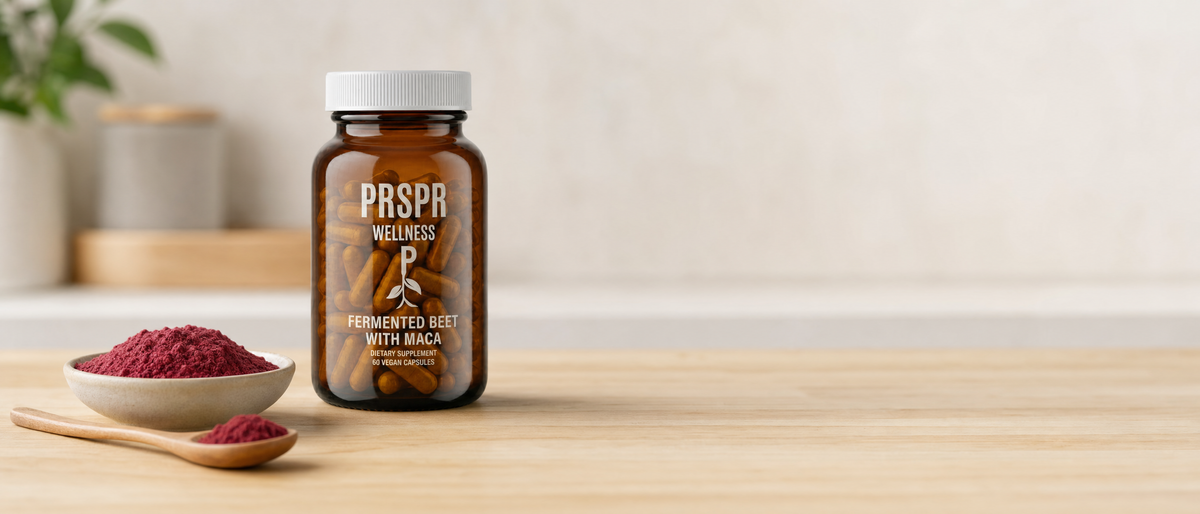
Our Fermented Beet Root and Maca is made with beetroot and maca root combined using a fermentation process, in a 60 capsule bottle. Counted units, printed on the label, for two roots that most of this shelf still sells by the scoop. It is manufactured in a GMP-certified facility and third-party batch tested, so what is on the label is what is in the bottle. Clear amounts, no guesswork.
The listing is on the Fermented Beet Root and Maca page, and you can see what else people reach for most on our best sellers page. If you are weighing a capsule against something you already scoop, take the quiz.
Answer all five questions to unlock a clear wellness plan made around your goal, schedule, preferred supplement format, and biggest roadblock.
Get clarity on what matters most right now.
See the product and routine connected to your goal.
Simple next steps you can use right away.
Pick the one you would fix first if you could.
This helps us make the guide easier to follow.
Consistency beats the “perfect” routine you never follow.
Be honest. We’re building something you’ll actually use.
Your guide will include one simple way around it.
Answer two more questions to unlock your product starting point, five-step plan, two-week routine, and one practical tip for your biggest roadblock.
Enter your details to open your five-step plan.
Verified PRSPR customer reviews
Expires when you close this page
*Your personal credit for completing the quiz. It's applied automatically at checkout on one-time purchases and expires when the timer runs out.
View full product detailsEverything in your plan, together — one add to cart.
Expires when you close this page
*Your personal credit for completing the quiz. It's applied automatically at checkout on one-time purchases and expires when the timer runs out.
View full product details Electrolytes
Salt is having a comparison week. Searches for celtic sea salt vs himalayan pink salt are up about 70 percent, pink himalayan salt vs table salt is...
 Kids
KidsPick up a box of children's snacks and somewhere on the front there is a number with the letter g after it, next to the word fiber. It looks like o...
 Label Reading
It is printed on the front of a lot of mineral bottles and it is one of the least understood words in the supplement business. Chelated. Search int...