
◎
Get clear
Get clarity on what matters most right now.

Pick up a box of children's snacks and somewhere on the front there is a number with the letter g after it, next to the word fiber. It looks like one of the simplest figures on the pack. It is one of the harder ones to actually read.
People are looking. Over the past week fiber snacks for kids ran at 35 in related queries, and that is the phrase this article is about, because a snack pack is where most people first meet a fiber figure and try to make sense of it. Around it sat the broader food searches: fiber foods for kids at 100, fiber foods at 92, high fiber foods at 51, fiber food for kids at 44, and foods high in fiber rising 40 percent.
This is a numeracy piece. It explains what the figure counts and how the arithmetic works. It makes no recommendation about what any child should eat, and anything to do with a child's digestion or diet belongs with a pediatrician or another qualified healthcare professional.
Dietary fiber on a nutrition label is a category, not a single substance. It covers the carbohydrate components of plant foods that are not digested in the small intestine, and that description takes in a lot of chemically different things: cellulose, hemicelluloses, pectins, beta glucans, inulin, resistant starch and others.
They are conventionally sorted into two groups. Soluble fibers dissolve in water and form a gel, and they are associated with foods such as oats, barley, beans, apples and citrus. Insoluble fibers do not dissolve, and they are associated with wheat bran, whole grain products, nuts and the skins of many fruits and vegetables. Most real foods contain both in some ratio rather than one exclusively.
Because the category is broad, the single number on the pack is a total. It tells you the combined weight in grams of everything in the product that meets the definition. It does not tell you which fibers, in what proportion, or from what source. Two snacks printing an identical figure can be made of entirely different material.
Some labels give you more. A panel may break out soluble and insoluble separately, and in some markets added fibers are distinguished from those naturally present in the food. When that breakdown is there it is worth more than the headline number, which is a general rule for reading panels rather than a fiber specific one.
Here is the part that catches people, and it is not about fiber specifically. It is about the word serving.
Every figure in a nutrition panel is per serving, and the serving is defined by the manufacturer within whatever rules apply. A multi pack box that contains six pouches will normally define one pouch as a serving. A large bag might define a serving as a fraction of the bag that nobody has ever actually measured out.
So a figure of three grams per serving on a box of six is eighteen grams for the box, and the number on the front is the small one. To get from the panel to what is actually eaten you need three things: the figure per serving, the serving size, and how many servings were consumed. The front of the pack reliably gives you one of the three.
The second trap is the phrasing of front of pack descriptors. Terms such as good source of and high in are defined in regulation and correspond to specific thresholds per serving. They are not vague marketing language, and that is the point people miss: a product can meet a threshold at a serving size smaller than anyone eats. The claim is accurate and the impression it creates is not.
None of this requires you to distrust labels. It requires you to read two numbers instead of one, and to notice which one is on the front.
Here is the bridge, and it explains why the search terms cluster the way they do.
Fiber foods for kids at 100 is the biggest phrase in this group, bigger than the general fiber foods at 92 and much bigger than high fiber foods at 51. That is unusual. In most nutrition categories the general query dominates and the audience specific version trails it. Here the children's phrasing wins outright.
The reason is that children's food is the part of the shop where parents actually read panels. Adult snacking is habitual and unmeasured. Buying for a child, especially a small one, is where people start comparing two boxes and looking at numbers, and where a per serving figure first becomes something they have to interpret rather than skim.
Fiber snacks for kids at 35 is the specific version of that, and it is a shopping search with a label question hidden inside it. Someone typing it is not asking what fiber is. They are standing in front of a shelf trying to decide between two packs, and the thing that would help them most is not a recommendation. It is knowing what the number on each pack is counting and what it is per.
Label literacy is the least glamorous thing in this industry and the one we care most about.
Every category has a headline figure that gets printed large and a set of qualifications that get printed small, and the gap between them is where most confusion lives. With fiber it is the serving size. With minerals it is the difference between compound weight and elemental weight. With herbal preparations it is whether the amount refers to the raw plant or to an extract. Different categories, same shape of problem.
The fix is never to trust a brand more. It is to read the second number. A shopper who checks the serving size before comparing two packs is doing something no amount of front of pack design can talk them out of, and we would rather have that shopper than an impressed one. We made the same argument about a supplement panel in our piece on reading a hair, skin and nails label.
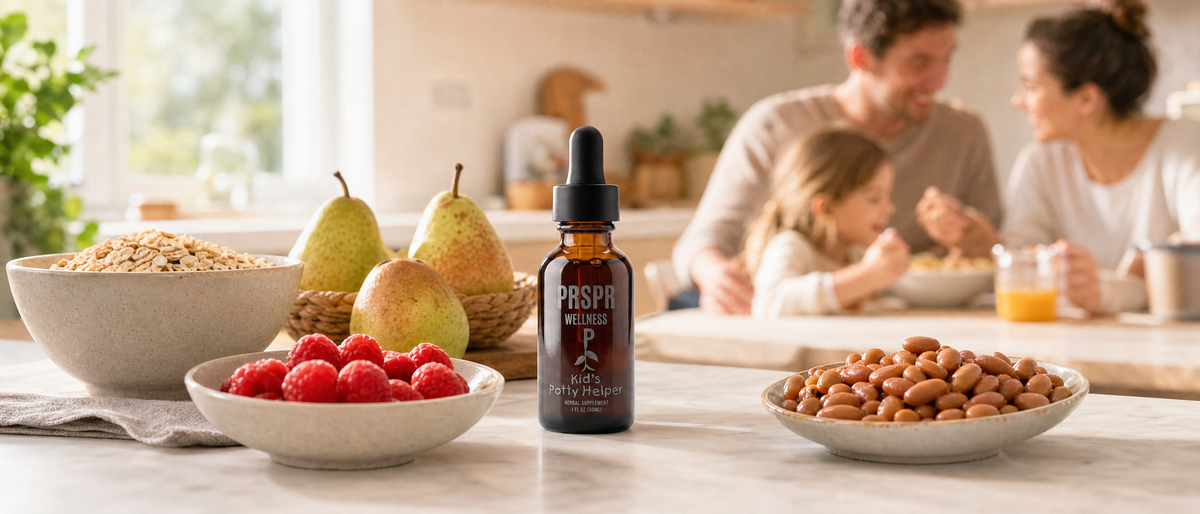
Kids Potty Helper is a liquid herbal blend for children, and its own panel is built the way we think panels should be built. It lists yellow dock root at 139 mg per ml, licorice root at 139 mg per ml and fresh marshmallow root at 133 mg per ml, with vegetable glycerin, deionized water and raspberry natural flavor, and it states the serving size and the number of servings per container on the same panel. It sits in our women's and children's health collection.
It is a botanical drop formula, not a fiber product, and we are not connecting it to anything above except the habit of reading a panel properly. What we will state about it is what we can verify: it is manufactured in a GMP certified facility and third party batch tested, and every amount is printed rather than concealed inside a blend name. Clear amounts, no guesswork.
If you want help working out what belongs in your household routine, take the quiz and build your own stack.
Answer all five questions to unlock a clear wellness plan made around your goal, schedule, preferred supplement format, and biggest roadblock.
Get clarity on what matters most right now.
See the product and routine connected to your goal.
Simple next steps you can use right away.
Pick the one you would fix first if you could.
This helps us make the guide easier to follow.
Consistency beats the “perfect” routine you never follow.
Be honest. We’re building something you’ll actually use.
Your guide will include one simple way around it.
Answer two more questions to unlock your product starting point, five-step plan, two-week routine, and one practical tip for your biggest roadblock.
Enter your details to open your five-step plan.
Verified PRSPR customer reviews
Expires when you close this page
*Your personal credit for completing the quiz. It's applied automatically at checkout on one-time purchases and expires when the timer runs out.
View full product detailsEverything in your plan, together — one add to cart.
Expires when you close this page
*Your personal credit for completing the quiz. It's applied automatically at checkout on one-time purchases and expires when the timer runs out.
View full product details Electrolytes
Salt is having a comparison week. Searches for celtic sea salt vs himalayan pink salt are up about 70 percent, pink himalayan salt vs table salt is...
 Label Reading
It is printed on the front of a lot of mineral bottles and it is one of the least understood words in the supplement business. Chelated. Search int...
 Botanicals
Beet root powder is holding a volume score of 37 this week. Maca powder and maca root powder are both at 29. Beetroot on its own leads the group at...