
◎
Get clear
Get clarity on what matters most right now.

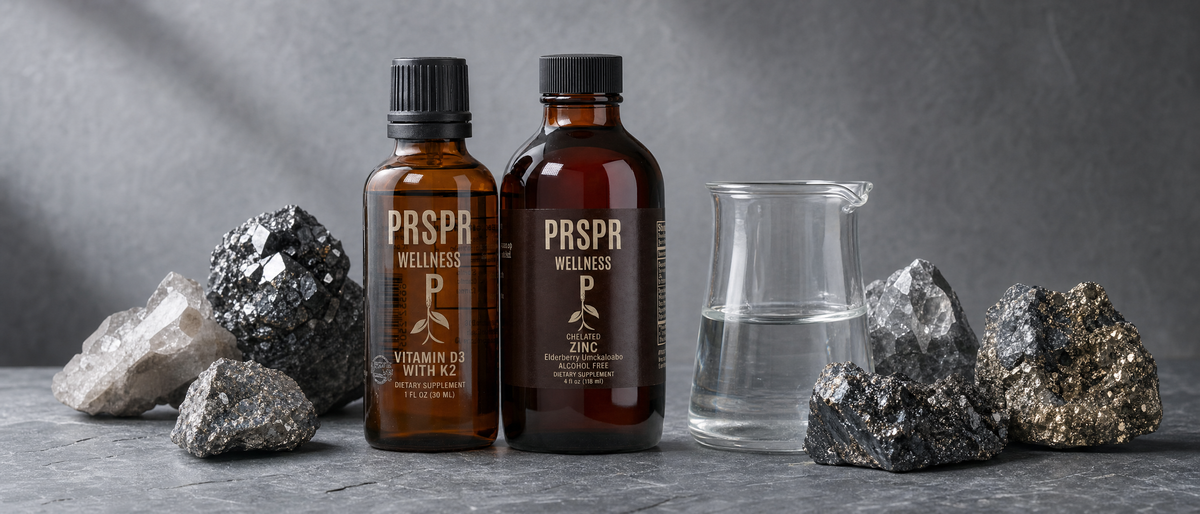
It is printed on the front of a lot of mineral bottles and it is one of the least understood words in the supplement business. Chelated. Search interest confirms the confusion: what is chelated zinc was the top related query in this cluster over the past week at 100, with chelated zinc vs zinc at 62, chelated zinc benefits at 42, and the bare phrase chelated meaning at 14 underneath them. Zinc benefits ran at 46 in the same window, and in a separate search set, umckaloabo benefits ran at 100.
So people are looking at a bottle, seeing a word they do not recognise sitting in front of a mineral they do, and going to find out what it is doing there. This piece answers that. It explains the chemistry, and it stops there. Nothing here says what zinc does in a body, and the benefits phrasings above are recorded as searches people run rather than questions we are answering.
The word comes from Greek. Chele means claw, the pincer of a crab or a lobster, and that image is the entire concept. A chelate is a compound in which an organic molecule grips a metal ion at more than one point at once, the way a claw closes around something rather than touching it at a single spot.
The chemists who named it in the early twentieth century picked the word deliberately for that picture. A regular salt pairs an ion with a partner at one point of contact. A chelate wraps. The molecule doing the wrapping is called a ligand, and the number of points where it attaches determines what kind of chelate you have. A ligand that grips at two points forms what is called a bidentate complex, which is literally two toothed.
So chelated zinc means zinc held inside one of these wrapping structures rather than paired as a simple mineral salt. The ligand is usually an amino acid, and the panel will normally say which one. Zinc bisglycinate, for example, names glycine as the ligand and bis tells you there are two of them.
That is what chelated meaning returns when you look it up, and it is not a supplement word at all. Chelation chemistry runs through water treatment, agriculture, food preservation and industrial processing. The supplement aisle borrowed a term that was already a hundred years old.
One consequence of the wrapping structure is worth understanding because it affects how you read a panel. The ligand has its own weight. When a label prints a figure for a chelated mineral it should distinguish between the weight of the whole complex and the weight of the mineral inside it, and those two numbers are never the same. A panel that gives you only one of them has left out the half you needed. This is the same arithmetic that catches people out across the whole mineral aisle, not just zinc.
Now the part the search data is really asking about. Chelated zinc vs zinc at 62 is the second biggest phrase here, and it is a comparison between a form and a mineral, which is a slightly confused question on its face. There is no such thing as a supplement containing bare zinc. Zinc, like iron, is a metal, and metals do not go into capsules as metals. Every zinc supplement contains zinc in some compound. The real comparison is always between two compounds, never between a compound and the pure element.
What the searcher usually means is chelated zinc against the older and cheaper mineral salts, the oxides and sulfates. Those are inorganic compounds. Chelates are organic ones in the carbon based sense. That is a genuine chemical difference and it is fair to name it.
What we will not do is tell you it makes the product better for you. Chelated zinc benefits at 42 and zinc benefits at 46 are both benefit shaped searches, and answering either one would mean making a claim about what a mineral does in a body. Answering either one would mean making a claim about what a mineral does in a body, and we do not make those. The chemistry is describable. The outcome is not, at least not by us, and a qualified healthcare professional is the right person to ask.
Here is what ties this together, and it goes beyond zinc.
Supplement labels are full of words that are precise in their field and opaque outside it. Chelated is one. Umckaloabo is another, and it is the top search in its own set at 100. That word is not Latin and not chemistry. It comes from Zulu, and it names a South African plant, Pelargonium sidoides, a relative of the geraniums in your neighbour's window box. It reached European vocabulary in the late nineteenth century and kept its original name rather than being translated, which is why it looks so unlike everything else on a panel.
Both words do the same job on a label. They are precise, they carry a real referent, and neither of them means anything to a shopper who has not looked it up. A brand can treat that as an advantage, printing terms that sound authoritative and letting the reader assume competence, or it can treat it as a debt and explain them. We think it is a debt. We took the same view of a different piece of jargon in our post on iron bisglycinate, which uses the word chelate for a different mineral, and of a botanical name in our post on what elderberry actually is.
The most useful thing about learning what chelated means is that it stops being impressive.
Right now the word functions as a quality signal for a lot of shoppers, purely because it is unfamiliar and sounds technical. Once you know it describes a structural arrangement, a ligand gripping an ion at multiple points, it becomes what it actually is: a specification. A fact about the compound in the bottle, sitting alongside the amount and the form, useful for comparing products and useless as a promise on its own.
That is the version of label literacy we are interested in. Not knowing more words so you can be reassured faster, but knowing enough words that the words stop doing your thinking for you.
The Adult Immunity Bundle pairs our Chelated Zinc with Elderberry, which also contains echinacea and umckaloabo root, with our Vitamin D3 plus K2 as MK7. It sits in our bundles collection.
What we will state is what we can verify. Both products are manufactured in a GMP certified facility and third party batch tested, and both print their amounts on the panel rather than concealing them inside a proprietary blend. When a label says chelated on the front, the panel should tell you which ligand it means, and ours does.
If you would rather work out what belongs in your routine than decode one bottle at a time, take the quiz and build your own stack.
Answer all five questions to unlock a clear wellness plan made around your goal, schedule, preferred supplement format, and biggest roadblock.
Get clarity on what matters most right now.
See the product and routine connected to your goal.
Simple next steps you can use right away.
Pick the one you would fix first if you could.
This helps us make the guide easier to follow.
Consistency beats the “perfect” routine you never follow.
Be honest. We’re building something you’ll actually use.
Your guide will include one simple way around it.
Answer two more questions to unlock your product starting point, five-step plan, two-week routine, and one practical tip for your biggest roadblock.
Enter your details to open your five-step plan.
Verified PRSPR customer reviews
Expires when you close this page
*Your personal credit for completing the quiz. It's applied automatically at checkout on one-time purchases and expires when the timer runs out.
View full product detailsEverything in your plan, together — one add to cart.
Expires when you close this page
*Your personal credit for completing the quiz. It's applied automatically at checkout on one-time purchases and expires when the timer runs out.
View full product details Electrolytes
Salt is having a comparison week. Searches for celtic sea salt vs himalayan pink salt are up about 70 percent, pink himalayan salt vs table salt is...
 Kids
KidsPick up a box of children's snacks and somewhere on the front there is a number with the letter g after it, next to the word fiber. It looks like o...
 Botanicals
Beet root powder is holding a volume score of 37 this week. Maca powder and maca root powder are both at 29. Beetroot on its own leads the group at...