
◎
Get clear
Get clarity on what matters most right now.

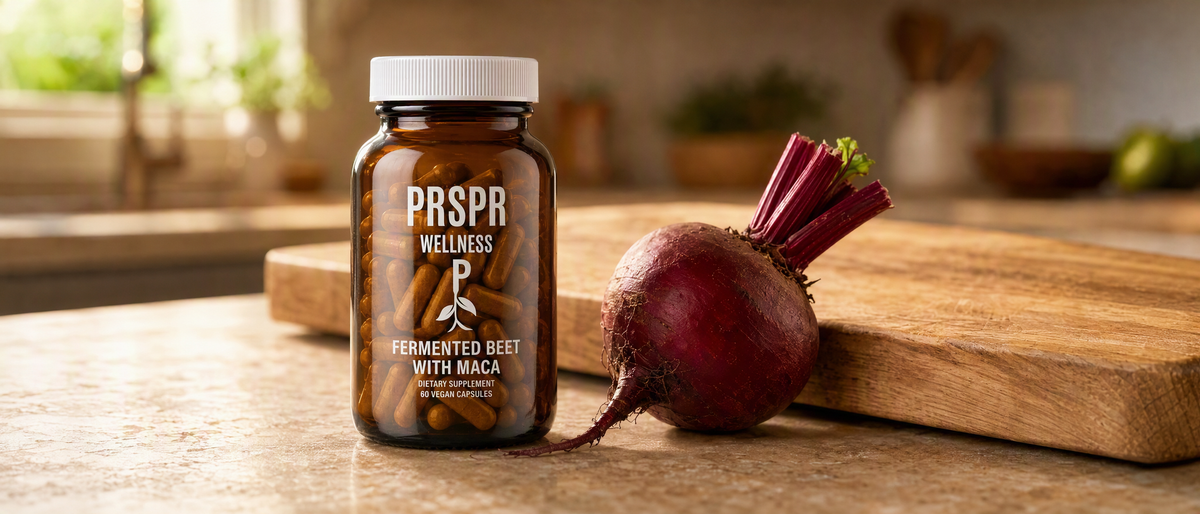
Beet root supplement searches are having a moment: best beetroot supplement is up 50 percent this week, beet root capsules benefits and benefits of beet root capsules both sit high on the volume charts, and the definitional questions are climbing alongside them. Over in its own corner, maca root benefits maxes out its chart entirely, with maca root for women and maca root for men splitting the follow-up interest and what is maca root close behind. Two roots, two trend lines, and, on our shelf, one jar that contains both, which makes this the right week to explain what these two plants actually are and what the word fermented is doing on our label.
House rules first, as always: this article names plants and processes, not effects. Whether beetroot, maca, or anything else earns a spot in your routine is a question for your own reading and a qualified healthcare professional. The what-does-it-do searches get attributed here, never answered.
Beetroot is the taproot of the beet plant, a staple food with centuries of kitchen history across Europe and the Middle East: roasted, pickled, borscht-ed, juiced. Its deep ruby color comes from pigments called betalains, which are also why beet stains are legendarily permanent. When beetroot moves from the plate to a capsule, nothing about the plant changes; the root is dried, processed, and measured into servings. That is the entire translation between beet root capsules and the vegetable aisle, and it is why the honest starting point for any beet root supplement question is the same as for any food-derived supplement: you are looking at a concentrated, convenient format of a plant you could also simply eat.
What is maca root is a top question this week, so here is the plain answer. Maca is a cruciferous root, Lepidium meyenii, a botanical cousin of radishes and turnips, cultivated for thousands of years in the high Andes of Peru, at altitudes where almost nothing else grows. In its home region it is a traditional food first: roasted, boiled, ground into flour for baking and porridge. Its modern fame arrived through the wellness aisle, where the maca root benefits conversation runs hot week after week, with the for-women and for-men variations reflecting how differently the internet markets the same root to different audiences. The root itself does not know who is buying it. It has one history, a food history, and it is a genuinely impressive one: a crop domesticated in one of the harshest agricultural environments on earth, kept in cultivation across centuries by Andean farming communities, and only recently rebranded by the wellness internet as a discovery. Knowing that history will not settle any benefits debate, and it is not meant to; it simply puts the trending jar in your hand into its correct, much older context.
Our jar reads Fermented Beet Root and Maca, and the first word is a process, not an ingredient. Fermentation is one of humanity's oldest food-processing methods: microorganisms are allowed to act on a food under controlled conditions, the same family of technique behind sourdough, yogurt, kimchi, and miso. On our label it means the beetroot and maca in the capsules went through a fermentation step before being combined and encapsulated, exactly as the live listing states. We will not attach outcome claims to the process; we name it because it is what happens to the ingredients, and a label should tell you how its contents were made when the method is a defining part of the product. If the word matters to you, now you know precisely what it refers to. If it does not, you still know exactly what is in the jar, which is the point of every label this brand prints.
Multi-ingredient jars deserve a slightly sterner version of the standard label read, because a second ingredient is a second place for vagueness to hide. So: both plants named in full, beetroot and maca root, not a proprietary roots blend with a total weight and no split. The form and the process disclosed, the way fermented is disclosed on ours, since how a food was prepared is part of what it is. The amount per serving and the serving count, so the month math is honest. The remaining ingredient lines read to the bottom, because capsule shells and processing aids are ingredients too and a thorough label owns them. And the testing line, because with agricultural ingredients from two different supply chains, batch testing is not a luxury; it is the receipt. A two-root jar that passes all of that has earned a professional conversation. One that fails has answered you already.
What is beet root capsules good for? Attributed, not answered: it is one of the steadier searches in the cluster, and the honest response is that what any concentrated food does for you depends on your diet and health picture, which makes it professional territory. What we can answer is what the capsules are, and this article just did.
Do beet root capsules have side effects? The beet root capsules side effects search deserves respect; it is the sound of someone taking an ingredient seriously. Take the actual jar, or its label, to a professional. One harmless heads-up we can offer from the food world: beets famously tint things red, and that is a well-known property of the vegetable, not a verdict on any product.
Why do the for-women and for-men searches split so evenly? Maca root for women outranks maca root for men this week, 49 to 33, and the split says more about marketing than about the root. The same plant is packaged under different promises for different audiences, which is exactly the pattern a label-first reader sees straight through: read the panel, and the audience segmentation evaporates.
Which is the best beetroot supplement? Rising 50 percent this week, and our answer is the house answer: the best one is the one that names its plants, states its amounts, discloses its process, and tests its batches. Rankings are rented; label literacy is owned.
Roots are having a deserved renaissance. Beetroot and maca are both real foods with real agricultural histories, not laboratory inventions with invented backstories, and the fact that this week's searchers are asking definitional questions before shopping questions is the healthiest possible sign. Our contribution is a jar that answers the definitional questions on its own panel: two named roots, one named process, nothing else. We think that is how every trending-ingredient product should be forced to introduce itself: plants first, process second, promises never.
Our Fermented Beet Root & Maca is a dietary supplement made with beetroot and maca root, combined using a fermentation process, exactly as the live listing reads. It is produced in a GMP-certified facility and third-party batch tested, so what is on the label is what is in the bottle. $44.99 on the current listing.
If two trending roots brought you here, land the habit properly: open the Fermented Beet Root & Maca page, read the short panel for yourself, and bring the what-will-it-do questions to someone qualified to answer them. The rest of our vitamins and supplements collection introduces itself the same plain way.
Answer all five questions to unlock a clear wellness plan made around your goal, schedule, preferred supplement format, and biggest roadblock.
Get clarity on what matters most right now.
See the product and routine connected to your goal.
Simple next steps you can use right away.
Pick the one you would fix first if you could.
This helps us make the guide easier to follow.
Consistency beats the “perfect” routine you never follow.
Be honest. We’re building something you’ll actually use.
Your guide will include one simple way around it.
Answer two more questions to unlock your product starting point, five-step plan, two-week routine, and one practical tip for your biggest roadblock.
Enter your details to open your five-step plan.
Verified PRSPR customer reviews
Expires when you close this page
*Your personal credit for completing the quiz. It's applied automatically at checkout on one-time purchases and expires when the timer runs out.
View full product detailsEverything in your plan, together — one add to cart.
Expires when you close this page
*Your personal credit for completing the quiz. It's applied automatically at checkout on one-time purchases and expires when the timer runs out.
View full product details Electrolytes
Salt is having a comparison week. Searches for celtic sea salt vs himalayan pink salt are up about 70 percent, pink himalayan salt vs table salt is...
 Kids
KidsPick up a box of children's snacks and somewhere on the front there is a number with the letter g after it, next to the word fiber. It looks like o...
 Label Reading
It is printed on the front of a lot of mineral bottles and it is one of the least understood words in the supplement business. Chelated. Search int...