
◎
Get clear
Get clarity on what matters most right now.

Damiana tea is holding a volume score of 80 this week. Damiana herb sits at 27, damiana liqueur at 22, damiana flower at 15. On the rising side, something less expected: damiana valle de guadalupe is up about 120 percent and damiana tequila about 50.
Valle de Guadalupe is a wine region in Baja California. Tequila is a spirit. Neither has anything obvious to do with a supplement shelf, and yet between them they are the fastest-moving searches attached to this plant right now.
The explanation is that damiana's biggest current search story is not a supplement story at all. It is a drinks story, and a regional one. This article is about that: where the liqueur comes from, why a plant ends up as a signature of a Mexican wine valley, and how a shrub with a Latin name became a bottle behind a bar. It is cultural and botanical history. It says nothing about what damiana does, and it does not present a liqueur as a use for anything we sell.
Damiana is a small aromatic shrub of the genus Turnera, found across Mexico, parts of Central and South America, the Caribbean and the far south of Texas. It is a plant of dry, hot, rocky ground, and it produces small yellow flowers, which is where damiana flower as a search term comes from. The leaves are the part that is harvested, dried and used.
We are going to keep this section short on purpose, because a plain-English guide to the plant itself already lives on this blog, written by Justin: what damiana is. If identity is what you came for, that is the piece. What follows here is the part it does not cover.
Damiana liqueur is a real and specific product category, made in Mexico, and it is the reason damiana liqueur and damiana tequila are sitting in this week's search data.
The best-known example comes from Baja California and is a sweet, herbal, golden liqueur made by infusing damiana. It is traditionally sold in a distinctively shaped bottle modelled on a round-bodied female figure, a design derived from pre-Columbian pottery, which is a large part of why the bottle is recognisable to people who could not name what is in it. It is a fixture of bars across the peninsula and a standard souvenir purchase in Baja tourist towns.
Its most-repeated claim to fame is in cocktail history. In Baja, damiana liqueur is often used in place of triple sec in a margarita, and the region has a long-running association with the drink's origin story. Whether any particular origin story about the margarita is true is disputed and probably unresolvable, as it is for most famous cocktails. What is not disputed is that the substitution is genuinely traditional there, which is enough to explain why the herb keeps turning up next to tequila in a search box.
That also explains the damiana tequila cluster. The two are not the same thing and damiana is not an ingredient in tequila. They co-occur because they share a drink, a region and a shelf, and search engines record co-occurrence faithfully without knowing the difference.
The fastest riser here needs its own explanation, because it is the least obvious of the group.
Valle de Guadalupe is Mexico's principal wine region, inland from Ensenada in Baja California. It has grown over the last two decades from a quiet agricultural valley into a serious food and wine destination, with a dense concentration of wineries, tasting rooms and restaurants, and it now draws a substantial international visitor trade.
Regions like that develop signatures. A visitor wants something local to drink, eat and take home, and the local thing has to be genuinely local rather than imported for the occasion. Damiana qualifies on every count. It grows in the surrounding country. It has a long regional history. It already exists as a finished bottled product with an unmistakable silhouette. And it is not available in most of the places visitors come from, which is exactly what a souvenir needs to be.
So a plant that grows on dry Baja hillsides gets adopted as a regional emblem by a wine valley that does not, itself, grow it commercially. That is not unusual. It is how regional food identity works nearly everywhere, and it is a much better explanation for a 120 percent search rise than anything happening in the supplement aisle.
Underneath all of that sits the largest term in the cluster, and the oldest format. Damiana tea, at 80, is comfortably bigger than any of the drinks terms.
Tea is the traditional way this leaf has been used, and it is a straightforward preparation: dried leaf, hot water, time. The leaf is aromatic, and the resulting infusion has a distinct, slightly bitter, herbal character that people tend to have opinions about. Damiana herb, at 27, is the same territory approached from the ingredient side rather than the preparation side.
It is worth noticing that the liqueur is, in a sense, the same idea with the water swapped out. An infusion extracts aromatic material from a dried leaf into a solvent, and both hot water and alcohol are solvents that will do it, with different results. That is the connection between the two halves of this cluster, and it is a preparation fact rather than a claim about either.
Damiana tea benefits, at 28, sits directly underneath the tea term and is the point at which this cluster stops being about preparation and starts being about outcomes. That is where we stop too. What an infusion of any leaf does for a person is a question for a qualified healthcare professional, and naming the search is as far as a company selling the plant should go.
We think this is one of the more charming things in our catalogue and it deserves to be said out loud.
Most of the ingredients on a supplement shelf have no life outside it. They are compounds with chemical names that exist in bottles and nowhere else. Damiana is not that. It is a shrub with yellow flowers that has been a drink, a regional emblem and a souvenir long before anyone put it in a dropper, and the fastest-growing thing anyone wants to know about it right now is a wine valley.
That does not tell you anything about whether it belongs in your routine, and we are not going to pretend it does. What it does tell you is that the plant has a history that is not a marketing invention, which is more than can be said for a lot of what gets sold as ancient wisdom. We would rather hand you the actual history and let it be interesting on its own terms.
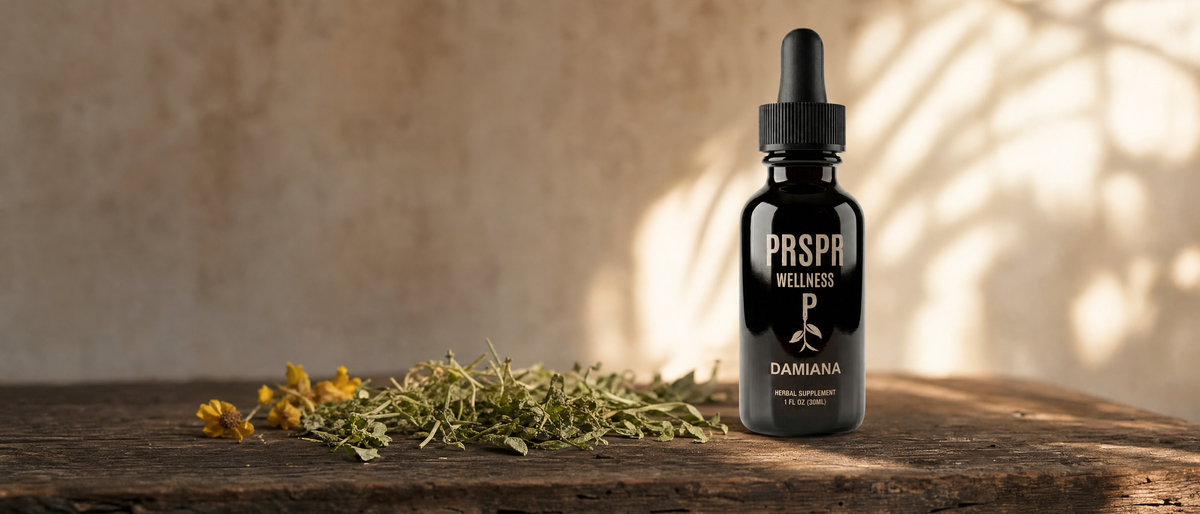
Our Damiana is a liquid botanical supplement made from Turnera diffusa, the damiana leaf. It is not a tea and it is not a liqueur. It is a dropper bottle, and that is a third format alongside the two this article has described. Those are composition facts from the live listing.
What we will add in our own voice is the quality story alone. It is made in a GMP-certified facility and third-party batch tested, so what is printed on the label is what is in the bottle. No guessing, no filler.
If the plant itself is what you want, Justin's guide to Turnera diffusa is the place to go. Otherwise open the Damiana page and read the panel and directions, browse the rest of the vitamins and supplements collection, or take the build-your-stack quiz. And if herbal preparations in general are the thread you are pulling, our piece on tea, tincture, extract and capsule as four ways to buy one plant covers the format question properly.
Answer all five questions to unlock a clear wellness plan made around your goal, schedule, preferred supplement format, and biggest roadblock.
Get clarity on what matters most right now.
See the product and routine connected to your goal.
Simple next steps you can use right away.
Pick the one you would fix first if you could.
This helps us make the guide easier to follow.
Consistency beats the “perfect” routine you never follow.
Be honest. We’re building something you’ll actually use.
Your guide will include one simple way around it.
Answer two more questions to unlock your product starting point, five-step plan, two-week routine, and one practical tip for your biggest roadblock.
Enter your details to open your five-step plan.
Verified PRSPR customer reviews
Expires when you close this page
*Your personal credit for completing the quiz. It's applied automatically at checkout on one-time purchases and expires when the timer runs out.
View full product detailsEverything in your plan, together — one add to cart.
Expires when you close this page
*Your personal credit for completing the quiz. It's applied automatically at checkout on one-time purchases and expires when the timer runs out.
View full product details Mind vocabulary
What is cognition? You have probably seen the word "cognitive" printed on a label, in a headline, or in a product name, and kept scrolling. It is o...
 Biology vocabulary
What is metabolism? You see the word on labels, in gym talk and in nutrition headlines, almost always used as if it were a single setting. Read eno...
 Sleep vocabulary
What are sleep cycles? You hear the phrase on podcasts, see it on sleep trackers, and read it in articles that assume you already know what it mean...