
◎
Get clear
Get clarity on what matters most right now.

One berry, four aisles. Chasteberry supplement is maxed out at a relative interest score of 100 this week. Chasteberry tea sits at 49, chasteberry supplements at 39, chasteberry for horses at 23, vitex chasteberry supplement at 21, and chasteberry extract at 16. Rising fastest, up about 110 percent, is vitex chasteberry benefits, which is a benefit query and one we will name rather than answer.
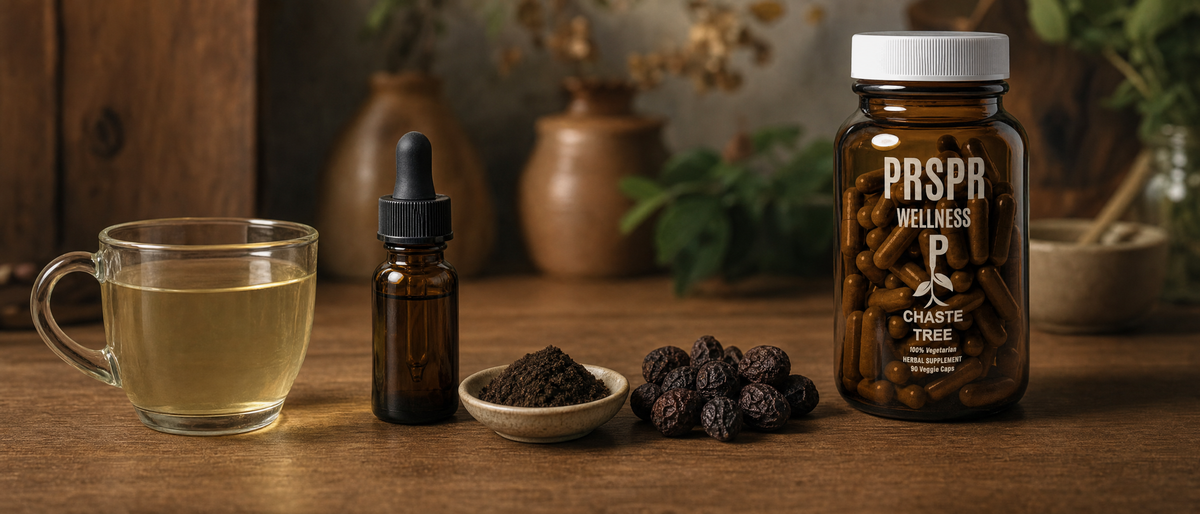
Set aside the benefit term and look at what is left. Tea. Extract. Supplement. Those are not three products. They are three preparations of the same plant material, and the difference between them is a manufacturing difference that changes what is physically in the container.
This article is about those preparations. What each one is as a process, why an herb's format list is longer than a vitamin's, and what changes between a dried berry in hot water and a capsule. It asserts nothing about PMS, cycles or hormones. Those are questions for a qualified healthcare professional.
Start with the raw material, because every preparation begins in the same place: the dried fruit of the plant, a small dark berry roughly peppercorn sized.
A tea, more precisely an infusion or a decoction, is the oldest preparation. Plant material goes into hot water, sits for a period, and is strained out. An infusion steeps; a decoction simmers, which is the usual approach for hard material like berries, bark or root. What ends up in the cup is whatever dissolved into water during that time. Water-soluble constituents transfer; oil-soluble ones largely do not.
A tincture is an extraction into alcohol, or into a mix of alcohol and water. Plant material is steeped in the solvent for weeks, then pressed and strained. Because alcohol dissolves a different range of compounds than water does, a tincture carries a different profile out of the same plant. It also keeps for a long time, which is why the format existed long before refrigeration, and it is measured in drops from a dropper rather than in cups.
An extract is the concentrated form. Plant material is extracted with a solvent, and then the solvent is removed, leaving a concentrated residue that can be a thick liquid or a dry powder. The concentration is often expressed as a ratio, such as 4:1, meaning four parts of raw material went into one part of finished extract. Standardized extracts go a step further and are adjusted so a named marker compound falls in a stated range.
A capsule is not a preparation at all. It is a container. What is inside it is one of the above, usually either milled dried berry or a dried extract, and the panel is where you find out which. A capsule of powdered whole berry and a capsule of concentrated extract are quite different products in identical-looking bottles.
This is the structural point, and it explains a great deal about why the botanical aisle is confusing.
A vitamin is one molecule. Vitamin C is ascorbic acid. There is a single defined substance, its amount can be stated in milligrams, and the only real questions are how much and in what carrier. That is why the vitamin aisle has essentially two formats: something you swallow and something you dissolve.
A botanical is not one molecule. It is plant material containing hundreds of compounds in proportions that vary. There is no single number that describes it, and different extraction methods pull different subsets of those compounds out. So each method produces a genuinely different product from the same starting material.
That is why the formats proliferate. They are not marketing variants. They are different chemical outcomes, and the format list is long because the number of ways to get compounds out of a plant is long.
The practical consequence for a shopper is that amounts do not translate across formats. A gram of dried berry, a milliliter of tincture and a capsule of 4:1 extract are not comparable quantities of anything, and any attempt to convert between them without the manufacturer's own figures is guesswork.
Three questions sort out any botanical product, and they work on every plant in the aisle.
First, which part of the plant. Berry, leaf, root and bark from the same species are different materials with different compositions. A good label says. For this plant it is the berry, which is why the word appears in the common name.
Second, whole material or extract. If the panel says a powder of the dried fruit, you are getting milled plant. If it says extract, you are getting a concentrate, and there should be a ratio or a standardization figure attached to tell you how concentrated.
Third, what solvent, where stated. Water, alcohol and CO2 extractions produce different profiles, and the better labels in this category say which was used.
Those three answers tell you what is actually in the container. Everything else on the front of the box is secondary. We took the naming half of this same plant apart in vitex, chasteberry, chaste tree, and covered format differences in a neighboring aisle in syrup, tincture, tea.
Chasteberry for horses at 23 is a genuine and slightly startling part of this plant's search profile, and it is worth reporting honestly rather than filtering out.
The plant has an established presence in the equine supplement market, and that is simply a fact about where it is used commercially. We are noting it because it appears in the data at meaningful volume, and because it says something useful about how botanicals move: a plant with a long history of traditional use tends to end up in several markets at once, human and veterinary, sold in different formats to different buyers.
It is also a small warning about search results. If you are researching a botanical and the results feel oddly off-topic, check who the page is written for. Human and animal product pages for the same plant sit next to each other in search and they are not addressing the same reader.
Our view is that format is the first question in the botanical aisle and almost nobody asks it first.
People arrive having decided on a plant, compare prices across four products, and never notice that one is dried berry, one is a concentrate, one is an alcohol extraction and one is a tea. Those products are not competing on price because they are not the same thing. Comparing their prices is like comparing the price of coffee beans to the price of espresso.
So the habit we would suggest is to settle the format before you look at a single price. Decide whether you want whole plant material or a concentrate, and whether you want something you prepare or something pre-portioned. Then compare within that group, where the numbers actually mean the same thing.
And read the part-of-plant line. It is the cheapest information on the label and it is the one that most often reveals that two products are not what you assumed.
Our Chaste Tree is made with Vitex agnus-castus, the chaste tree berry, and it is sold as a capsule. Species named, part of the plant named, format named.
By the framework above, that tells you the raw material and the container. The panel is where you check the rest, which is exactly the reading this article has been arguing for, and it applies to our label as much as to anyone else's.
The one thing we state in our own voice is process. GMP-certified facility, third-party batch tested, so the panel and the capsule agree.
If the format question is the one you take away, put it to work. The Chaste Tree page names the species and the part, the women's and children's health collection has more botanical panels to practice on, and the build-your-stack quiz is there if you would rather start from a routine.
Answer all five questions to unlock a clear wellness plan made around your goal, schedule, preferred supplement format, and biggest roadblock.
Get clarity on what matters most right now.
See the product and routine connected to your goal.
Simple next steps you can use right away.
Pick the one you would fix first if you could.
This helps us make the guide easier to follow.
Consistency beats the “perfect” routine you never follow.
Be honest. We’re building something you’ll actually use.
Your guide will include one simple way around it.
Answer two more questions to unlock your product starting point, five-step plan, two-week routine, and one practical tip for your biggest roadblock.
Enter your details to open your five-step plan.
Verified PRSPR customer reviews
Expires when you close this page
*Your personal credit for completing the quiz. It's applied automatically at checkout on one-time purchases and expires when the timer runs out.
View full product detailsEverything in your plan, together — one add to cart.
Expires when you close this page
*Your personal credit for completing the quiz. It's applied automatically at checkout on one-time purchases and expires when the timer runs out.
View full product details Mind vocabulary
What is cognition? You have probably seen the word "cognitive" printed on a label, in a headline, or in a product name, and kept scrolling. It is o...
 Biology vocabulary
What is metabolism? You see the word on labels, in gym talk and in nutrition headlines, almost always used as if it were a single setting. Read eno...
 Sleep vocabulary
What are sleep cycles? You hear the phrase on podcasts, see it on sleep trackers, and read it in articles that assume you already know what it mean...