
◎
Get clear
Get clarity on what matters most right now.

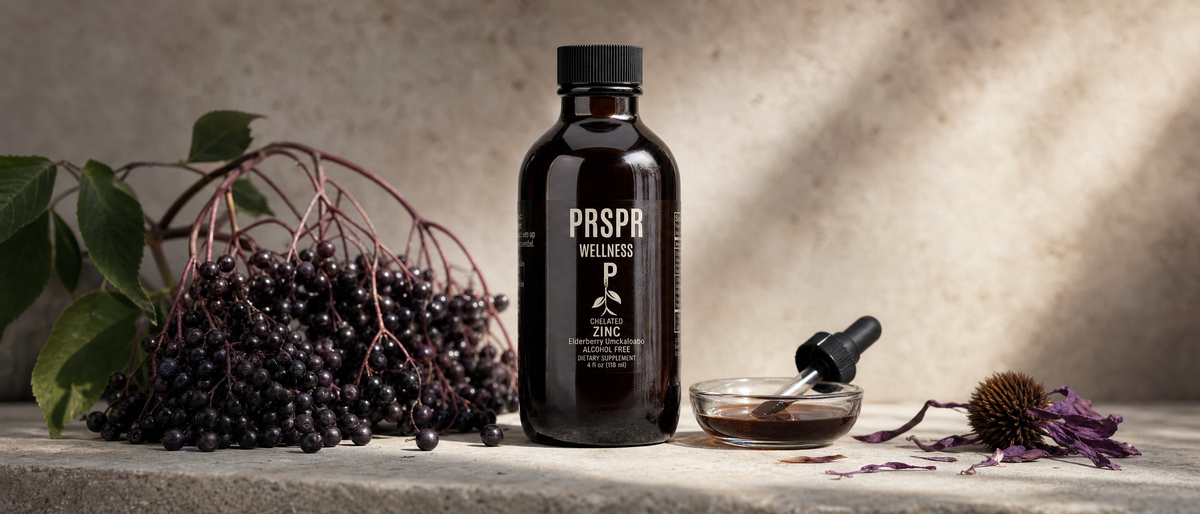
Two plants show up together on almost every shelf in this corner of the store, and a lot of people quietly assume they are versions of the same thing. The fastest-climbing search in the category suggests they have started to wonder.
"Elderberry vs echinacea" is up around 350 percent. That is the steepest riser here by a distance, and it is a question about identity rather than about effect. Around it: "elderberry syrup" at 100 on the relative interest scale, "echinacea tea" at 100, "echinacea purpurea" at 57, "elderberry recipe" at 38. Climbing too are "echinacea tincture benefits," up about 160 percent, "european elderberry," up about 110 percent, and two dosing questions we will come back to and decline to answer.
So: two different plants, and a set of preparation words that get used interchangeably when they should not be. Both of those are answerable without making a single claim, so that is what this piece does.
They are not related. That is the first and most important thing, and it surprises people.
Elderberry is the fruit of shrubs in the genus Sambucus, in the family Adoxaceae. It is a small, dark, almost black berry that grows in heavy drooping clusters, on a shrub that produces broad flat heads of cream-coloured flowers earlier in the year. The part used is the fruit, and the flower is used separately in its own right.
Echinacea is a coneflower, a member of the daisy family, Asteraceae. It is a herbaceous perennial native to central and eastern North America with distinctive drooping purple petals and a raised bristly central cone that gives the genus its name, from the Greek word for hedgehog. The parts used are the aerial parts and the root, not a fruit.
A shrub fruit and a prairie wildflower's root and stems. Different families, different continents of origin, different parts of the plant, different growing habits. The only thing they genuinely share is a shelf.
Two of the other searches are asking to narrow those names further, which is exactly the right instinct.
"European elderberry" distinguishes Sambucus nigra, the black elder of Europe, from the North American species that share the common name. Common names travel badly across continents and the qualifier is doing real work.
"Echinacea purpurea" is a species name, and it matters because several Echinacea species are used and they are not identical plants. Purpurea is the most commonly cultivated. A label naming the species has told you more than one saying only "echinacea."
The other half of the search list is formats, and these words are not decorative. Each one describes a different extraction method, and the method decides what ends up in the bottle.
A tea, or infusion, is the simplest. Plant material meets hot water for a few minutes and you drink the result. Water pulls out what is water-soluble and leaves the rest behind. It is made fresh and drunk immediately, which is why "echinacea tea" is a preparation and not a product with a shelf life.
A tincture uses alcohol, usually mixed with water, as the solvent instead. Plant material steeps for weeks rather than minutes. Alcohol extracts a different and broader range of plant constituents than water alone, and it also preserves the result, which is why tinctures keep for years and are dispensed in drops from a dropper bottle. Some products are made alcohol-free using glycerine instead, and the label will say so.
A syrup is a preparation in a sweet base. Historically it was a way of making something palatable and of preserving it, since sugar concentration inhibits spoilage. Syrups are measured by the spoonful and are usually the format aimed at people who will not take drops.
The practical point is that these three are not interchangeable and cannot be compared by volume. A teaspoon of syrup and a dropper of tincture are not the same amount of anything, because they were made by different methods in different concentrations. Comparing them requires reading each label's own stated serving, and there is no conversion between the formats that a shopper can do in their head.
Preparation words are the most quietly informative thing on a herbal label, and they get treated as branding.
Somebody choosing between a syrup and a tincture usually thinks they are choosing a flavour or a convenience. They are actually choosing between two different extractions of a plant, made with different solvents over different timescales. That is not a small difference, and nobody is telling them.
Our frustration with this aisle is that the format words and the plant names, which are the two checkable things on the pack, are the two that go unexplained, while the front panel gets the space. Knowing that echinacea is a coneflower root and aerial part, and that a tincture is an alcohol extraction, costs nothing and lasts forever. It also makes you much harder to sell something vague to.
The rest of what people want to know here is medical, and we will not pretend otherwise. Whether either plant is appropriate for you is not a question a brand should be answering.
There is one more naming habit worth carrying out of this piece, because it applies to every herbal product you will ever pick up. A complete botanical identification has three parts: the genus and species, the part of the plant used, and the preparation method. "Echinacea purpurea root tincture" contains all three and leaves nothing to guess at. "Echinacea" alone contains one of the three. Once you start reading for those three slots, the gaps in a label become obvious very quickly, and so does the difference between a manufacturer who has committed to specifics and one who has not.
How much elderberry should I take daily? This is one of the fastest-climbing searches on the topic and it is a dosing question, which means it depends on you, on the preparation and on its concentration. We do not answer dosing questions. Follow the directions on the specific product you are holding and take the question itself to a qualified healthcare professional.
How much elderberry syrup to take daily? The same answer, with one addition worth knowing: because syrups, tinctures and teas are made by different methods, an amount that applies to one format tells you nothing about another. Read the label of the exact product in front of you, and ask a professional.
Our Chelated Zinc with Elderberry combines zinc with a blend of botanical ingredients including elderberry, echinacea and umckaloabo root, and it is a liquid rather than a syrup or a capsule. The label names the botanicals rather than leaving them to a category word, which is the convention we would rather follow.
Everything we make is manufactured in a GMP-certified facility and third-party batch tested. What is on the label is what is in the bottle. No guessing, no filler, no cutting corners. With botanicals whose common names are shared across unrelated species and continents, verified identity is the foundation of everything else.
If you want an introduction to the ingredients themselves rather than to their preparations, we wrote about what elderberry, zinc, echinacea and umckaloabo actually are. Our wellness quiz takes a couple of minutes, and the bottle sits with the rest of our vitamins and supplements.
Answer all five questions to unlock a clear wellness plan made around your goal, schedule, preferred supplement format, and biggest roadblock.
Get clarity on what matters most right now.
See the product and routine connected to your goal.
Simple next steps you can use right away.
Pick the one you would fix first if you could.
This helps us make the guide easier to follow.
Consistency beats the “perfect” routine you never follow.
Be honest. We’re building something you’ll actually use.
Your guide will include one simple way around it.
Answer two more questions to unlock your product starting point, five-step plan, two-week routine, and one practical tip for your biggest roadblock.
Enter your details to open your five-step plan.
Verified PRSPR customer reviews
Expires when you close this page
*Your personal credit for completing the quiz. It's applied automatically at checkout on one-time purchases and expires when the timer runs out.
View full product detailsEverything in your plan, together — one add to cart.
Expires when you close this page
*Your personal credit for completing the quiz. It's applied automatically at checkout on one-time purchases and expires when the timer runs out.
View full product details Electrolytes
Salt is having a comparison week. Searches for celtic sea salt vs himalayan pink salt are up about 70 percent, pink himalayan salt vs table salt is...
 Kids
KidsPick up a box of children's snacks and somewhere on the front there is a number with the letter g after it, next to the word fiber. It looks like o...
 Label Reading
It is printed on the front of a lot of mineral bottles and it is one of the least understood words in the supplement business. Chelated. Search int...