
◎
Get clear
Get clarity on what matters most right now.

Vitex agnus castus is up 50 percent this week. So is chaste berry vitex. Vitex chaste tree berry is up 110 percent, chaste tree berry up 100 percent, and vitex berry benefits up 70 percent. Underneath the rising terms, vitex supplement and chaste tree supplement are both holding steady volume, and someone is still typing the most basic version of the question: what is vitex.
Every one of those searches is about the same plant. Not similar plants, not a family of related species. One plant, with three names in circulation and a search index that treats them as loosely interchangeable. The result is a set of results that mixes garden centres with supplement shops, because the shrub is genuinely sold in both, and a shopper who cannot tell which is which.
This is a naming article. It sorts out which name is which, where each came from, and why the botanical one is the only one that settles anything.
Vitex agnus-castus is a deciduous shrub or small tree in the mint family, native to the Mediterranean basin and parts of western Asia. It grows to a few metres, throws up slender spikes of small purple flowers in late summer, and has palmate leaves that fan out from a central point like fingers. It is widely planted as an ornamental in warm climates, which is the first half of the confusion: this is a plant people buy from nurseries.
After flowering it produces small dark fruits, roughly peppercorn-sized. Those fruits are the part used in supplements, and their size and appearance are the reason for one of the plant's other nicknames, monk's pepper.
The binomial itself is worth unpacking because it is unusually literal. Vitex is the genus, from a Latin root referring to the plant's flexible withies, which were historically used in basketwork. Agnus castus translates roughly as chaste lamb, and it is the source of every English name the plant carries. So the Latin is not a separate name from the common ones. It is where they came from.
Chaste tree is the plant. Chasteberry, or chaste tree berry, is the fruit of that plant. That distinction is the single most useful thing in this article, because it is the one that tells you what part a product used.
In practice the two get used interchangeably in search and often on packaging, which is a shame, because the difference is real and it is exactly the kind of detail a panel should be precise about. A product made from the berry and a product made from the leaf are different products. When a listing says berry, it has told you something. When it says chaste tree with no part named, it has not.
Vitex, meanwhile, is just the genus name used on its own, the way people say echinacea. It is shorthand, it is common in the supplement aisle specifically, and it is the reason vitex supplement and chaste tree supplement behave as two separate searches with separate volumes despite meaning the same thing. Two shopper populations, two vocabularies, one shelf.
The naming split even shows up in who uses which word. Gardeners and nurseries tend to say chaste tree, because they are selling a landscape plant. Supplement shoppers tend to say vitex, because that is the word on the bottles. Search sits in the middle and returns both.
The hyphen is a small extra wrinkle. Written strictly, the species epithet is agnus-castus with a hyphen, and you will see it printed both ways across labels, catalogues and databases. Both refer to the same species. It is a typographic convention rather than a distinction, so do not read anything into which version a listing uses.
Here is the bridge. Most botanical ingredients on a supplement shelf are not things anyone plants in a front garden. Nobody is landscaping with saw palmetto or yellow dock. Vitex is an exception: it is a genuinely popular ornamental in warm regions and a genuinely common supplement ingredient, and both industries use overlapping names for it.
So the mixed search results are not an error. They are an accurate reflection of a plant that lives in two commercial worlds at once. The way through is the same as always, which is to look for the binomial and the plant part. Vitex agnus-castus plus berry gets you to one shelf. Chaste tree on its own gets you to both.
We should be plain about what this article is not doing. This plant sits next to a set of questions about cycles, hormones and pregnancy, and vitex berry benefits and chaste tree benefits are live searches this week. We are not answering any of them, and the parenthetical on our own product name is not a claim we are making here. Those questions are specific, they are personal, and several of them are genuinely medical. They belong with a doctor, a pharmacist or another qualified healthcare professional who knows your history. What belongs on this page is the identity of the plant.
It is also worth knowing that vitex is a large genus. Vitex agnus-castus is one species in it, and others are grown and used elsewhere in the world, including timber species with no relationship to this shelf at all. So vitex on its own is a genus label, not a product specification, in exactly the way that saying citrus does not tell you whether you have a lemon or a grapefruit.
We keep coming back to the same position on botanicals, which is that a species name and a plant part cost nothing to print and settle almost every question a shopper has before they have even read the rest of the panel. Vitex is the strongest case for that argument we have run into, because here the ambiguity is not just between brands. It is between a supplement and a shrub.
Naming aside, the plant is also a reminder that a long record of traditional use and a modern supplement are two different objects. The historical record for this shrub is genuinely old and genuinely well documented, and it is history. It describes what people have done. It is not a statement about what a capsule will do, and the gap between those two things is where most of the confusion in this entire category lives.
If you take one habit from this article, make it this one: on any botanical product, find the Latin and find the part. Two lines. If a listing gives you neither, you do not actually know what you are looking at, however good everything else on the page looks. We made the same argument about a different plant in our elderberry piece, and it holds here for the same reasons.
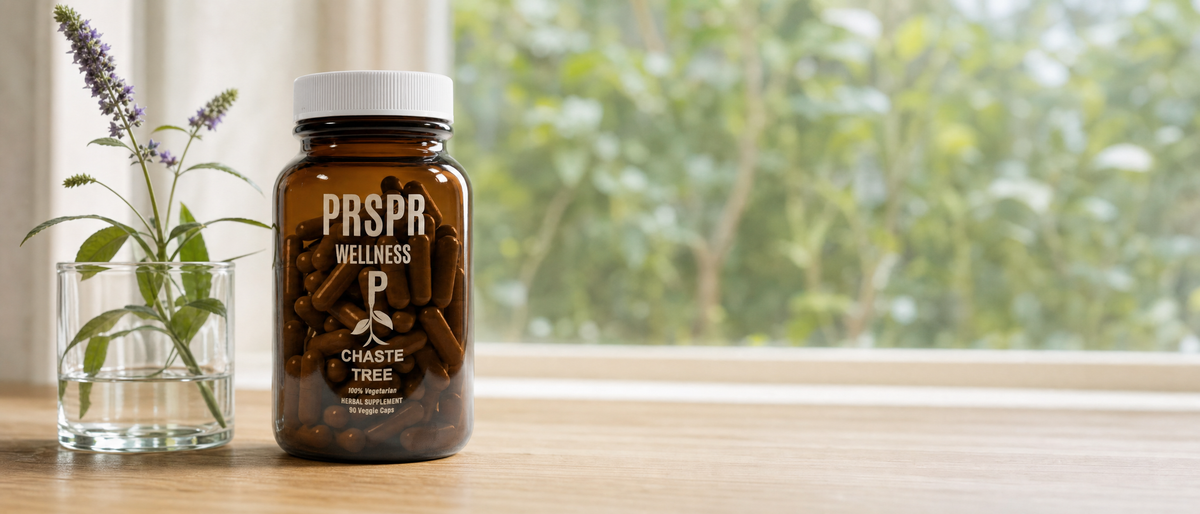
Our Chaste Tree is made with Vitex agnus-castus, named on the listing by its binomial and identified as chaste tree berry, so both halves of the disclosure this article has been arguing for are actually present. It is manufactured in a GMP-certified facility and third-party batch tested, so what is on the label is what is in the bottle. No guessing, no filler.
You can read it on the Chaste Tree page, and see the rest of that shelf on our women's and children's health page. If you want a hand working out where a single-botanical supplement sits next to what you already take, take the quiz.
Answer all five questions to unlock a clear wellness plan made around your goal, schedule, preferred supplement format, and biggest roadblock.
Get clarity on what matters most right now.
See the product and routine connected to your goal.
Simple next steps you can use right away.
Pick the one you would fix first if you could.
This helps us make the guide easier to follow.
Consistency beats the “perfect” routine you never follow.
Be honest. We’re building something you’ll actually use.
Your guide will include one simple way around it.
Answer two more questions to unlock your product starting point, five-step plan, two-week routine, and one practical tip for your biggest roadblock.
Enter your details to open your five-step plan.
Verified PRSPR customer reviews
Expires when you close this page
*Your personal credit for completing the quiz. It's applied automatically at checkout on one-time purchases and expires when the timer runs out.
View full product detailsEverything in your plan, together — one add to cart.
Expires when you close this page
*Your personal credit for completing the quiz. It's applied automatically at checkout on one-time purchases and expires when the timer runs out.
View full product details Electrolytes
Salt is having a comparison week. Searches for celtic sea salt vs himalayan pink salt are up about 70 percent, pink himalayan salt vs table salt is...
 Kids
KidsPick up a box of children's snacks and somewhere on the front there is a number with the letter g after it, next to the word fiber. It looks like o...
 Label Reading
It is printed on the front of a lot of mineral bottles and it is one of the least understood words in the supplement business. Chelated. Search int...