
◎
Get clear
Get clarity on what matters most right now.

"Ferritin face" is one of the fastest-climbing phrases on the internet this week. In Google Trends' related searches (US, past seven days), "ferritin face social media trend" is marked Breakout, "what is ferritin face and do you have it" is up +4,400%, "ferritin face meaning" is up +350%, and plain "ferritin face" is up +250%.
Underneath the trend, the older questions are still there. "What is ferritin" carries a volume score of 51, and "transferrin," the name of a second iron protein, sits at 8. People are hearing a new phrase and then going back to look up the word inside it.
So this piece does two things. It reports what the trend says, in the trend's own terms, and then it explains the vocabulary: what ferritin is, what transferrin is, and where both names come from. What any of this means for a particular person is a question for a qualified healthcare professional, and only a clinician can interpret an individual's iron status.
The phrase has already drawn mainstream coverage. Writing in The Conversation on September 16, 2026, a nutrition lecturer at Bournemouth University described "ferritin face" as "the social media term" for the claim that low iron shows visible clues on the face, and named TikTok as the platform where it is spreading.
That description is the whole ferritin face meaning, as the trend itself uses it. Creators are posting that a certain look in the mirror is a sign of something inside, and they have attached the name of an iron protein to that idea. The trend's premise is that a face can be read for iron.
We are going to leave the premise exactly where we found it: with the people posting it. Whether a look in the mirror says anything about iron is not a vocabulary question, and it is not one we will answer. It belongs to a clinician who can look at a whole person.
This is the fastest-rising search in the cluster, up +4,400%, and it is worth noticing how it is phrased. It asks for a definition and a verdict in one breath. The definition is above. The verdict is not something an article, a video or a mirror can give, which is why we point that half of the question to a qualified healthcare professional and keep this page on the words.
Here is the part the dictionary and the medical references can answer cleanly.
MedlinePlus, the consumer health site from the National Library of Medicine, defines it simply: "Ferritin is a protein that binds to iron and stores it in your body." The same page notes that much of the body's ferritin is stored in the liver. The Cleveland Clinic puts it just as plainly: "Ferritin is a protein that stores iron inside your cells," and compares it to a storage closet.
So when someone asks "what is ferritin," the short answer is a storage protein. Ferritin is not iron itself. It is the protein that holds iron.
Ferritin has an unusual shape for a protein. According to a structural review indexed in the National Library of Medicine, ferritin is built from 24 subunits that assemble into an almost spherical shell, and iron is kept in the cavity inside it. Picture a hollow ball with iron packed in the middle, and you have the basic idea.
The name gives the job away. The Online Etymology Dictionary traces the combining form ferro- to the Latin ferrum, "iron." Merriam-Webster dates "ferritin" to 1937 and describes it as an alteration of "ferratin," an older name for an iron-containing protein.
That 1937 date lines up with the lab history. A review archived in PubMed Central, the National Library of Medicine's article library, records that ferritin was discovered in 1937, when a new protein was isolated from horse spleen that contained up to 23% iron by dry weight.
If ferritin is the storage protein, transferrin is the one that moves iron around. The two names look alike because they share a root, and they are often mentioned together.
The Cleveland Clinic defines it this way: "Transferrin is a protein that moves iron through your blood," adding that it "carries iron to places that need it, like your bone marrow and muscles." MedlinePlus describes transferrin as "a protein that moves iron throughout the body."
The NCBI Bookshelf's StatPearls reference adds some chemistry. It describes transferrin as a blood plasma glycoprotein, notes that liver cells produce it, and states that one transferrin molecule can bind two atoms of ferric iron.
The word is almost a sentence. Collins English Dictionary dates transferrin to 1947 and builds it from trans-, plus the Latin ferrum, "iron," plus the chemical ending -in. The Online Etymology Dictionary glosses that prefix trans- as "across, beyond, through." Iron, carried across. The name describes the job.
Put the two side by side and the vocabulary sorts itself out:
Both names start from the same Latin word for iron. One is about keeping it, the other about moving it. For the third iron word people search this week, our piece on hemoglobin, heme and iron explains where hemoglobin fits in the same family of names.
Here is the bridge from the video to the vocabulary. The ferritin face social media trend borrows a real scientific word, and real words carry authority. "Ferritin" sounds like a lab result, because it is the name of a real protein that labs really do discuss. Attaching it to a look gives the trend a vocabulary it did not have to invent.
That is exactly why the definitions matter. Once you know that ferritin is a storage protein, and transferrin is a transport protein, you can tell the difference between the word and the claim built on top of it. The word has a dictionary entry. The claim is something creators are posting.
It also explains the shape of the search data. People hear "ferritin face," search the phrase, and then search "what is ferritin" and "transferrin" to understand the words underneath it. That second step, looking up the word itself, is the useful one. It is the step this article exists for.
What the words cannot do is answer a personal question. A protein name describes a molecule. Reading what any of it means for one person is a clinician's job.
We like it when a trend sends people to the dictionary. Ferritin and transferrin are good words, with clean Latin roots and clear definitions, and a lot more people know them this week than knew them last week. That is a good thing.
We are also careful about where a word ends and a claim begins. "Ferritin face" is a phrase from social media. We report it as that, and we do not grade it. Whether a face says anything about iron is not a question we can answer from here, and we do not think any video can answer it either. That is what clinicians are for.
What we can do is get the vocabulary right. Ferritin stores iron. Transferrin carries it. Both are named after ferrum. If a trend leaves you with those three facts, it has left you with something real.
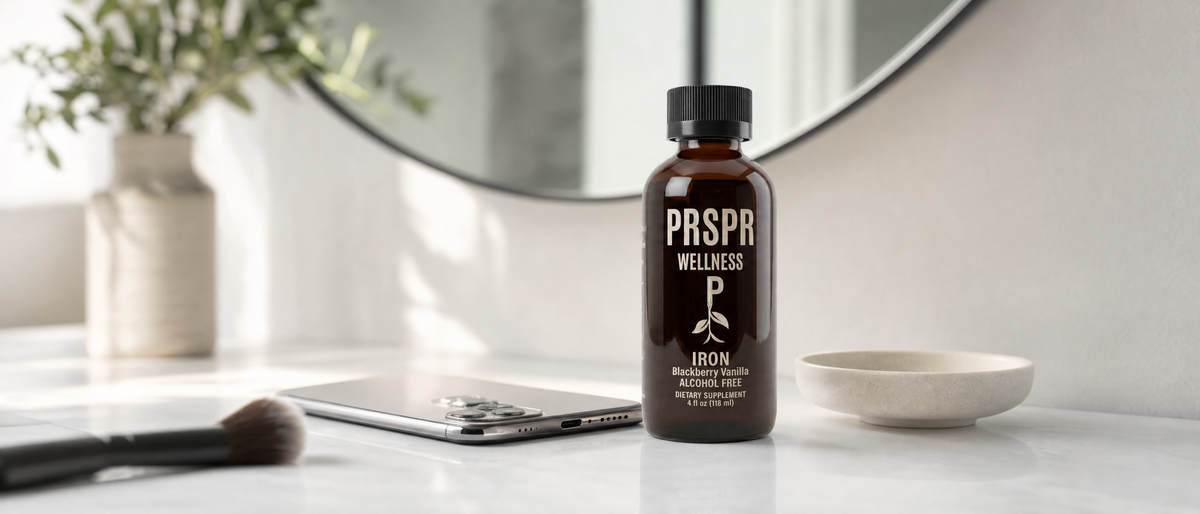
Iron is also the subject of our own bottle, PRSPR Liquid Iron. In the listing's own words, it is "a dietary supplement containing iron in the form of ferrous bisglycinate chelate, combined with wild harvested yellow dock root. It is formulated for convenient daily use."
For the chemistry words on that label, our guide to the chemistry words on an iron label takes it apart term by term, and our piece on yellow dock covers the botanical half of the bottle.
What we will add in our own voice is how it is made. PRSPR Liquid Iron is manufactured in a GMP-certified facility and third-party batch tested, so what's on the label is what's in the bottle.
To read the full label yourself, open the Liquid Iron product page, browse the rest of the vitamins and supplements collection, or take the build-your-stack quiz to see where it fits alongside everything else we carry.
Answer all five questions to unlock a clear wellness plan made around your goal, schedule, preferred supplement format, and biggest roadblock.
Get clarity on what matters most right now.
See the product and routine connected to your goal.
Simple next steps you can use right away.
Pick the one you would fix first if you could.
This helps us make the guide easier to follow.
Consistency beats the “perfect” routine you never follow.
Be honest. We’re building something you’ll actually use.
Your guide will include one simple way around it.
Answer two more questions to unlock your product starting point, five-step plan, two-week routine, and one practical tip for your biggest roadblock.
Enter your details to open your five-step plan.
Verified PRSPR customer reviews
Expires when you close this page
*Your personal credit for completing the quiz. It's applied automatically at checkout on one-time purchases and expires when the timer runs out.
View full product detailsEverything in your plan, together — one add to cart.
Expires when you close this page
*Your personal credit for completing the quiz. It's applied automatically at checkout on one-time purchases and expires when the timer runs out.
View full product details Mind vocabulary
What is cognition? You have probably seen the word "cognitive" printed on a label, in a headline, or in a product name, and kept scrolling. It is o...
 Biology vocabulary
What is metabolism? You see the word on labels, in gym talk and in nutrition headlines, almost always used as if it were a single setting. Read eno...
 Sleep vocabulary
What are sleep cycles? You hear the phrase on podcasts, see it on sleep trackers, and read it in articles that assume you already know what it mean...