
◎
Get clear
Get clarity on what matters most right now.

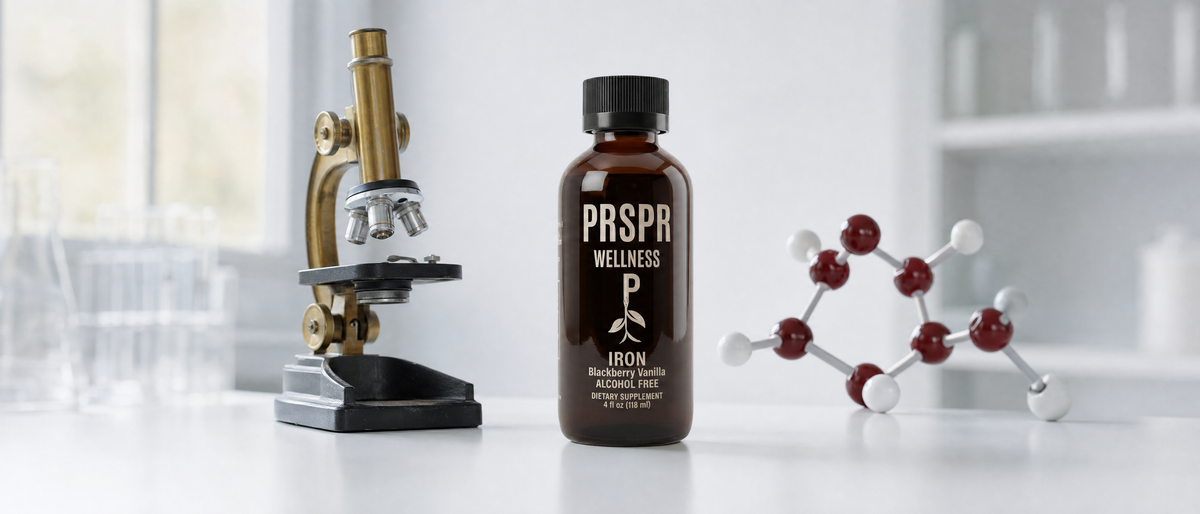
What is hemoglobin? That exact question is leading a cluster of blood-word searches this week. What is hemoglobin carries a volume score of 84, hematocrit 46, what is a hemoglobin 39, hemoglobin and hematocrit 22, rbc 20, is hemoglobin iron 14, and hemoglobin meaning 14.
Read that list top to bottom and you can see the pattern. These are not people shopping. They are people holding a word they just ran into, usually on a lab printout or in a conversation, and trying to find out what it names.
Some of them phrase it twice, "what is hemoglobin" and "what is a hemoglobin," which tells you the word itself feels unfamiliar. Then the question narrows to the one that brings us into it: is hemoglobin iron?
We are going to stay on the vocabulary, because that is what these searches are asking and it is answerable from standard references. What a particular number on a blood test means for you is a question for a qualified healthcare professional. We are not going to read lab values in either direction.
Hemoglobin is a protein, and it lives inside red blood cells.
MedlinePlus, the National Library of Medicine's consumer health site, puts it in one line: hemoglobin is an iron-rich protein in your red blood cells, and it carries oxygen from your lungs to the rest of your body. That is the textbook definition, and every other word in this cluster hangs off it.
So when someone asks "what is a hemoglobin," the grammar is a little off but the instinct is right. Hemoglobin is a kind of molecule, and red blood cells are where it is found. You rarely talk about one hemoglobin. You talk about hemoglobin the way you talk about water: as a substance.
Encyclopaedia Britannica describes each hemoglobin molecule as four heme groups arranged around a globin group. The globin is the protein part, made of two linked pairs of chains. The heme groups are the smaller units tucked into those chains.
Britannica also describes what a heme group is made of: a ring-shaped organic compound called a porphyrin, with an iron atom attached. Four heme groups, one iron atom each. That detail is the whole answer to the next search on the list.
The hemoglobin meaning searchers are after is partly definition and partly the word itself, so here is the word.
According to the Online Etymology Dictionary, hemoglobin dates to 1862 as a shortening of an older term, haematoglobin, recorded in 1845. The first half comes from the Greek haima, meaning "blood." The second half comes from globulin, a name for a type of simple protein, which traces back to "globule," an old word for a blood corpuscle.
So the name is doing honest work. "Hemo" says blood. "Globin" says protein. Put together, it reads as "the blood protein," which is close to a definition on its own.
The Online Etymology Dictionary also lists "hemato-" as a word-forming element meaning "blood," from the same Greek haima. That prefix is why hematocrit and hemoglobin sound like relatives. Once you spot it, a page of lab vocabulary gets less intimidating. It is one root wearing different endings.
No, but iron is inside it. That is the precise answer to "is hemoglobin iron."
Hemoglobin is a protein. Iron is a chemical element. Per Britannica's description, each hemoglobin molecule holds four iron atoms, one in each heme group, attached to the porphyrin ring. The iron is a small, specific part of a much larger structure made mostly of protein chains.
A useful comparison: a ring is not a diamond just because a diamond is set in it. Hemoglobin contains iron the way a setting contains a stone. Remove the idea of the protein and you do not have hemoglobin anymore. You just have iron.
This is also why the MedlinePlus wording says "iron-rich protein" rather than "iron." The noun is protein. Iron is the adjective. If you have ever wondered why iron and hemoglobin show up together in articles and on the same lab reports, that shared structure is the reason the two words travel as a pair.
The other words on this list are lab names, so here they are as vocabulary, nothing more.
Hematocrit. MedlinePlus defines a hematocrit test as a blood test that measures the amount, as a percent, of your blood that is made up of red blood cells. So hematocrit is a proportion. It does not measure hemoglobin directly. It measures how much of a blood sample is red cells.
RBC. RBC is short for red blood cell. MedlinePlus describes an RBC count as a blood test that measures how many red blood cells you have, and notes that RBCs contain hemoglobin. So RBC is a count of cells, while hemoglobin is a protein inside those cells.
Hemoglobin and hematocrit. People search the two together because they are often reported side by side. Keep the difference straight and the pairing makes sense: one names a protein, the other names a share of the blood sample that is red cells. Related, not the same.
What any of these numbers say about a specific person is not a vocabulary question. That belongs with a qualified healthcare professional, who can read a result in context.
Here is where the vocabulary turns into a label-reading skill.
When you search iron, the word hemoglobin is never far away, because heme, the iron-holding unit, is built into hemoglobin. So it is natural to pick up an iron supplement and wonder whether the iron on the label is the same thing as the iron in hemoglobin.
Read the label at its actual size. Our Liquid Iron listing names iron "in the form of ferrous bisglycinate chelate." That is a mineral form: iron bound to the amino acid glycine. It does not say heme, and it does not say hemoglobin. Those are different structures with different names, and the label is naming only its own.
We unpacked every word in that chelate phrase in our guide to the chemistry words on an iron label. If you are coming at iron from the food side instead, our piece on what "iron-rich" means on a food list walks through how food lists count it. This piece sits between the two: it is about where the word iron shows up inside the blood vocabulary itself.
Hemoglobin is a word worth knowing properly.
It shows up on lab reports, in textbooks and all over iron marketing, usually without a definition. Once you know it is a protein with four iron atoms tucked inside, the rest of the vocabulary lines up. Heme is the iron-holding unit. Hematocrit is a share of blood that is red cells. RBC is a count of those cells.
We also think iron products should stay precise about what they name. An iron label names a form of iron. It is not a lab result and it is not a blood protein. Our own listing names its form, ferrous bisglycinate chelate, and stops there, and we would rather you read it that way than read more into it.
So here is the habit we want you to build. When a lab word starts with "hemo" or "hemato," read it as "blood," then look at the ending to find out which part of blood it names.
Liquid Iron is, in the listing's own words, "a dietary supplement containing iron in the form of ferrous bisglycinate chelate, combined with wild harvested yellow dock root." That is the whole of what we say the product is.
What we will add in our own voice is how it is made. Liquid Iron is manufactured in a GMP-certified facility and third-party batch tested, so what's on the label is what's in the bottle. No guessing, no filler.
If you want to see the iron form for yourself, open the Liquid Iron page and read the ingredient panel as written, browse the vitamins and supplements collection, or take the build-your-stack quiz to see where it fits alongside everything else we carry.
Answer all five questions to unlock a clear wellness plan made around your goal, schedule, preferred supplement format, and biggest roadblock.
Get clarity on what matters most right now.
See the product and routine connected to your goal.
Simple next steps you can use right away.
Pick the one you would fix first if you could.
This helps us make the guide easier to follow.
Consistency beats the “perfect” routine you never follow.
Be honest. We’re building something you’ll actually use.
Your guide will include one simple way around it.
Answer two more questions to unlock your product starting point, five-step plan, two-week routine, and one practical tip for your biggest roadblock.
Enter your details to open your five-step plan.
Verified PRSPR customer reviews
Expires when you close this page
*Your personal credit for completing the quiz. It's applied automatically at checkout on one-time purchases and expires when the timer runs out.
View full product detailsEverything in your plan, together — one add to cart.
Expires when you close this page
*Your personal credit for completing the quiz. It's applied automatically at checkout on one-time purchases and expires when the timer runs out.
View full product details Mind vocabulary
What is cognition? You have probably seen the word "cognitive" printed on a label, in a headline, or in a product name, and kept scrolling. It is o...
 Biology vocabulary
What is metabolism? You see the word on labels, in gym talk and in nutrition headlines, almost always used as if it were a single setting. Read eno...
 Sleep vocabulary
What are sleep cycles? You hear the phrase on podcasts, see it on sleep trackers, and read it in articles that assume you already know what it mean...