
◎
Get clear
Get clarity on what matters most right now.

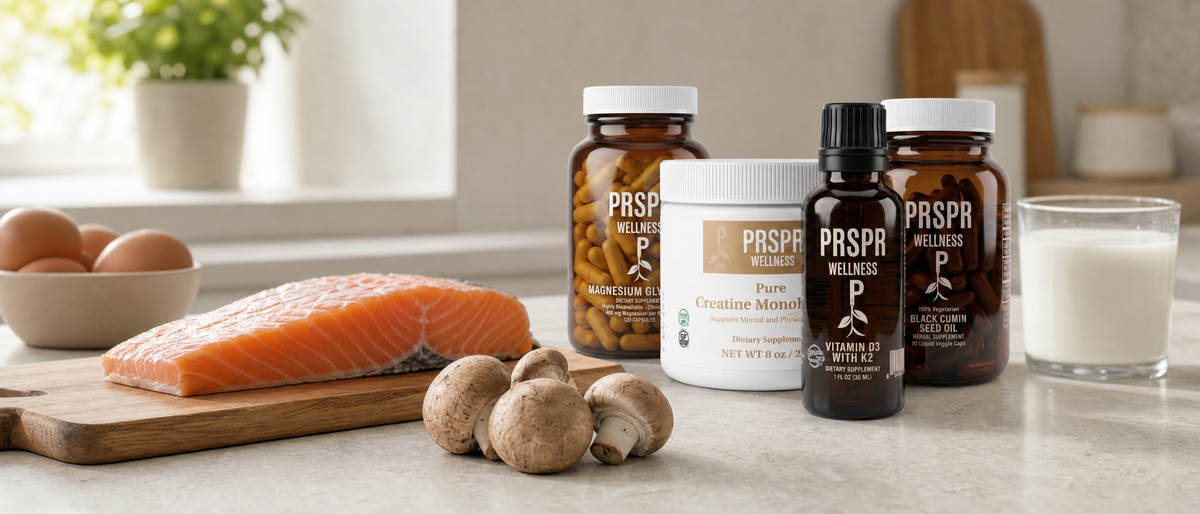
Foods with vitamin D are having a moment in search. "Good sources of vitamin d" is up +60% this week, and so, tellingly, is the single word "salmon," also up +60%. "Vitamin d foods list" is up +40%, and the plain question "what foods contain vitamin d" is up +40% too.
The steady searches are just as clear. "Vitamin d in foods" carries a volume score of 100, "foods with vitamin d" sits at 64, and "vitamin d rich foods" at 30. People are not asking what vitamin D is. They are asking where it is, and they want the list.
So here is the list, built the way a reference book would build it: from named food databases, with every number attributed. What we are not doing is telling you how much of any of it to eat. Questions about your own intake, your own levels or what any of it means for you are questions for a qualified healthcare professional, and we are not going to answer them here in either direction.
The honest answer starts with a short sentence. According to the NIH Office of Dietary Supplements (ODS), very few foods naturally contain vitamin D.
ODS names the ones that do. The flesh of fatty fish, such as trout, salmon, tuna and mackerel, along with fish liver oils, are described by ODS as among the best sources. Beef liver, egg yolks and cheese, ODS says, have small amounts. Mushrooms are the odd one out: ODS says they provide variable amounts, and that some mushrooms sold in stores have been treated with UV light to raise that amount.
That is close to the whole natural list. Fish, a few animal foods, and mushrooms. Everything else on a typical vitamin D foods list got there a different way, which we will come to.
ODS also points out two forms that show up in food. Beef liver, egg yolks and cheese carry vitamin D mainly as vitamin D3, while mushrooms carry vitamin D2. Keep those two labels in mind, because the database uses them too.
Names are useful. Numbers are better. The USDA's FoodData Central database reports vitamin D food by food. All of the figures below come from its SR Legacy records and are given per 100 grams of the food as described, so you can compare them side by side.
Salmon is the food the whole trend keeps circling back to, and the database explains why. USDA FoodData Central lists sockeye salmon, cooked with dry heat, at 16.7 micrograms (670 IU) of vitamin D per 100 grams, all of it recorded as vitamin D3. Canned sockeye, drained, is listed at 21.0 micrograms (841 IU) per 100 grams.
Those are the largest fish numbers in this piece, and it is easy to see why "salmon" climbs alongside every vitamin D search.
Fish is not one number. USDA FoodData Central lists Atlantic sardines canned in oil (drained solids) at 4.8 micrograms (193 IU) per 100 grams, and light tuna canned in water (drained) at 1.2 micrograms (47 IU) per 100 grams. Same broad category, very different entries, which is exactly why a list that just says "fish" leaves out the useful part.
USDA FoodData Central lists raw egg yolk at 5.4 micrograms (218 IU) per 100 grams, recorded as vitamin D3. The yolk is the part that carries it, which matches the ODS wording above. Braised beef liver is listed at 1.2 micrograms (49 IU) per 100 grams.
This is the most interesting pair in the database. USDA FoodData Central lists raw white mushrooms at 0.2 micrograms (7 IU) of vitamin D per 100 grams. It also lists raw white mushrooms exposed to ultraviolet light at 26.2 micrograms (1,050 IU) per 100 grams, all of it recorded as vitamin D2.
Same mushroom, same weight, two very different numbers. The difference is the UV step ODS describes. If you see mushrooms on a list of vitamin D rich foods, the useful question is which mushrooms, and the package is where you find out.
Look back over those entries and you will notice something. Most vitamin D in foods comes from a small club: a few kinds of fish, egg yolks, liver, and mushrooms that have seen UV light. Vegetables, grains and fruit are not on the ODS list at all.
That is not a gap in the database. It is the finding. ODS says it plainly: very few foods naturally contain vitamin D. A list of good sources of vitamin D is short because the natural list is short.
The sun is part of why vitamin D stands apart from most nutrients, and we covered that side of the story in our piece on why vitamin D is called the sunshine vitamin. This article stays on the plate.
If the natural list is that short, why do so many foods with vitamin D show up in the grocery store? One word: fortified.
The word is older than the practice. According to the Online Etymology Dictionary, "fortify" comes through Old French from Late Latin fortificare, built from the Latin fortis, "strong," and facere, "to make." It was used for building walls around towns in the mid-1400s, and the sense "add nutrients to food" dates from 1939.
That last sense is the one on the grocery shelf. A fortified food is one where a nutrient has been added by the maker. It is a statement about how the food was made, not about the food in its original form.
According to ODS, almost all of the U.S. milk supply is fortified with about 3 micrograms (120 IU) of vitamin D per cup. ODS adds that many plant-based alternatives, such as soy milk, almond milk and oat milk, are similarly fortified, while foods made from milk, like cheese and ice cream, usually are not.
ODS also says vitamin D is added to many breakfast cereals and to some brands of orange juice, yogurt, margarine and other products. The word "some" matters there. ODS advises checking the Nutrition Facts label for the amount of vitamin D in a food or beverage, because it varies.
The database shows the fortification step directly. USDA FoodData Central lists 2% milk with added vitamin A and vitamin D at 1.2 micrograms (49 IU) of vitamin D per 100 grams, and 2% milk without added vitamin A and vitamin D at 0.0 micrograms. Same milk. One entry has the vitamin D added, the other does not.
Here is where the trend meets the shelf. Every entry above was reported in two units: micrograms and IU. ODS gives the conversion as 1 microgram of vitamin D equals 40 IU, and you can check it against the database yourself: 16.7 micrograms times 40 is 668, which the salmon entry rounds to 670 IU. If that pair of units has ever confused you on a bottle, our piece on why vitamin D labels print the same number two ways walks through it.
The form words carry over too. The database records salmon and egg yolk as vitamin D3 and UV-exposed mushrooms as vitamin D2. Those are the same "D3" and "D2" you will see on supplement labels, and they mean the same thing in both places: they name which form of vitamin D is present.
So a food list and a label are really the same kind of document. Both tell you which form, and how much, in stated units. A food list does it per 100 grams of fish or egg. A supplement label does it per serving. Reading one well makes the other easier to read.
Format is a separate subject, and we gave it its own piece when we looked at children's vitamin D drops. Here the question is simply where vitamin D appears, on a plate or on a panel.
The most useful thing to know about foods with vitamin D is how short the natural list really is. Fatty fish like salmon, egg yolks, liver, some cheese and UV-treated mushrooms, according to ODS. After that, the list is mostly fortified foods, where the vitamin D was added by the maker.
We think the best habit is to read past the name: check the database entry, and on anything packaged, the Nutrition Facts label ODS points to. "Fish" on a list can mean 16.7 micrograms or 1.2, depending on the fish. "Mushrooms" can mean 0.2 or 26.2, depending on the light. "Milk" can mean 1.2 or zero, depending on the carton. The name of the food is the start of the answer. The label is the rest of it.
And when you see D3 or D2 on a bottle, you now know it is the same vocabulary the food database uses. Nothing more mysterious than that.
The Essentials Bundle is a set of four formulas. Under "What's Included," the listing names Magnesium Glycinate, Black Seed Oil, Vitamin D3 + K2 and Creatine Monohydrate. Vitamin D3 is the same form word the food database uses for salmon and egg yolk, sitting here on a supplement label instead of a food record.
What we will add in our own voice is how the bundle is made: manufactured in a GMP-certified facility and third-party batch tested, so what's on the label is what's in the bottle.
To see all four formulas and read each label for yourself, open the Essentials Bundle page, browse the vitamins and supplements collection, or take the build-your-stack quiz to see how it sits alongside everything else we carry.
Answer all five questions to unlock a clear wellness plan made around your goal, schedule, preferred supplement format, and biggest roadblock.
Get clarity on what matters most right now.
See the product and routine connected to your goal.
Simple next steps you can use right away.
Pick the one you would fix first if you could.
This helps us make the guide easier to follow.
Consistency beats the “perfect” routine you never follow.
Be honest. We’re building something you’ll actually use.
Your guide will include one simple way around it.
Answer two more questions to unlock your product starting point, five-step plan, two-week routine, and one practical tip for your biggest roadblock.
Enter your details to open your five-step plan.
Verified PRSPR customer reviews
Expires when you close this page
*Your personal credit for completing the quiz. It's applied automatically at checkout on one-time purchases and expires when the timer runs out.
View full product detailsEverything in your plan, together — one add to cart.
Expires when you close this page
*Your personal credit for completing the quiz. It's applied automatically at checkout on one-time purchases and expires when the timer runs out.
View full product details Mind vocabulary
What is cognition? You have probably seen the word "cognitive" printed on a label, in a headline, or in a product name, and kept scrolling. It is o...
 Biology vocabulary
What is metabolism? You see the word on labels, in gym talk and in nutrition headlines, almost always used as if it were a single setting. Read eno...
 Sleep vocabulary
What are sleep cycles? You hear the phrase on podcasts, see it on sleep trackers, and read it in articles that assume you already know what it mean...