
◎
Get clear
Get clarity on what matters most right now.

Vitamin d drops for kids is holding a volume score of 44 this week, sitting inside a much larger cluster: vitamins for kids and best vitamin d for kids are both maxed out, vitamin d supplement for kids is at 74, best kids vitamins at 38, best vitamins for kids at 26. And on the rising side, foods high in vitamin d is up 80 percent.
Two different instincts are visible in that data. One group is shopping. The other is trying to solve the same thing at the dinner table. Both are reasonable, and the second one is arguably the more important of the two.
This article is about a narrow, practical question inside all of that: why children's vitamin D is so often sold as a liquid in a dropper rather than as a chewable or a gummy, and where vitamin D turns up in food. It is a format and food article. It contains no dosing guidance and no advice about any child, and we will say clearly where those questions belong.
A dropper product is a liquid preparation in a small bottle with a graduated pipette or a built-in dispenser. You draw up a measured amount and deliver it, either directly or into something else.
The reason this format dominates the children's end of the vitamin D shelf comes down to three unglamorous practicalities.
The first is that no chewing is required. A liquid works for a child who has no teeth yet, is losing teeth, refuses to chew things, or is simply too young for anything that could be a choking hazard. That covers a wide age range and it is the single biggest reason the format exists.
The second is that it mixes. Drops can go into water, juice, milk or food, which routes around the entire negotiation that chewables and tablets can turn into. Parents of a determined four-year-old will recognise why that is worth something.
The third is measurement. A dropper measures in small graduated units, which lets a single bottle serve very different amounts precisely. A chewable is a fixed unit: you get one tablet's worth or two, with nothing in between.
Vitamin D also happens to be fat-soluble, which is a chemistry classification about how it dissolves, and it is why these preparations are typically made in an oil base rather than as a watery syrup. That is a formulation fact, and it explains the texture and the small volume.
There is a trade-off attached to all three of those advantages, and it is worth naming. A dropper has to be measured every single time, which is one more step than handing over a chewable, and it is a step that can be done carelessly. A fixed-dose format removes that possibility. So the format that gives you precision also asks for a little attention, and which of those you want depends on your household more than on the product.
Foods high in vitamin d is the fastest-rising search here, and it is worth taking seriously because the food route is where most nutrition actually comes from.
Vitamin D is unusual among vitamins in that relatively few foods carry meaningful amounts of it naturally. The natural sources that come up consistently are oily fish, egg yolks, and some mushrooms, particularly those exposed to ultraviolet light. Beyond that, a large share of dietary vitamin D in many countries comes from fortification rather than from the food itself: it is added to products like milk, some plant milks, certain breakfast cereals, and some spreads, which is a public health measure rather than a property of those foods.
The other well-known route is sunlight, where the body synthesises vitamin D in skin exposed to ultraviolet B. How much that contributes varies enormously with latitude, season, time of day, skin tone, clothing and sun protection, which is why it is not something anyone can give you a simple number for.
What none of that adds up to is a plan. How much vitamin D a particular child needs, whether they are getting it, and whether a supplement belongs in the picture are questions that depend on the child, their diet, where you live and their medical history. That is a conversation for a paediatrician. We are not going to guess at it, and you should be suspicious of any product page that does.
Here is the bridge. Most of the search volume in this cluster is spent on best. Best vitamin d for kids, best kids vitamins, best vitamins for kids. Those searches are asking for a ranking, and a ranking is the one thing that cannot be answered generically, because the right product for a specific child depends on facts about that child that no article has.
Format, by contrast, is a question you can genuinely answer for yourself, standing in a shop, in about ten seconds. Will this child swallow a tablet. Will they chew something. Will they drink something with a few drops in it. Does the thing need to travel in a bag. Those answers are known to you and to nobody else, and they eliminate most of a shelf immediately.
So our suggestion is to invert the usual order. Settle the format first, because that is the part you have the information for. Then take the shortlist and the actual dosing question to your paediatrician, who has the part you do not.
It is also worth separating two searches that look alike. Vitamins for kids is a category search covering the whole multivitamin shelf, while vitamin d supplement for kids and vitamin d drops for kids are single-nutrient searches. Those lead to genuinely different products: a broad multi versus one nutrient on its own. Knowing which of the two you are actually shopping for saves a lot of time, and the answer usually comes from whatever your paediatrician suggested rather than from the shelf.
The children's supplement aisle is louder than it needs to be, and a lot of that noise is aimed at parents rather than at the practical problem. What most parents want is something a child will actually take, from a company that says plainly what is in the bottle, with the amount decided by someone who has met their child.
A dropper is not a clever innovation. It is a measuring device that solves the chewing problem, and that is enough. We would rather explain what it does than dress it up.
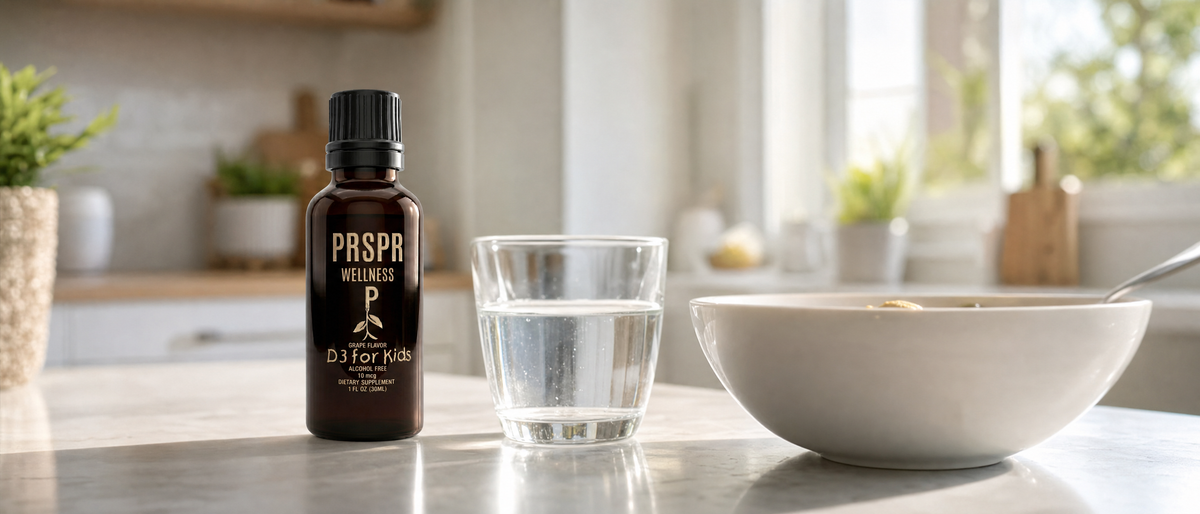
Our Children's Liquid Vitamin D3 is a liquid vitamin D3 for kids in a natural grape flavour, in the dropper format this article has been describing. It is manufactured in a GMP-certified facility and third-party batch tested, so what is on the label is what is in the bottle. Clear amounts, no guesswork, and the amount your child should have is a conversation with their paediatrician rather than with us.
The listing is on the Children's Liquid Vitamin D3 page, and the rest of that shelf is on our women's and children's health page. If you want the adult version of the vitamin D labelling conversation, including what those letters and units mean, that piece is here. And if you are working out what belongs in a household routine, take the quiz.
Answer all five questions to unlock a clear wellness plan made around your goal, schedule, preferred supplement format, and biggest roadblock.
Get clarity on what matters most right now.
See the product and routine connected to your goal.
Simple next steps you can use right away.
Pick the one you would fix first if you could.
This helps us make the guide easier to follow.
Consistency beats the “perfect” routine you never follow.
Be honest. We’re building something you’ll actually use.
Your guide will include one simple way around it.
Answer two more questions to unlock your product starting point, five-step plan, two-week routine, and one practical tip for your biggest roadblock.
Enter your details to open your five-step plan.
Verified PRSPR customer reviews
Expires when you close this page
*Your personal credit for completing the quiz. It's applied automatically at checkout on one-time purchases and expires when the timer runs out.
View full product detailsEverything in your plan, together — one add to cart.
Expires when you close this page
*Your personal credit for completing the quiz. It's applied automatically at checkout on one-time purchases and expires when the timer runs out.
View full product details Electrolytes
Salt is having a comparison week. Searches for celtic sea salt vs himalayan pink salt are up about 70 percent, pink himalayan salt vs table salt is...
 Kids
KidsPick up a box of children's snacks and somewhere on the front there is a number with the letter g after it, next to the word fiber. It looks like o...
 Label Reading
It is printed on the front of a lot of mineral bottles and it is one of the least understood words in the supplement business. Chelated. Search int...