
◎
Get clear
Get clarity on what matters most right now.

Fiber foods for kids is holding a maximum volume score of 100 this week. Fiber foods sits at 92, high fiber foods for kids at 49, fiber food for kids at 44, fiber snacks for kids at 35. Rising alongside them, foods high in fiber is up about 40 percent.
Look at what is not there. Every one of the biggest terms in this cluster is about food. Not products, not supplements, not brands. Groceries. When parents go looking for fiber, they overwhelmingly go looking for it in the kitchen first, and the search data is unambiguous about it.
So this is a food article. What fiber is as a component of plant food, which everyday foods are the ones that carry a lot of it, and why the question is asked about children specifically. It is general nutrition education and nothing more. It is not about any child in particular, it names no condition, and any question about a specific child belongs with a paediatric professional who knows them.
Dietary fiber is not a single substance. It is a category term for the parts of plant food that pass through the human digestive system without being broken down and absorbed the way starch, sugar, protein and fat are.
Most of it is structural. Plants build cell walls out of carbohydrate polymers, and those polymers are what give a plant its rigidity: the reason celery snaps, the reason a bean has a skin, the reason wheat bran is papery. Cellulose is the most abundant of them. Alongside it sit hemicelluloses, pectins, gums and, in woodier tissue, lignin, which is not a carbohydrate at all. What unites them is not chemistry, it is behaviour. They are plant material that human digestive enzymes cannot dismantle.
Two consequences follow, and they explain nearly everything about where fiber shows up.
The first is that fiber is a plant thing exclusively. Meat, fish, eggs, milk and cheese contain none, because animals do not build cell walls out of carbohydrate. That single fact tells you more about which foods are high in fiber than any list can.
The second is that processing removes it. Fiber lives in structure, and most food processing is structural: milling, refining, peeling, juicing, straining. Take the bran and germ off a wheat grain and you have removed most of its fiber. Peel a potato and you have removed a share of it. Juice a fruit and you have removed almost all of it, leaving the sugar and water behind. This is the reason whole keeps appearing on packaging, and it is a genuinely informative word rather than a decorative one.
You can work most of this out from the two rules above without memorising anything.
Legumes are the densest common source. Beans, lentils, chickpeas and split peas are, in fiber terms, in a class of their own among everyday foods. If a single food group deserves to be named first in an article called which foods are actually the high-fiber ones, it is this one.
Whole grains come next, and the word whole is load-bearing. Oats, brown rice, wholemeal bread and flour, barley, popcorn. The intact grain keeps the bran; the refined version does not, which is why white bread and white rice sit far down the list while their whole counterparts sit near the top.
Fruit with edible skins and seeds is the third group. Berries are unusually high because a raspberry or a blackberry is largely seed and skin by structure. Apples and pears with the skin on, figs, and dried fruit generally carry a good deal. Fruit juice carries almost none, for the reason given above.
Vegetables vary, and the pattern follows structure again. The fibrous ones are the ones with obvious structure to them: broccoli and its stalks, carrots, peas, sweetcorn, artichokes, the skins on potatoes.
Nuts and seeds are the fourth, and they are dense in fiber the way they are dense in most things, because a seed is a tightly packed storage organ.
Notice what that list is. It is not a list of health foods or specialist items. It is beans, oats, berries, apples, popcorn, peas and nuts. The high-fiber foods are, almost without exception, ordinary foods in their less-processed form, which is why fiber foods for kids returns recipes and shopping suggestions rather than a shelf of products.
Fiber foods and fiber foods for kids are both near the top of this cluster, and the child-specific version is worth understanding on its own terms.
Part of it is practical. The foods listed above are, in aggregate, the foods children are most likely to push away. Legumes, whole grains, vegetables and fruit skins are not the easy end of a child's plate. A parent who has read a general list is immediately confronted with the question of how any of it gets eaten, which is a different question from what the list is.
Part of it is that children's food is more processed on average. The categories marketed specifically to children skew heavily toward refined grain, and refining is the step that takes fiber out. So a diet assembled from children's products will tend to land lower than the same household's adult food, without anyone deciding that.
And part of it is that parents are reading labels rather than foods, which is where fiber snacks for kids at 35 comes from. That is a label question rather than a grocery question, and it has its own set of traps around what the printed number counts and how serving sizes are declared. We wrote that one up separately in the fiber number on a snack label, explained, and this article deliberately stays on the food side of that line.
What we will not do is offer a target, a threshold or a recommendation for any child. Amounts for children vary with age and with the individual, and that is a conversation for a paediatric professional who knows the family. This article is about what the foods are, and it stops there.
We think it is genuinely encouraging that this search cluster is about food.
A category that could easily have become a product search has stayed a grocery search. Parents typing fiber foods for kids and high fiber foods for kids are asking a food-literacy question, and food literacy is the thing that keeps working long after any particular purchase is forgotten. Knowing that fiber lives in plant structure, and that processing removes structure, is a piece of knowledge that reorganises an entire supermarket for you. Nothing on a shelf does that.
The honest thing for a supplement company to say here is that the kitchen is the first place to look and the aisle is not a substitute for it. So that is what we are saying. Beans, oats, berries and the skins you were about to peel off. That is the answer to the search, and it does not require anything from us.
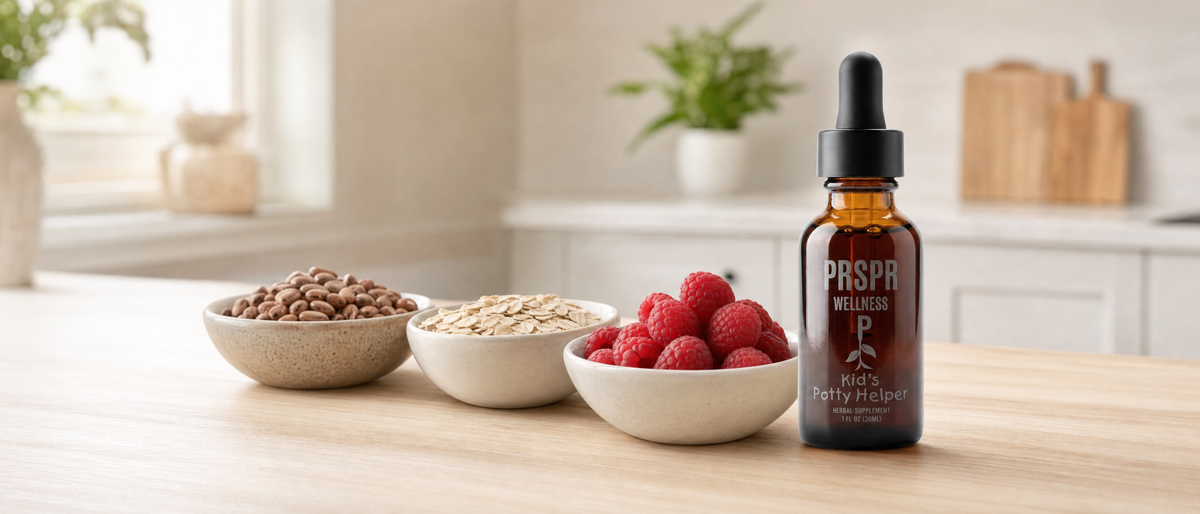
Our Kids Potty Helper is a dietary supplement made with a blend of plant-based ingredients, designed for children as part of a balanced daily routine. That is what the live listing says, word for word, and it is the whole of what we are going to say about it here. Nothing in the food discussion above is a statement about this product.
What we will add in our own voice is the quality story alone. It is made in a GMP-certified facility and third-party batch tested, so what is printed on the panel is what is in the bottle. No guessing, no filler.
If you would rather keep reading about food and labels, the piece on the fiber number is the direct sequel to this one. Otherwise open the Kids Potty Helper page and read the panel and directions in full, browse the rest of the women's and children's health collection, or take the build-your-stack quiz.
Answer all five questions to unlock a clear wellness plan made around your goal, schedule, preferred supplement format, and biggest roadblock.
Get clarity on what matters most right now.
See the product and routine connected to your goal.
Simple next steps you can use right away.
Pick the one you would fix first if you could.
This helps us make the guide easier to follow.
Consistency beats the “perfect” routine you never follow.
Be honest. We’re building something you’ll actually use.
Your guide will include one simple way around it.
Answer two more questions to unlock your product starting point, five-step plan, two-week routine, and one practical tip for your biggest roadblock.
Enter your details to open your five-step plan.
Verified PRSPR customer reviews
Expires when you close this page
*Your personal credit for completing the quiz. It's applied automatically at checkout on one-time purchases and expires when the timer runs out.
View full product detailsEverything in your plan, together — one add to cart.
Expires when you close this page
*Your personal credit for completing the quiz. It's applied automatically at checkout on one-time purchases and expires when the timer runs out.
View full product details Mind vocabulary
What is cognition? You have probably seen the word "cognitive" printed on a label, in a headline, or in a product name, and kept scrolling. It is o...
 Biology vocabulary
What is metabolism? You see the word on labels, in gym talk and in nutrition headlines, almost always used as if it were a single setting. Read eno...
 Sleep vocabulary
What are sleep cycles? You hear the phrase on podcasts, see it on sleep trackers, and read it in articles that assume you already know what it mean...