
◎
Get clear
Get clarity on what matters most right now.

Loading phase of creatine is maxed out at a relative interest score of 100 this week. Loading phase for creatine sits right behind it at 93, what is creatine loading at 58, creatine loading dose at 35, loading phase creatine monohydrate at 31, and what is a loading phase for creatine at 13. Rising fastest on the seed, up about 80 percent, is best time to take creatine.
Six of those seven terms are about one phrase. That is an unusually concentrated cluster, and it is a phrase that did not exist in general conversation twenty years ago. It came out of sports science, escaped into gym vocabulary, and has now arrived in general search where it lands in front of people who have never seen it before and cannot tell whether it is a technical term or a marketing one.
This article is about where the phrase came from and what it names. It does not tell you a dose, a schedule or a protocol to follow, and it does not tell you when to take anything. Creatine loading dose and best time to take creatine are both instructions for a person, and instructions for a person come from a qualified healthcare professional who knows that person, not from a supplement blog.
Loading is a borrowed word, and it was borrowed from a specific place.
In pharmacology there is a long-established concept called a loading dose. The idea is straightforward: when a substance accumulates in the body over time toward a steady level, you can reach that level faster by giving a larger amount at the start and then a smaller amount to hold it there. The larger initial amount is the loading dose, the smaller ongoing one is the maintenance dose. This is standard clinical vocabulary and it long predates any supplement.
Creatine research in the early 1990s adopted the framework directly, because the underlying situation matched. That literature described protocols with a short higher-intake period followed by a lower ongoing one, and the phrase loading phase came with the framework.
From there it moved outward the way technical vocabulary does. Research papers, then coaching and training publications, then gym conversation, then product packaging, then general search. By the time it reaches a first-time buyer it has been through four translations and arrives with no citation attached.
Since what is creatine loading is one of the bigger searches here, here is what the term denotes, described as a structure rather than as an instruction.
A loading protocol has two parts. There is an initial period, described in the literature as short, during which intake is higher. Then there is an ongoing period, described as continuing, during which intake is lower. The purpose of the two-part shape is to reach a target level sooner than the lower amount alone would.
The literature also describes the alternative, which is simply not doing the first part: taking the lower ongoing amount from the start and reaching the same target more slowly. Both approaches appear in the research and both have been studied.
We are describing the shape of these protocols and attributing them to the research literature they come from. We are not printing numbers and we are not recommending either approach, because which one is appropriate for any individual, if either is, is a question for a professional. If you want the figures, they belong in the source material and in a conversation with someone qualified to interpret them for you, not in brand copy.
Here is the practical part, and it is the reason these searches cluster around purchase.
Any two-part protocol changes how much product a container represents. If a period of higher intake exists at the start, the arithmetic of how long a tub lasts is different in the first weeks than afterward. Somebody who has read about loading and is looking at a 16 ounce tub is trying to do that sum, and the phrase and the pack size arrive in the same browser session because they are parts of the same calculation.
That is also why loading phase creatine monohydrate exists as a term at 31. It pins the protocol vocabulary to a specific form of the ingredient, which is what a shopper does when they are trying to check that what they read applies to what is in front of them.
The genuinely useful skill here has nothing to do with creatine. It is knowing how to convert a container into servings. Total mass divided by serving size gives servings per container, and servings per container divided by servings per day gives days. That arithmetic works on any product in any category, and it is the thing that makes a pack size mean something. We ran it in detail in how to read a creatine label.
There is a general habit worth taking from this, because loading phase is not the last escaped technical term you will meet.
When a phrase arrives without a source, three questions sort it out quickly. First, is it a technical term or a marketing one? Technical terms have a field they came from and you can usually find it in a sentence or two. Marketing terms do not, and the trail goes cold at a product page. Second, what does it actually name? A protocol, a substance, a process, a result? These are different kinds of things and the answer changes what to do with it. Third, who is the phrase addressed to? Research vocabulary is written for researchers, and its precision does not survive translation into general advice.
Loading phase passes the first test cleanly. It is a real technical term with a documented origin in pharmacology and a documented adoption in creatine research. It names a protocol shape. And it was written for a research audience, which is exactly why it should not be lifted out of that context and applied to yourself on the strength of a search result.
We are glad this phrase is being looked up rather than simply followed, and that is not a throwaway line.
The searches here are dominated by what-is questions. What is creatine loading. What is a loading phase for creatine. That is people encountering a term and stopping to find out what it means before doing anything about it, which is the correct order and not the usual one. The alternative, which was the norm for a long time, was people copying a protocol from a forum post with no idea where the numbers originated.
Our view on the protocol itself is that it is not ours to have. It is a question about your body, your training, your history and your circumstances, and the people qualified to answer it can see all four of those. What we can offer is the origin of the phrase, an honest description of what it names, and the arithmetic for working out what a container holds. Everything past that line belongs to someone with your file in front of them. The other creatine question dominating search right now is about coffee, and we took that one apart in the hot coffee piece.
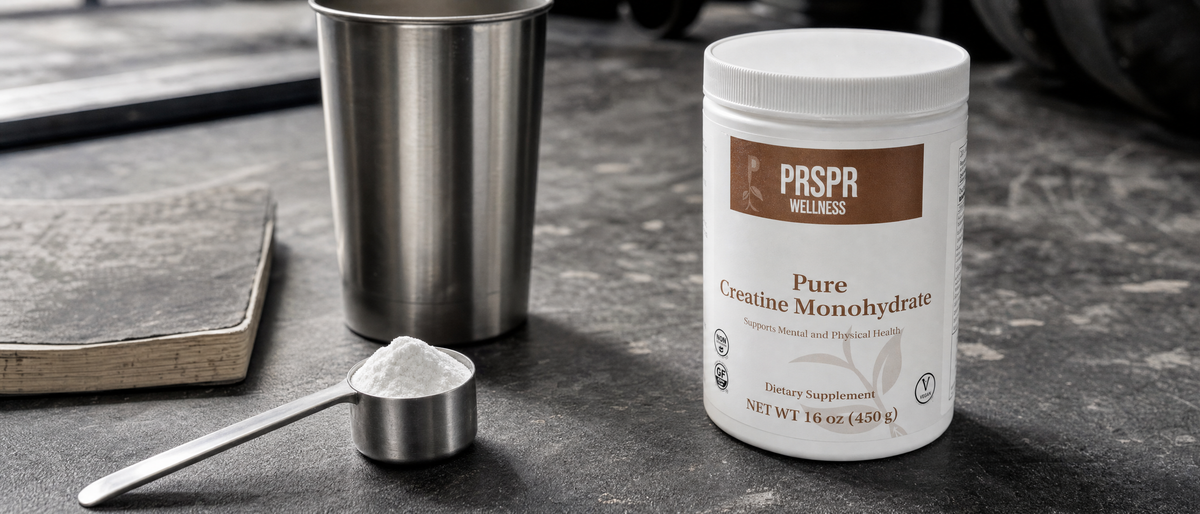
Our Pure Creatine Monohydrate 16oz is a single-ingredient powder: creatine monohydrate, in a 16 ounce tub, which is about 450 grams. One ingredient, one number on the front, and a panel that tells you the serving size so you can do the division yourself.
We print it that way deliberately. A single-ingredient product has nothing to hide behind, and a total mass on the front plus a serving size in the panel is everything you need to work out how long it lasts under whatever approach a professional has agreed with you.
The only thing we add in our own voice is manufacturing. GMP-certified facility, third-party batch tested, so the tub and the panel agree. No guessing, no filler.
If the arithmetic was the useful part, go and run it. The Pure Creatine Monohydrate page has the numbers, the muscle and joint collection has the rest of the shelf, and the build-your-stack quiz is there if you would rather start somewhere else entirely.
What is creatine loading?
A term borrowed from pharmacology, where a loading dose is a larger initial amount used to reach a target level faster, followed by a smaller maintenance amount. Creatine research of the early 1990s adopted the framework and the name came with it.
What is a loading phase for creatine?
The first of the two parts described above: a short initial period of higher intake, preceding a longer period of lower ongoing intake. We describe the shape and attribute it to the research literature. Whether any protocol is appropriate for you is a question for a qualified healthcare professional.
Answer all five questions to unlock a clear wellness plan made around your goal, schedule, preferred supplement format, and biggest roadblock.
Get clarity on what matters most right now.
See the product and routine connected to your goal.
Simple next steps you can use right away.
Pick the one you would fix first if you could.
This helps us make the guide easier to follow.
Consistency beats the “perfect” routine you never follow.
Be honest. We’re building something you’ll actually use.
Your guide will include one simple way around it.
Answer two more questions to unlock your product starting point, five-step plan, two-week routine, and one practical tip for your biggest roadblock.
Enter your details to open your five-step plan.
Verified PRSPR customer reviews
Expires when you close this page
*Your personal credit for completing the quiz. It's applied automatically at checkout on one-time purchases and expires when the timer runs out.
View full product detailsEverything in your plan, together — one add to cart.
Expires when you close this page
*Your personal credit for completing the quiz. It's applied automatically at checkout on one-time purchases and expires when the timer runs out.
View full product details Mind vocabulary
What is cognition? You have probably seen the word "cognitive" printed on a label, in a headline, or in a product name, and kept scrolling. It is o...
 Biology vocabulary
What is metabolism? You see the word on labels, in gym talk and in nutrition headlines, almost always used as if it were a single setting. Read eno...
 Sleep vocabulary
What are sleep cycles? You hear the phrase on podcasts, see it on sleep trackers, and read it in articles that assume you already know what it mean...