
◎
Get clear
Get clarity on what matters most right now.

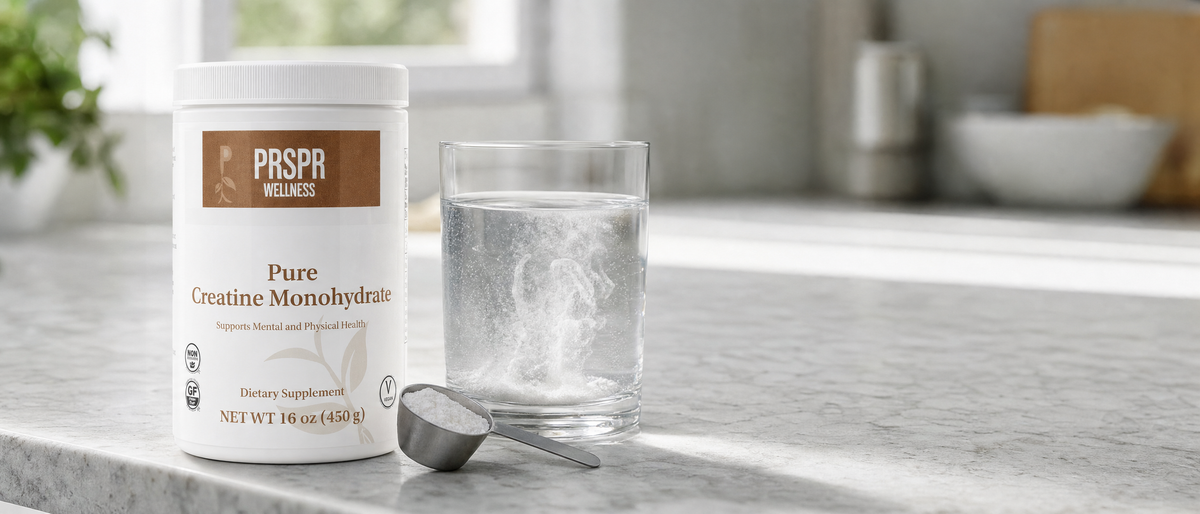
Of all the things people are asking about creatine right now, the one climbing fastest is not about muscle, dosage or timing. It is about breakfast.
"Can i put creatine in hot coffee" is a breakout search term, which means interest in it has risen faster than the tools can usefully put a number on. It sits above every other rising query in this category. Underneath it the familiar shelf language continues: "creatine monohydrate" at 100 on the relative interest scale, "creatine monohydrate powder" at 100, "creatine monohydrate bulk" at 98, "micronized creatine monohydrate" and "micronized creatine" both at 58, "best creatine powder" at 46, and the pack size "creatine monohydrate 500g" climbing about 120 percent.
The coffee question is the interesting one, because it is not really a question about coffee. It is a question about how a powder behaves in liquid, and almost nobody has been told how that works. So that is what this piece covers: the physical behaviour of the stuff in the tub. What it will not tell you is whether any of this changes what creatine does inside a body, because that is a claim, and claims are not ours to make.
Strip the question down and there are three separate things bundled inside it, which is why it is hard to answer in one line.
The first is about dissolving. Creatine monohydrate is only modestly soluble in water, and like most solids its solubility rises as temperature rises. That is the plain physical answer to the surface question: warm liquid takes up more of it than cold liquid does, and stirring it into something hot will generally look tidier in the cup than stirring it into something cold.
The second is about what people are actually seeing when they ask. Most of the frustration behind this query is not chemistry, it is grit. Powder that sits at the bottom of a glass, or a sandy layer left in the last mouthful, is what sends people searching. That is a dispersion and settling problem rather than a solubility one, and it depends on particle size, how vigorously the liquid was moved, and how long the cup sat before it was finished.
The third thing hidden in the question is a worry people rarely type out, which is whether heat ruins it. That is the part we are not going to answer. It is a question about whether the product still does what it is meant to do, which is exactly the territory we stay out of. It is a reasonable thing to want to know, and a qualified healthcare professional or the manufacturer's own technical information is the right place for it, not a brand's blog post.
Here is a thing that answers a lot of format questions at once: supplements of this kind are sold as dry powder rather than as a ready-made drink for reasons that are mostly about the container, not the contents.
A dry powder is stable on a shelf, cheap to ship because you are not paying to move water, and leaves the serving size in the buyer's hands. A pre-mixed liquid has to solve storage, preservation and packaging problems that a tub simply does not have. That is why the default form in this category is a scoop and a tub, and it is also why the "how do I get it into a drink" question exists at all. The format hands you a step that a bottled drink would have done for you.
This is where "micronized" earns a mention, because it is the word most directly aimed at that step. Micronized means the material has been milled to a smaller particle size. Nothing is added and nothing is chemically changed. Finer particles have more surface area for their volume and stay suspended in a liquid longer before settling, which is precisely the grit complaint above. It is a texture and mixing descriptor, and it is worth reading as one rather than as a quality ranking, not least because the word is not standardised and two products carrying it can be ground quite differently.
The practical version, then, is unremarkable. Liquid that is moving takes powder better than liquid that is still. Finer grinds settle more slowly than coarse ones. A cup that sits for twenty minutes will have more at the bottom than one that does not. None of that is exotic, and all of it is the actual content of a search that gets asked thousands of times a week.
One more practical note, since the search list is full of the word "bulk." Buying a larger tub changes nothing about the powder itself; it changes how long you are committed to it and how long it sits open. A powder that is opened and closed daily for six months lives a different life from one finished in six weeks, and storage matters more for the larger tub. Keep the lid closed, keep the scoop dry, and keep it away from the steam of a kettle, because moisture is what turns a free-flowing powder into a solid block.
The coffee question is our favourite kind of search, because it is somebody being practical and getting no help.
Nearly everything written about creatine is about outcomes. Almost nothing is about the twenty seconds in the kitchen where a person is actually holding the tub, and that is the moment where routines are won or lost. Somebody who cannot get a powder into a drink pleasantly will stop using it, and no amount of information about what it might do will rescue that.
What frustrates us is that the answer here is genuinely simple and genuinely non-controversial. Dissolving is temperature-dependent. Settling is particle-dependent. Movement helps. Those three sentences would resolve most of the search volume behind this query, and they are almost impossible to find because everybody writing about the ingredient is competing on claims instead.
So: put it in whatever you will actually drink, stir it properly, and finish it while it is moving rather than letting it stand. That is a texture recommendation and nothing more. The questions about whether and how much belong with a professional.
Our Pure Creatine Monohydrate is a single-ingredient supplement made with creatine monohydrate, and the tub carries its net weight printed on the front as 16 oz (450 g). Single-ingredient products are the easiest thing in this industry to verify and the hardest to hide anything in, which is a large part of why we like them.
Everything we make is manufactured in a GMP-certified facility and third-party batch tested. What is on the label is what is in the tub. No guessing, no filler, no cutting corners. On a product with exactly one ingredient, that verification is essentially the whole proposition, because there is nothing else to talk about.
If you want the search-trend side of this ingredient rather than the kitchen side, we covered what people are really asking about creatine. If you are comparing tubs against capsule bottles, the number to work out is servings rather than price, which means dividing the net weight by the weight of one scoop before you compare anything. Our wellness quiz takes a couple of minutes, and the tub sits with the rest of our vitamins and supplements.
Answer all five questions to unlock a clear wellness plan made around your goal, schedule, preferred supplement format, and biggest roadblock.
Get clarity on what matters most right now.
See the product and routine connected to your goal.
Simple next steps you can use right away.
Pick the one you would fix first if you could.
This helps us make the guide easier to follow.
Consistency beats the “perfect” routine you never follow.
Be honest. We’re building something you’ll actually use.
Your guide will include one simple way around it.
Answer two more questions to unlock your product starting point, five-step plan, two-week routine, and one practical tip for your biggest roadblock.
Enter your details to open your five-step plan.
Verified PRSPR customer reviews
Expires when you close this page
*Your personal credit for completing the quiz. It's applied automatically at checkout on one-time purchases and expires when the timer runs out.
View full product detailsEverything in your plan, together — one add to cart.
Expires when you close this page
*Your personal credit for completing the quiz. It's applied automatically at checkout on one-time purchases and expires when the timer runs out.
View full product details Electrolytes
Salt is having a comparison week. Searches for celtic sea salt vs himalayan pink salt are up about 70 percent, pink himalayan salt vs table salt is...
 Kids
KidsPick up a box of children's snacks and somewhere on the front there is a number with the letter g after it, next to the word fiber. It looks like o...
 Label Reading
It is printed on the front of a lot of mineral bottles and it is one of the least understood words in the supplement business. Chelated. Search int...