
◎
Get clear
Get clarity on what matters most right now.

Can i take magnesium and vitamin d together is holding a volume score of 51 this week, sitting just under vitamin d supplement at 100. Further along the same shelf, beet root powder benefits is also maxed out at 100, with what does beet root powder do at 13, what is beet root powder good for at 9, and how much beet root powder per day at 9.
Read those together and a pattern shows up. Almost nobody is searching for a stack. They are searching for one bottle at a time, and then, separately, for permission to put the bottles in the same morning.
That last question is a real one and we are not going to answer it. Whether any two supplements belong in your routine at the same time depends on your health, your prescriptions and your clinician, and the only sensible place to take it is a qualified healthcare professional. What we can do is explain the thing behind the question that nobody explains: why a daily stack arrives as three separate bottles instead of one tidy pill, and what a label direction is actually able to settle.
A stack is a purchasing convention, not a formulation. Three finished products are boxed together because a shopper wants all three, not because they were designed as one thing. Each bottle keeps its own label, its own directions, and its own supplement facts panel. Nothing about being sold together changes what is inside any of them.
That sounds obvious until you compare it with the alternative. A single combined pill is a formulation. Somebody chose the amount of every ingredient in it, and that decision is fixed for everyone who buys it. Once ingredients share a tablet they cannot be separated, reduced, skipped for a week, or replaced with a different brand of one component.
There is also a plain physical constraint that the supplement aisle rarely says out loud. Ingredients occupy volume. Minerals in particular are heavy and bulky in the amounts commonly used, which is why magnesium products are so often large capsules or a powder rather than something small. A fat-soluble vitamin measured in micrograms takes almost no room at all. Put a mineral, a fat-soluble vitamin and a plant powder in one dose and you get either a very large object or very small amounts of each. Separate bottles are the way around that trade-off.
Every one of these products carries its own directions, and directions are written for one product at a time. A direction can tell you a serving size, how many capsules make that serving, how often the maker intends it to be taken, and whether the maker suggests food or water alongside it. That is a genuinely useful set of instructions and it is worth reading before anything else.
Here is the limit. A direction printed on one bottle cannot know what else is in your cabinet. It is not written with your other two bottles in front of it, let alone a prescription. So the label answers the question it was written for, which is how to take this product, and it does not answer the question people are typing, which is how to take this product alongside something else. That gap is exactly where can i take magnesium and vitamin d together comes from, and it is why the search volume sits there year after year without a label ever resolving it.
Notice how the beet searches behave differently. What does beet root powder do, what is beet root powder good for and how much beet root powder per day are all single-product questions, and two of the three are outcome questions rather than instructions. Beet root powder benefits, at a full score of 100, is the largest term in that group and the least answerable one on a product blog. We have written before about the difference between reading an ingredient and reading a category, and the same split applies here.
The useful way to think about a stack is that it keeps the editing rights with you.
Because each product is intact, you can start one and not the others. You can stop one without losing the rest. You can finish one bottle faster and reorder it on its own, which matters because a powder, a capsule and a softgel almost never run out on the same day. You can take one at a different time from the others if your clinician tells you to. None of that is possible once the same ingredients are pressed into one tablet.
The cost of that flexibility is that you have to read three panels instead of one, and you have to make the timing decision yourself rather than having it made for you. That is a fair trade and it is worth understanding before you buy, rather than discovering it when three bottles arrive and you are looking at three different sets of directions.
It also explains why the beet component here is a capsule rather than the powder that dominates search. Powder is the format most people picture, because that is how the category is usually sold. A capsule is a measured version of the same idea, and it fits a multi-bottle routine in a way a scoop and a shaker do not. We looked at that specific trade-off in powder against capsules for beet root.
We think the bottle count is the most misread thing in this whole category. People see three containers and assume it is upselling. It is closer to the opposite. Three containers is the format that refuses to make decisions on your behalf.
The honest position is that we would rather you understood what you were holding than that you bought quickly. A stack is three products, three panels and three sets of directions, and it is meant to be read that way. If that sounds like more work than a single pill, it is. It is also the version you can adjust for the rest of your life instead of the version that was fixed for you in a factory.
And the timing question stays where it belongs. Ask a professional who knows your situation. That is not us being cautious for the sake of it. It is that the correct answer genuinely depends on facts about you that no label and no article can see.
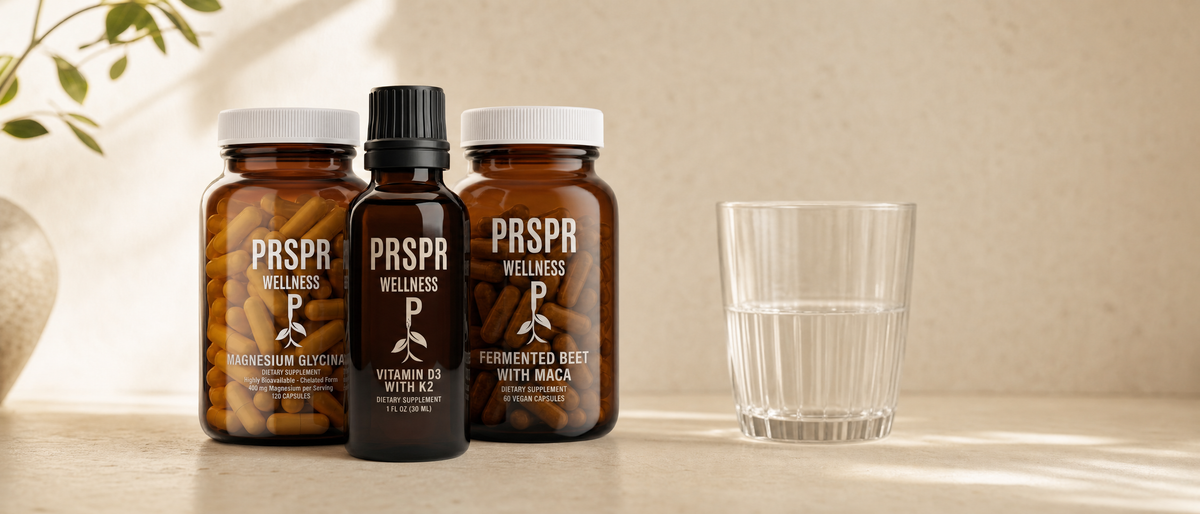
Our Wellness Foundation Stack is three products sold together: Fermented Beet Root and Maca, Magnesium Glycinate, and Vitamin D3 + K2. Each arrives as its own bottle with its own panel and its own directions, which is the whole point of the format described above. Those are composition facts, taken from the live listings as they read today.
What we will add in our own voice is the quality story, and only that. Every one of these is made in a GMP-certified facility and third-party batch tested, so what is printed on each panel is what is in each bottle. No guessing, no filler.
If you want to see how the three read side by side, open the Wellness Foundation Stack page and look at each panel in turn, or work through the rest of the bundles collection the same way. If you would rather start from a routine than from a panel, the build-your-stack quiz is the other door into the same catalogue. And a related read, if the composition of the D3 and K2 bottle is what you actually came for, is our piece on what D3 plus K2 names part by part.
Can I take magnesium and vitamin d together?
This is the most-asked version of the stack question and it is a question for a qualified healthcare professional who knows your medications and your history. What we can say is that no single product label is written to answer it, because each label describes one product on its own.
What does beet root powder do, and what is beet root powder good for?
Both are outcome questions about a body rather than questions about a product, so they go to a clinician or a medical reference rather than to us. What we can describe is what the ingredient is and what format it arrives in.
How much beet root powder per day?
An amount question, which is settled by the directions on the specific product you are holding and by the professional advising you, not by a general figure quoted on a blog.
Answer all five questions to unlock a clear wellness plan made around your goal, schedule, preferred supplement format, and biggest roadblock.
Get clarity on what matters most right now.
See the product and routine connected to your goal.
Simple next steps you can use right away.
Pick the one you would fix first if you could.
This helps us make the guide easier to follow.
Consistency beats the “perfect” routine you never follow.
Be honest. We’re building something you’ll actually use.
Your guide will include one simple way around it.
Answer two more questions to unlock your product starting point, five-step plan, two-week routine, and one practical tip for your biggest roadblock.
Enter your details to open your five-step plan.
Verified PRSPR customer reviews
Expires when you close this page
*Your personal credit for completing the quiz. It's applied automatically at checkout on one-time purchases and expires when the timer runs out.
View full product detailsEverything in your plan, together — one add to cart.
Expires when you close this page
*Your personal credit for completing the quiz. It's applied automatically at checkout on one-time purchases and expires when the timer runs out.
View full product details Mind vocabulary
What is cognition? You have probably seen the word "cognitive" printed on a label, in a headline, or in a product name, and kept scrolling. It is o...
 Biology vocabulary
What is metabolism? You see the word on labels, in gym talk and in nutrition headlines, almost always used as if it were a single setting. Read eno...
 Sleep vocabulary
What are sleep cycles? You hear the phrase on podcasts, see it on sleep trackers, and read it in articles that assume you already know what it mean...