
◎
Get clear
Get clarity on what matters most right now.

There is one word that decides how black seed oil products get compared to each other, and most shoppers have never heard it. Thymoquinone black seed is maxed out at a relative interest score of 100. Black seed oil thymoquinone sits at 89, thymoquinone benefits at 44, what is thymoquinone at 36, and best black seed oil with highest thymoquinone at 9. Rising on the same seed, thymoquinone supplement is up about 50 percent and thymoquinone health benefits is up about 50.
Look at that last volume term again. Best black seed oil with highest thymoquinone. It is small, but it is the most revealing search in the set, because it shows a shopper who has learned that the way to compare two bottles of this oil is to compare one number on the panel.
This article explains that number. What a marker compound is, why an industry standardizes to one, and what a percentage on a front label is actually a claim about. It says nothing about what thymoquinone does. The benefit-shaped searches here are named as searches, and questions about effect belong with a qualified healthcare professional.
Thymoquinone is a chemical compound found in the seed of Nigella sativa. It is a quinone, which is a class of organic compound, and it is one of the constituents of the oil pressed from that seed. It is not the oil and it is not the seed. It is one molecule among the many that make up both.
That distinction matters more than it sounds. A pressed botanical oil is not a single substance. It is a mixture, containing fatty acids, volatile compounds, pigments and various minor constituents, in proportions that vary with the plant, the growing conditions, the harvest and the pressing method.
Thymoquinone is one entry in that mixture, and it happens to be the one the industry has settled on as the point of comparison.
This is the concept the whole article turns on, and it is used across the entire botanical industry rather than just this one plant.
A botanical product has a composition problem. The plant is variable, so two batches of the same oil from the same species will not be chemically identical. That is a difficulty for anyone who needs to describe a product consistently, test it, or compare two of them.
The industry's answer is to nominate one measurable constituent as a marker. A marker compound is chosen because it can be reliably identified and quantified by laboratory analysis, and because it is characteristic of the plant in question. The concentration of that one compound is then used as a proxy for describing the material as a whole.
Standardization is the practice built on top of that. A standardized extract is one that has been produced or adjusted so that the marker compound falls within a stated range, and the label prints that figure. It is a manufacturing and quality-control convention, and it exists so that batch to batch variability can be described in a number rather than left unstated.
The same practice appears across the category under different molecule names. Botanicals get standardized to whichever constituent is analytically convenient and characteristic. Thymoquinone is simply the one that fills that role for Nigella sativa.
Here is the precise answer to the question in the search term, and it is narrower than most people assume.
A stated thymoquinone percentage is a claim about analytical composition. It says that when this material was tested, the concentration of that one compound was at or above the stated figure. That is all it says.
It is not a claim about the rest of the oil, which is the great majority of what is in the bottle. It is not a claim about the other constituents, which are not being measured by that figure. And it is emphatically not a claim about what the product does, because a concentration is a measurement, not an outcome.
There are also two practical caveats worth knowing. The first is that a percentage without a total amount is incomplete arithmetic. A high percentage of a small quantity of oil can be less of the compound than a lower percentage of a larger quantity, and only the panel's total tells you which situation you are in. The second is that standardization figures are only as good as the testing behind them, which is why third-party verification is the relevant question rather than the number in isolation.
So best black seed oil with highest thymoquinone, as a search, is asking a coherent question. It is just a narrower question than the person asking it usually realizes.
Not every black seed oil on the shelf carries a thymoquinone figure, and that is worth understanding rather than assuming it is an omission.
An oil sold without a standardization claim is being sold as the pressed oil itself, with whatever composition the seed and the process produced. That is a legitimate way to sell a botanical oil and it is how such oils have been sold for a very long time. What it does not offer is a number to compare against another bottle.
A standardized product offers that number, and in exchange it has usually been through additional processing or blending to hit the stated range. Which of those two things you want is a preference about how a product is made, and it is one worth making deliberately rather than by accident.
The reading rule is straightforward: if a percentage appears on the front, look for the total oil amount in the panel and do the multiplication. If no percentage appears, the product is not making that claim and comparing it on that axis is not possible. We took the naming problem on the same bottle apart in black seed, black cumin, Nigella sativa, and applied the same panel arithmetic to a mineral list in the electrolyte label walkthrough.
We think marker compounds are a genuinely good idea that gets used badly, and both halves of that are worth saying.
The good part is real. Before standardization, a botanical product was essentially unquantifiable, and a buyer had no way to distinguish a carefully produced material from a poor one except by trusting the seller. A measurable figure, verified by a laboratory, is a substantial improvement on trust.
The bad part is what happens when the number escapes onto marketing. A marker is a proxy for consistency, and it gets sold as a proxy for quality, then read by shoppers as a proxy for effect. Each of those steps is a small stretch and the accumulated result is a percentage on a front panel doing work it was never designed to do.
Our position is to keep the number in its lane. It is a composition measurement. Treat it as a consistency signal, ask who verified it, multiply it by the total to get an actual quantity, and do not read it as a promise. That is the honest use of a very useful piece of chemistry.
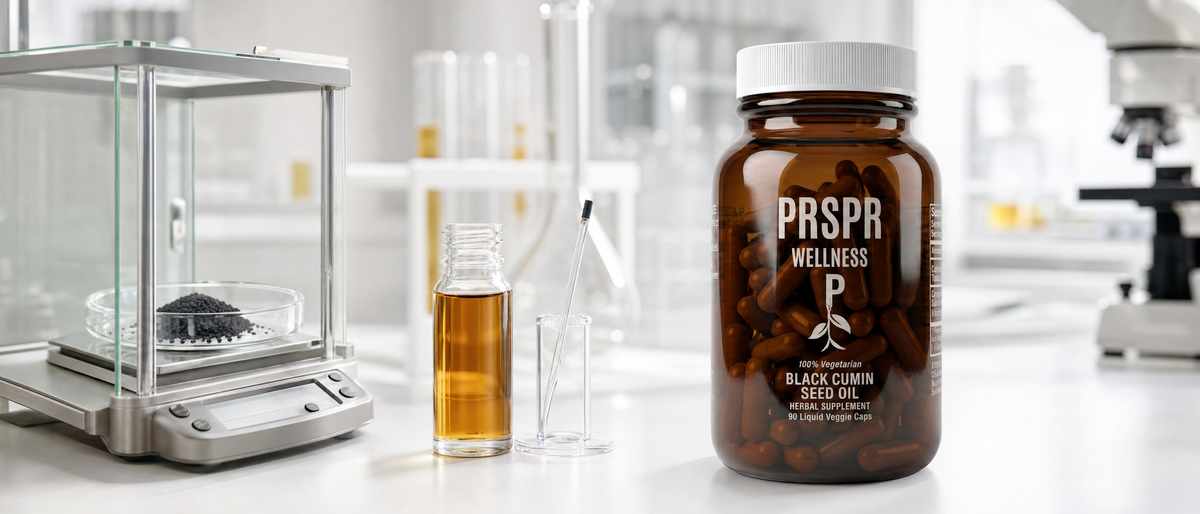
Our Black Seed Oil is Black Cumin Seed Oil made with Nigella sativa, in a vegetarian veggie-cap, 90 count. That is the composition as the live listing states it: the species named, the format named, the count named.
We are not going to print a thymoquinone claim in this article, because a number like that belongs on a panel backed by the test that produced it, not in a blog post where it would function as decoration.
What we will state in our own voice is the process behind any such figure being meaningful at all. GMP-certified facility, third-party batch tested. Independent testing is the thing that makes a composition number worth reading, and it is the part of this story we can actually vouch for.
If the marker-compound idea is what you take away, use it as a question rather than a target. Read the Black Seed Oil page, ask what has been tested and by whom, run the same question across the vitamins and supplements collection, or take the build-your-stack quiz.
Answer all five questions to unlock a clear wellness plan made around your goal, schedule, preferred supplement format, and biggest roadblock.
Get clarity on what matters most right now.
See the product and routine connected to your goal.
Simple next steps you can use right away.
Pick the one you would fix first if you could.
This helps us make the guide easier to follow.
Consistency beats the “perfect” routine you never follow.
Be honest. We’re building something you’ll actually use.
Your guide will include one simple way around it.
Answer two more questions to unlock your product starting point, five-step plan, two-week routine, and one practical tip for your biggest roadblock.
Enter your details to open your five-step plan.
Verified PRSPR customer reviews
Expires when you close this page
*Your personal credit for completing the quiz. It's applied automatically at checkout on one-time purchases and expires when the timer runs out.
View full product detailsEverything in your plan, together — one add to cart.
Expires when you close this page
*Your personal credit for completing the quiz. It's applied automatically at checkout on one-time purchases and expires when the timer runs out.
View full product details Mind vocabulary
What is cognition? You have probably seen the word "cognitive" printed on a label, in a headline, or in a product name, and kept scrolling. It is o...
 Biology vocabulary
What is metabolism? You see the word on labels, in gym talk and in nutrition headlines, almost always used as if it were a single setting. Read eno...
 Sleep vocabulary
What are sleep cycles? You hear the phrase on podcasts, see it on sleep trackers, and read it in articles that assume you already know what it mean...