
◎
Get clear
Get clarity on what matters most right now.

Nigella sativa oil is holding a maximum volume score this week. So is black cumin seed oil benefits. Black seed oil benefits is at 97. Black seed nigella sativa sits at 89, nigella sativa black seed oil at 64, and further down the chart someone has typed the question outright: black seed oil vs black cumin seed oil.
That last query is the tell. When a search term exists purely to ask whether two names are the same thing, the naming has gone wrong somewhere. And it has. Black seed, black cumin, and nigella sativa are three names for one plant, our label prints one of them, and search uses all three roughly interchangeably. This article is about that split, because a shopper who cannot match the name on the bottle to the name in their head has a real problem, and it is a problem that has nothing to do with what the oil does.
Nigella sativa is a flowering annual in the buttercup family, grown across the Mediterranean, the Middle East, North Africa and South Asia. It produces a seed pod, and the pod holds small, hard, matte black seeds with sharp corners. Those seeds are the whole story. Press them and you get an oil. Leave them whole and you get a spice that has been used in bread, curries and pickles for a very long time.
The seed is old in the record. It has been found in Egyptian archaeological contexts, it is named in classical medical texts, and it holds a place in traditional practice across several cultures that has been documented for centuries. That heritage is the reason the plant has so many common names in the first place: a crop that travels through that many languages accumulates one name per stop.
Nigella sativa oil, then, is simply the pressed oil of that seed, named by the plant's botanical binomial rather than by any of its common names. When a listing uses the Latin, it is choosing the one name that cannot be confused with anything else, which is the entire point of botanical nomenclature.
One more identification detail, since nigella sativa seeds are a live search in their own right. The seeds are small, angular and matte rather than glossy, and they are sold whole in most spice shops under whichever of the three names that shop prefers. They are the same seeds that go on top of naan and on some Turkish and Levantine breads, where they are often called by yet another set of regional names. If you have eaten them without knowing it, that is extremely common.
Black seed is the plainest of the three. It describes the seed by looking at it, and it is what the plant gets called in a lot of English-speaking markets. It is also the least precise, because a great many plants produce black seeds.
Black cumin is where the confusion earns its keep. The seeds resemble cumin seeds in size and colour, so the name attached by resemblance, but Nigella sativa is not cumin and is not closely related to it. Cumin is Cuminum cyminum, an umbellifer, in the same family as carrots and parsley. Nigella is a ranunculus relative. The two plants sit in completely different corners of the plant kingdom, and the shared name is an accident of appearance. To make it worse, there is another plant, Bunium bulbocastanum, that also gets called black cumin in some places. This is exactly the situation botanical names exist to fix.
Nigella sativa is the fix. It is the binomial, it refers to one species, and it is the name a label can print if it wants to be unambiguous.
Here is the bridge, and it explains a pattern you will see across the whole supplement shelf. Labels drift toward precision because precision is what a label is for. Search drifts toward whatever people actually say out loud, which is usually the common name they first heard. Those two forces pull in opposite directions, and the gap between them is where queries like black seed oil vs black cumin seed oil get born.
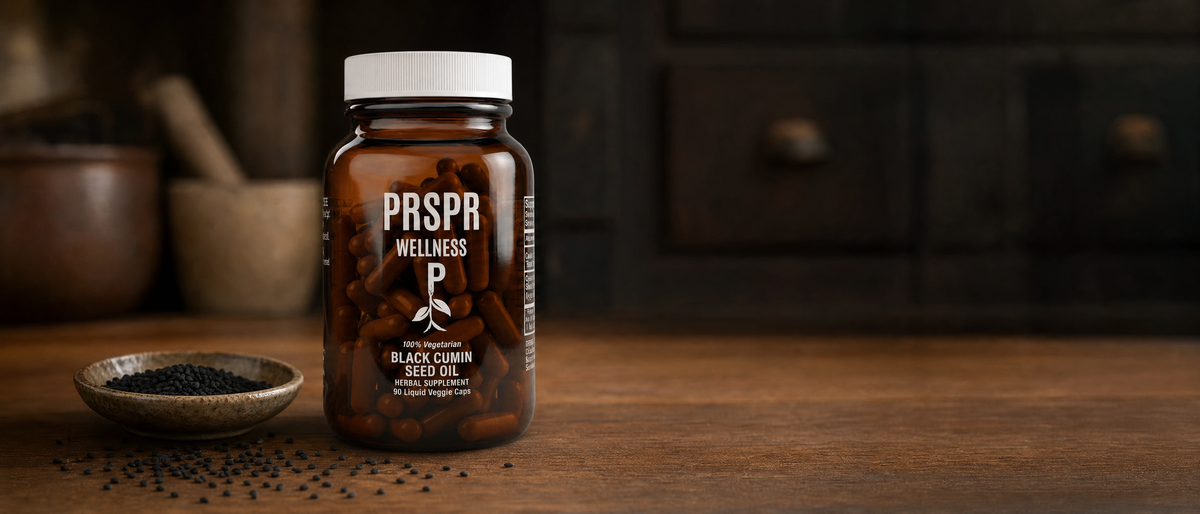
Our bottle is labelled PRSPR Wellness Black Cumin Seed Oil, and the listing names Nigella sativa directly. So this product is sitting on both sides of the gap on purpose: the common name on the front for recognition, the botanical name in the description for certainty. If you searched any of the three names and landed here, you landed in the right place.
The practical version of this, for any product and not just ours: when two names appear on the same listing, that is a disclosure, not a redundancy. It is the seller telling you which plant they mean. When a listing gives you only a common name and no binomial, you have less information than you think you do, and black cumin is a name where that shortfall genuinely matters.
You will notice we have not said a word about what the oil does. Benefits of black cumin seed oil, black cumin seed oil benefits, black seed oil benefits and benefits of black seed oil for men are all live searches, and they are all outcome questions. We read them as evidence that people are still trying to identify this plant, not as questions we should be answering in our own voice. Effects belong to a healthcare professional who knows your history.
There is a format point buried in the naming question too. Because the plant is sold as a spice, as a pressed oil in a bottle, and as that same oil packed into capsules, the word oil on a listing does not tell you how the product arrives. A bottle of oil is measured by spoon and tastes strongly of the seed. A capsule is counted and tastes of nothing. Both are honestly described as black seed oil, and the difference between them is one you have to read for rather than assume.
Naming confusion is not a trivial problem, and the industry is too relaxed about it. If a shopper cannot tell whether the bottle in their hand is the thing their friend recommended, every other quality signal on the label is wasted. A binomial costs nothing to print and removes the entire question.
So our rule is simple. Look for the Latin. If a botanical product does not name its species anywhere on the listing or the panel, that is worth noticing before you compare anything else. It is the cheapest transparency there is, and the brands that skip it usually skip other things too.
Our Black Cumin Seed Oil is made with Nigella sativa in a vegetarian veggie-cap capsule, which means the pressed oil arrives in a counted capsule rather than a bottle you measure. It is manufactured in a GMP-certified facility and third-party batch tested. What is on the label is what is in the bottle.
The full panel is on the Black Seed Oil product page, and you can see the rest of the range on the vitamins and supplements page. Black seed also turns up as a named component elsewhere in our range, which we touched on in our hair, skin and nails label piece. If you want help working out where a single-botanical capsule fits next to what you already take, take the quiz.
Answer all five questions to unlock a clear wellness plan made around your goal, schedule, preferred supplement format, and biggest roadblock.
Get clarity on what matters most right now.
See the product and routine connected to your goal.
Simple next steps you can use right away.
Pick the one you would fix first if you could.
This helps us make the guide easier to follow.
Consistency beats the “perfect” routine you never follow.
Be honest. We’re building something you’ll actually use.
Your guide will include one simple way around it.
Answer two more questions to unlock your product starting point, five-step plan, two-week routine, and one practical tip for your biggest roadblock.
Enter your details to open your five-step plan.
Verified PRSPR customer reviews
Expires when you close this page
*Your personal credit for completing the quiz. It's applied automatically at checkout on one-time purchases and expires when the timer runs out.
View full product detailsEverything in your plan, together — one add to cart.
Expires when you close this page
*Your personal credit for completing the quiz. It's applied automatically at checkout on one-time purchases and expires when the timer runs out.
View full product details Electrolytes
Salt is having a comparison week. Searches for celtic sea salt vs himalayan pink salt are up about 70 percent, pink himalayan salt vs table salt is...
 Kids
KidsPick up a box of children's snacks and somewhere on the front there is a number with the letter g after it, next to the word fiber. It looks like o...
 Label Reading
It is printed on the front of a lot of mineral bottles and it is one of the least understood words in the supplement business. Chelated. Search int...