
◎
Get clear
Get clarity on what matters most right now.

Vitamin K and potassium share a letter, and a lot of people are noticing. In Google's related searches for "vitamin k" this week, "vitamin k potassium" carries a volume score of 36, and plain "potassium" sits at 36 right beside it. That pairing tells you something: people are seeing the letter K and wondering whether the vitamin and the mineral are the same thing.
They are not. But the confusion is understandable, and the other searches in the same list show where it comes from. "Where does vitamin k come from" is up +100% this week. "What is vitamin k in" has a volume score of 86. "K2" scores 54 and "vitamin k2" scores 53.
So this piece is about the letter. Where the K in vitamin K came from, where the K in potassium came from, why those are two different stories, and what the "2" in K2 means on a label. What any vitamin or mineral does in a body, or how much of one a person needs, is a question for a qualified healthcare professional. This is a naming explainer.
Vitamin K is a group of organic compounds. Potassium is a chemical element. Each one ended up with the letter K for its own reason, in a different century, in a different language.
The vitamin's K comes from a word. The element's K comes from an abbreviation. Neither one borrowed the letter from the other. When you see "vitamin K" and "K" side by side, you are looking at a coincidence of the alphabet, not a shared ingredient.
That matters because a letter on a label invites a guess. If a bottle says K2 and a periodic table says K, it is natural to assume one is inside the other. The rest of this piece walks through why that guess does not hold, starting with the vitamin.
Hold one idea in mind the whole way through: a letter on a label is a name, not a list of ingredients.
The search "where does vitamin k come from" can mean two things. One is a food question, and we cover that separately in our piece on where K2 turns up in food. The other is a naming question: where does the letter come from? That is the one we are answering here.
According to the Linus Pauling Institute at Oregon State University, vitamin K was originally identified for its role in blood clot formation, and the "K" is derived from the Danish word "koagulation."
The discovery belongs to Danish science. NobelPrize.org records that the 1943 Nobel Prize in Physiology or Medicine was divided between Henrik Dam "for his discovery of vitamin K" and Edward Adelbert Doisy "for his discovery of the chemical nature of vitamin K." Britannica notes that Dam named it vitamin K, for "Koagulations-Vitamin."
So the K in vitamin K is the first letter of a word, koagulation. It is a nickname, taken from the language of the lab that found it.
"What is vitamin k in" is an odd-looking search, and it shows up at a volume score of 86. One useful way to read it: what category is vitamin K in? The answer is that it is not a single molecule. The NIH Office of Dietary Supplements describes vitamin K as including phylloquinone (vitamin K1) and a series of menaquinones (vitamin K2). It is a family name.
Potassium got its letter from a completely different place: a pile of ashes.
The Royal Society of Chemistry lists potassium as element 19, in Group 1 of the periodic table, and says the name is derived from the English word "potash." Its history note records that in 1807 Humphry Davy exposed moist potash to an electric current and saw droplets of the new metal form.
The Online Etymology Dictionary fills in the rest. It dates "potash" in English to 1751 (earlier "pot-ash" from the 1640s) and calls it a loan-translation of older Dutch potaschen, literally "pot ashes." It dates the word "potassium" to 1807, coined by Davy.
And the symbol? According to the Online Etymology Dictionary, the chemical symbol K is from Latin kalium, "potash," from Arabic al-qaliy, "the ashes, burnt ashes." So the element's K is short for a Latin name that points back to an Arabic word for ashes. The English name and the symbol simply come from two different languages describing the same substance.
Put the two stories next to each other and the collision is clear:
Same letter, no shared root. The vitamin was not named after the element, and the element was not named after the vitamin.
Not as part of what vitamin K is. You can see this in the chemistry. PubChem lists the molecular formula of phylloquinone as C31H46O2, and the formula of menaquinone-7 as C46H64O2. That is carbon, hydrogen and oxygen. There is no K in either formula, which means no potassium atom in the molecule.
Potassium, meanwhile, is a single element. PubChem's entry for potassium gives its formula as simply K. One is a large carbon-based molecule; the other is a metal on the periodic table.
The formulas make the letter collision easy to spot. In chemistry, the capital K is reserved for potassium, so if potassium were part of the molecule, you would see a K inside the formula itself. You do not. The only K attached to vitamin K sits in front of it, as a name.
So "vitamin k potassium" is best read as a letter question. Vitamin K is not potassium, and it does not contain potassium as a defining element. The mineral and the vitamin are separate subjects that happen to share an initial. Here, we are sticking to the alphabet.
Now to the "2." Searches for "k2" (volume score 54) and "vitamin k2" (53) are close to the top of this week's list, and the number on the label is a naming convention, not a grade or a strength.
According to the Linus Pauling Institute, vitamin K1, or phylloquinone, is synthesized by plants. The name carries that in plain sight: the Online Etymology Dictionary defines "phyllo-" as a word-forming element meaning "leaf," from Greek phyllon. A leaf quinone.
K2 is not one compound but a series. The NIH Office of Dietary Supplements describes menaquinones as predominantly of bacterial origin and notes they are designated MK-4 through MK-13 based on the length of their side chain. The Linus Pauling Institute puts it the same way: menaquinone-n, or MK-n, where n is the number of 5-carbon units.
So MK-7 means menaquinone with seven of those units in its side chain. When a label says "K2" and then "MK7," the second term is simply telling you which member of the K2 family is inside. Our longer guide to cholecalciferol, menaquinone-7 and the other long words on a D3 + K2 label goes deeper into those chemical names.
Here is where the trend meets the shelf. A supplement label compresses a lot of chemistry into a few characters: D3, K2, MK7. Each one is a naming shortcut, and each one has a history that makes it more readable once you know it.
Read a label with this piece in mind and the K stops being ambiguous. On a vitamin label, K2 points to the menaquinone family, named for a Danish word. On a mineral panel or a periodic table, K points to potassium, named from Latin and Arabic words for ashes. They can sit on the same shelf, even on the same bottle panel, without having anything to do with each other.
That is the bridge from "vitamin k potassium" to reading a real label: the letter is shared, the substance is not.
One practical habit follows from it. When a letter on a label leaves you unsure, look for the full name next to it. "Vitamin K2" and "menaquinone" point one way; "potassium" spelled out points the other.
We think the K confusion is one of the best small puzzles in label vocabulary, and one of the easiest to clear up once you see both stories. Two unrelated naming systems, one from a Danish laboratory and one from a Latin element list, landed on the same letter. Nobody planned it. It just happened, and a Danish word and an Arabic word for ashes ended up sharing a single letter.
We also think it is worth fixing, because letters are how most people read a supplement label. If K means potassium in one place and a vitamin family in another, the reader deserves to know which is which before they draw a conclusion.
So when a label uses shorthand, we would rather explain it than leave you to guess. A reader who knows that K2 is a vitamin family, and K on its own is an element, reads every bottle on the shelf a little more clearly, ours included.
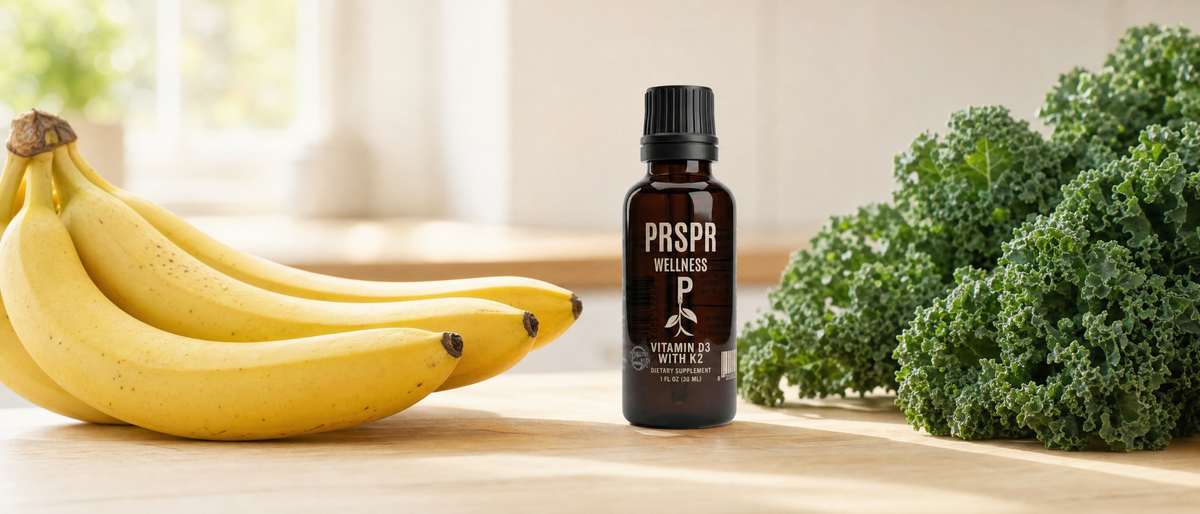
Which brings us to our own bottle. Our Vitamin D3 + K2 Plus MK7 is named in exactly the vocabulary this piece has been unpacking. The front label reads "Vitamin D3 with K2." The listing name adds "MK7," which, as the naming convention above shows, tells you which menaquinone the K2 refers to. For the D3 side of the label and how its amount is printed, our piece on IU and mcg on vitamin D labels walks through the units.
What we will add in our own voice is how it is made. It is manufactured in a GMP-certified facility and third-party batch tested, so what's on the label is what's in the bottle.
To read the full label for yourself, open the Vitamin D3 + K2 Plus MK7 product page, browse the rest of the vitamins and supplements collection, or take the build-your-stack quiz to see where it fits alongside everything else we carry.
Answer all five questions to unlock a clear wellness plan made around your goal, schedule, preferred supplement format, and biggest roadblock.
Get clarity on what matters most right now.
See the product and routine connected to your goal.
Simple next steps you can use right away.
Pick the one you would fix first if you could.
This helps us make the guide easier to follow.
Consistency beats the “perfect” routine you never follow.
Be honest. We’re building something you’ll actually use.
Your guide will include one simple way around it.
Answer two more questions to unlock your product starting point, five-step plan, two-week routine, and one practical tip for your biggest roadblock.
Enter your details to open your five-step plan.
Verified PRSPR customer reviews
Expires when you close this page
*Your personal credit for completing the quiz. It's applied automatically at checkout on one-time purchases and expires when the timer runs out.
View full product detailsEverything in your plan, together — one add to cart.
Expires when you close this page
*Your personal credit for completing the quiz. It's applied automatically at checkout on one-time purchases and expires when the timer runs out.
View full product details Mind vocabulary
What is cognition? You have probably seen the word "cognitive" printed on a label, in a headline, or in a product name, and kept scrolling. It is o...
 Biology vocabulary
What is metabolism? You see the word on labels, in gym talk and in nutrition headlines, almost always used as if it were a single setting. Read eno...
 Sleep vocabulary
What are sleep cycles? You hear the phrase on podcasts, see it on sleep trackers, and read it in articles that assume you already know what it mean...