
◎
Get clear
Get clarity on what matters most right now.

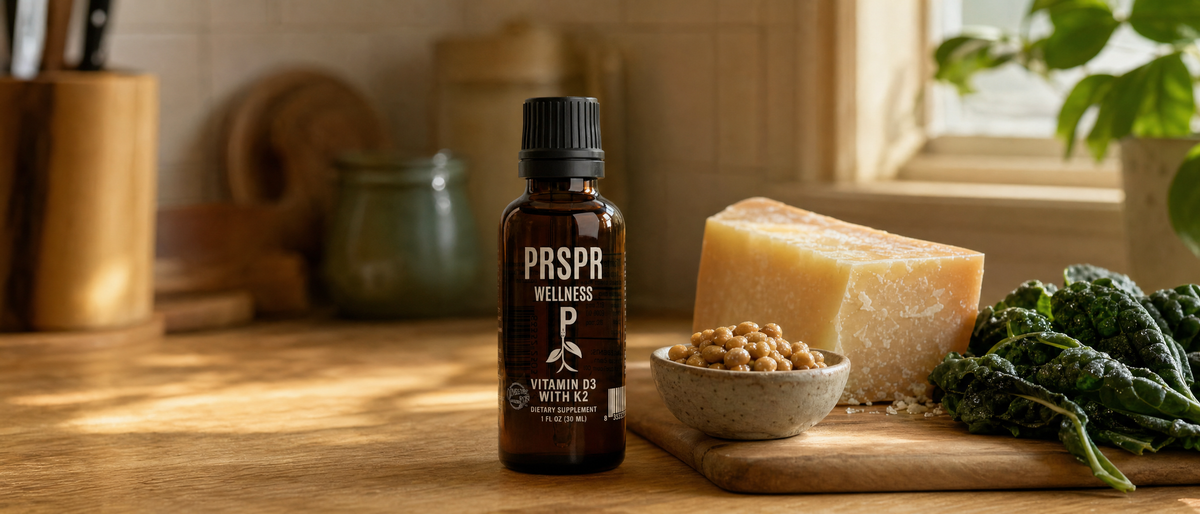
The bottle says D3 plus K2. Nearly everybody who buys it is there for the first half. Search behaviour makes that plain: vitamin D is one of the most searched supplement terms in existence, and vitamin K2 gets a fraction of the traffic despite being printed in the same size type on the same label.
When people do search the second half, this is what they ask. What food has vitamin K2 rose 40 percent in the past week's related queries. What is k2 ran at 26, best vitamin k2 at 19, vitamin k2 benefits and k2 benefits both at 18, vitamin d and k2 at 18, and the fastest rising phrase of all was side effects of vitamin k2 with d3, up 60 percent.
This is a piece about the K vitamins as a family and about the foods they are associated with in standard nutrition references. It makes no claim about bones, arteries, calcium or anything else, and it does not answer the side effects question. That one belongs with a qualified healthcare professional or a pharmacist.
Start with the letter, because the story behind it is genuinely odd. Vitamin K was identified in the 1930s by the Danish biochemist Henrik Dam, and the K comes from Koagulationsvitamin, the German and Danish spelling of coagulation. It is the only vitamin named after a non English word, which is why the letter sits out of sequence with the A, B, C, D, E series that came before it.
It is not a single compound. Vitamin K is a family of related molecules that share a common ring structure and differ in the side chain attached to it. The two branches that matter for labels are K1, called phylloquinone, and K2, called menaquinone. Phylloquinone takes its name from phyllon, Greek for leaf, which tells you where it is found.
K2 is subdivided further, and this is where the label vocabulary comes from. The menaquinones are numbered by the length of their side chain, written as MK followed by a number. MK4 has a four unit chain. MK7 has a seven unit chain. When a bottle prints K2 as MK7, it is specifying which member of the K2 branch is inside, in the same way a bottle might specify which salt of a mineral it contains.
Standard nutrition references associate the two branches with quite different foods, which is the most useful thing to know about the family.
K1, the phylloquinone branch, is associated with green leafy plants. Kale, spinach, collards, broccoli, parsley. The leaf name is accurate. That branch is the one most people are getting the majority of their K intake from without thinking about it, because it comes attached to ordinary vegetables.
K2, the menaquinone branch, is associated with two quite different sources: fermented foods and animal foods. The single most cited example in the literature is natto, a Japanese fermented soybean preparation, which is by a wide margin the richest commonly documented food source of MK7 specifically. Beyond that, references list certain aged and hard cheeses, egg yolks, butter, and organ meats, with the amounts varying considerably by production method.
That is the whole reason the food question gets searched at all. K1 is in things people already eat every week. K2 is in natto, which almost nobody outside Japan eats, and in fermented and animal foods whose K2 content depends heavily on how they were made. It is a genuinely harder question, which is why it is the rising one.
We are reporting food associations here as they appear in standard nutrition references. We are not telling you what to eat, how much of anything you need, or what any of it does in a body.
Here is the bridge between the vitamin and the shelf.
Vitamin K2 is rarely sold alone in the mainstream supplement aisle. It is overwhelmingly sold as the second half of a D3 product, which is why the search phrase vitamin d and k2 exists at all and why what is k2 gets searched by people who have already bought the bottle. They are looking up an ingredient they did not go shopping for.
That pairing is now a category convention. Best vitamin k2 at 19 is a low volume search precisely because very few people set out to buy K2 on its own. The convention arrived, the products followed, and the labelling settled into the current pattern where two vitamins share a front panel and one of them does all the marketing.
The consequence is a shopper who owns a supplement containing an ingredient they cannot describe. That is a bad outcome regardless of what the ingredient is, and it is the reason this article exists. We read the whole name part by part in our earlier piece on the D3 and K2 label, and this one takes the neglected half on its own terms.
Our position is that an ingredient nobody can name is a labelling failure, not a shopper failure.
The information needed to fix it is small. K is for coagulation, in Danish. It is a family, not a compound. K1 comes from leaves, K2 from fermentation and animal foods, and MK7 specifies which K2. That is four sentences, and knowing them turns an unfamiliar string of characters on a bottle into a specification you can actually compare between products.
What we are not going to do is tell you why the two are paired in terms of what happens inside you. That explanation is everywhere online, it is stated with far more confidence than any supplement brand has earned, and it is a question for a qualified healthcare professional rather than for a page trying to sell you something.
Our Vitamin D3 plus K2 with MK7 names its K2 form on the label rather than leaving it as a bare letter, which is the point of everything above. It sits in our vitamins and supplements collection.
What we will state is what we can verify. It is manufactured in a GMP certified facility and third party batch tested, and the panel prints the amounts rather than concealing them. Clear amounts, no guesswork, including for the half of the bottle most people never look up.
If you would rather work out what belongs in your routine than decode one bottle at a time, take the quiz and build your own stack.
The menaquinone branch of the vitamin K family. It shares a ring structure with K1 and differs in the side chain, and its members are numbered MK4, MK7 and so on by the length of that chain.
Standard nutrition references most often cite natto, a Japanese fermented soybean food, as the richest documented source of MK7, along with certain aged and hard cheeses, egg yolks, butter and organ meats. K1, by contrast, is associated with green leafy vegetables.
This was the fastest rising search in this cluster and we are not going to answer it. Interactions and suitability are clinical questions that depend on the individual and on anything else they are taking. Ask a qualified healthcare professional or a pharmacist.
Because people buy the bottle for the D3 and then look up the ingredient they did not choose. We record those as searches rather than answering them.
Answer all five questions to unlock a clear wellness plan made around your goal, schedule, preferred supplement format, and biggest roadblock.
Get clarity on what matters most right now.
See the product and routine connected to your goal.
Simple next steps you can use right away.
Pick the one you would fix first if you could.
This helps us make the guide easier to follow.
Consistency beats the “perfect” routine you never follow.
Be honest. We’re building something you’ll actually use.
Your guide will include one simple way around it.
Answer two more questions to unlock your product starting point, five-step plan, two-week routine, and one practical tip for your biggest roadblock.
Enter your details to open your five-step plan.
Verified PRSPR customer reviews
Expires when you close this page
*Your personal credit for completing the quiz. It's applied automatically at checkout on one-time purchases and expires when the timer runs out.
View full product detailsEverything in your plan, together — one add to cart.
Expires when you close this page
*Your personal credit for completing the quiz. It's applied automatically at checkout on one-time purchases and expires when the timer runs out.
View full product details Electrolytes
Salt is having a comparison week. Searches for celtic sea salt vs himalayan pink salt are up about 70 percent, pink himalayan salt vs table salt is...
 Kids
KidsPick up a box of children's snacks and somewhere on the front there is a number with the letter g after it, next to the word fiber. It looks like o...
 Label Reading
It is printed on the front of a lot of mineral bottles and it is one of the least understood words in the supplement business. Chelated. Search int...