
◎
Get clear
Get clarity on what matters most right now.

What are amino acids is holding a volume score of 100 this week. Amino acid sits at 82, are amino acids proteins at 53, what do amino acids do at 44, how many amino acids at 35, essential amino acids at 29, amino acids 20 at 23, and what are amino acids made of and types of amino acids at 16 each.
Read in order, that is a biology syllabus. Definition, relationship to protein, function, count, classification, composition. Somebody is either studying for a test or trying to understand a word on a label, and the search data cannot tell which. The good news is that both people need the same answers, and every one of those answers is settled textbook material.
One boundary before we start. When we answer what amino acids do, we mean it the way a chemistry textbook means it. What any particular amino acid does for a particular person is a question for a qualified healthcare professional rather than for the company selling the bottle.
Our reason for writing this is a single ingredient. L-theanine, the ingredient in our MindfulThea, is an amino acid. It is also not one of the twenty that the rest of this article is about. Explaining how both of those can be true is a good way to learn how amino acids are classified.
Encyclopaedia Britannica defines an amino acid as an organic molecule made of three parts: a basic amino group, an acidic carboxyl group, and an organic side chain that is unique to each amino acid. In the standard layout, the amino group and the carboxyl group are both attached to one central carbon atom, called the alpha carbon, which also carries a hydrogen atom and the side chain.
The name is simply a description of those parts. Amino refers to the nitrogen-containing amino group. Acid refers to the carboxyl group. Anything with both, arranged this way, is an amino acid.
So what are amino acids made of, at the level of elements? Carbon, hydrogen, oxygen and nitrogen in every case, because those are the atoms in the shared backbone. A couple add sulfur in the side chain. PubChem lists cysteine as C3H7NO2S and methionine as C5H11NO2S, and that S makes them easy to spot on a formula sheet.
The side chain is where all the variety lives. It can be a single hydrogen atom, a ring, a chain of carbons, or a group that carries a charge, and it gives each amino acid its identity.
No, amino acids are not proteins. They are the units proteins are built from. MedlinePlus, the reference service of the US National Library of Medicine, puts it plainly: amino acids are molecules that combine to form proteins. A protein is a long chain of amino acids joined end to end and folded into shape. The relationship is the one between letters and a sentence.
That is also the textbook answer to what do amino acids do. In chemistry terms, they are the building blocks that proteins are assembled from. The genetic code is, at bottom, a set of instructions for which amino acid goes where in that chain.
Which brings us to how many amino acids. According to Encyclopaedia Britannica's entry on the genetic code, DNA and RNA are read in three-letter units called codons. There are 64 possible codons. Three of them signal the end of a protein, and the remaining 61 specify the 20 amino acids that make up proteins. That is where the search term amino acids 20 comes from, and it is the number introductory textbooks teach.
The twenty is not quite the end of the story. Two further amino acids, selenocysteine and pyrrolysine, are built into proteins in some organisms by reinterpreting codons that normally mean stop, and they are sometimes counted as the 21st and 22nd. For label reading, the twenty is the number that matters.
There are several ways to sort the twenty, and the types of amino acids you meet depend on who is sorting. Chemists group them by the chemistry of their side chains. Nutrition references group them by where they come from, and that is the scheme behind essential amino acids.
MedlinePlus defines essential amino acids as those that cannot be made by the body, and so must come from food. It lists nine: histidine, isoleucine, leucine, lysine, methionine, phenylalanine, threonine, tryptophan and valine. Nonessential amino acids are ones the body can produce even if they are not in the diet. MedlinePlus also names a third, in-between group, conditionally essential amino acids.
Here is the part people get wrong. Essential in this phrase is a sourcing word, not a ranking. It means must come from the diet. It does not mean more important, and nonessential does not mean unnecessary. A protein chain is built from both kinds without distinction. The words only describe where the molecule can come from.
Now back to the ingredient. PubChem's record for theanine gives the formula C7H14N2O3, and the ChEBI description in that record names it N5-ethyl-L-glutamine and notes it has been isolated from green tea.
That name is a map. Glutamine is one of the twenty. PubChem lists it as C5H10N2O3. Theanine is glutamine with an ethyl group, two carbons and their hydrogens, attached to the nitrogen at the end of the side chain. Add C2H4 to glutamine's formula and you get theanine's. It still has an amino group and a carboxyl group on its central carbon, so it is an amino acid by definition.
What it is not is proteinogenic. No codon specifies it, so it is not built into proteins. A 2022 paper in the journal Horticulture Research describes theanine as a tea-plant-specific non-proteinogenic amino acid, made in the plant from glutamate and ethylamine. Non-proteinogenic is simply the formal term for an amino acid that exists on its own rather than as a protein building block.
So theanine passes the structural test from the first section of this article and fails only the membership test from the second. It is an amino acid by build, and outside the twenty by use. That is the whole point of the title.
That also settles a common confusion. The essential and nonessential lists are classifications of protein-building amino acids, so theanine does not appear on either. The L- in L-theanine is a separate matter of molecular handedness, which we covered in why the label spells it three ways.
One of the twenty has the simplest structure of all, a single hydrogen atom for a side chain, and a name that means sweet. It is the second word on a magnesium glycinate label, and we gave it a full article in what glycine is, from formula to glycinate.
We think amino acid is one of the most misread phrases on a supplement shelf, and essential is the word doing the most damage. Shoppers see essential and hear important. Then they see an amino acid that is on neither list and assume it must be a lesser one. Both readings are wrong, because both words are classifications, not grades.
The better way to read the phrase is structural. Amino acid tells you what the molecule is built like. Proteinogenic or not tells you whether it ends up in protein. Essential or not tells you where a protein-building amino acid comes from. Three separate questions, three separate answers, and none of them is a verdict on the ingredient.
It is also why we would rather you knew the molecule than the marketing. L-theanine names one specific compound with one specific formula, and you can look it up in the same public databases this article used. That is a better starting point for reading a label than any adjective printed next to it.
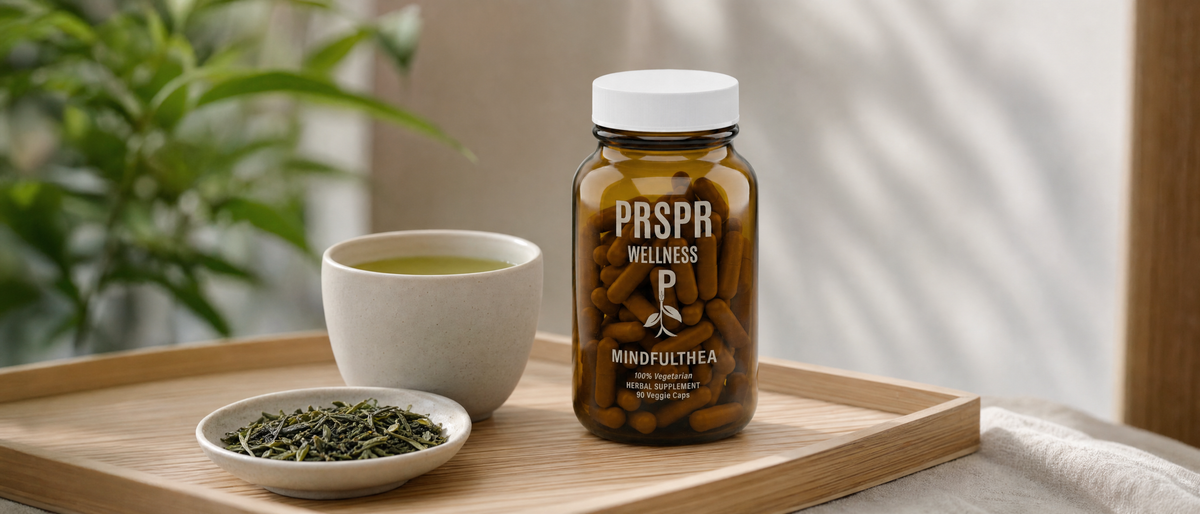
Our MindfulThea is a dietary supplement made with L-theanine. That is the composition as the live listing states it, and L-theanine is the amino acid outside the twenty that this article has been working toward.
What we will add in our own voice is the quality story alone. It is made in a GMP-certified facility and third-party batch tested, so what is on the label is what is in the bottle.
If the tea side of the story is what you want next, how L-theanine started in a teacup is the companion piece. Otherwise open the MindfulThea page and read the panel, browse the vitamins and supplements collection, or take the build-your-stack quiz.
Answer all five questions to unlock a clear wellness plan made around your goal, schedule, preferred supplement format, and biggest roadblock.
Get clarity on what matters most right now.
See the product and routine connected to your goal.
Simple next steps you can use right away.
Pick the one you would fix first if you could.
This helps us make the guide easier to follow.
Consistency beats the “perfect” routine you never follow.
Be honest. We’re building something you’ll actually use.
Your guide will include one simple way around it.
Answer two more questions to unlock your product starting point, five-step plan, two-week routine, and one practical tip for your biggest roadblock.
Enter your details to open your five-step plan.
Verified PRSPR customer reviews
Expires when you close this page
*Your personal credit for completing the quiz. It's applied automatically at checkout on one-time purchases and expires when the timer runs out.
View full product detailsEverything in your plan, together — one add to cart.
Expires when you close this page
*Your personal credit for completing the quiz. It's applied automatically at checkout on one-time purchases and expires when the timer runs out.
View full product details Mind vocabulary
What is cognition? You have probably seen the word "cognitive" printed on a label, in a headline, or in a product name, and kept scrolling. It is o...
 Biology vocabulary
What is metabolism? You see the word on labels, in gym talk and in nutrition headlines, almost always used as if it were a single setting. Read eno...
 Sleep vocabulary
What are sleep cycles? You hear the phrase on podcasts, see it on sleep trackers, and read it in articles that assume you already know what it mean...