
◎
Get clear
Get clarity on what matters most right now.

Glycine abbreviation is up 50 percent this week, and glycine molecular formula is up 40 percent. On the steadier list, what is glycine holds a volume score of 100, magnesium glycine sits at 43, glycine amino acid at 41, glycine structure at 28, glycine foods at 14 and is glycine an amino acid at 13.
That is two audiences typing into the same box. The rising terms read like chemistry homework: someone needs the three-letter code or the formula, fast. The steadier terms read like label reading. Magnesium glycine, at 43, is most likely people shortening the name printed on a bottle of magnesium glycinate and wondering what the second word means.
The cluster also carries searches about what glycine does for a person. Those are questions for a qualified healthcare professional rather than for the company selling the bottle, and we will leave them with one.
Everything else here has a textbook answer, and both audiences want the same thing: what the molecule is. So this is an article about glycine itself. What it is, where the name comes from, how its abbreviation and formula are written, which foods carry it, and how glycine turns into the glycinate on a magnesium label.
Is glycine an amino acid? Yes, and a very particular one. The ChEBI chemical dictionary, as served in PubChem, describes glycine as the simplest proteinogenic amino acid, with a hydrogen atom as its side chain. Proteinogenic means it is one of the amino acids used to build proteins.
Every glycine amino acid unit has the same basic layout as its relatives: a central carbon atom holding an amino group and a carboxylic acid group. What makes each amino acid different is the fourth attachment, its side chain. Other amino acids hang rings, sulfur atoms or long carbon chains there. Glycine hangs a single hydrogen atom. It is hard to build anything smaller.
That tiny side chain has one more consequence. ChEBI also lists glycine as the only achiral proteinogenic amino acid. Its central carbon carries two identical hydrogen atoms, so the molecule has no left-handed and right-handed versions. That is why you will never see an L- in front of glycine on a label, a prefix we explained in why L-theanine is spelled three ways.
Glycine is named for its taste. Encyclopaedia Britannica describes it as sweet-tasting and notes that it was among the earliest amino acids to be isolated, from gelatin, in 1820.
The name is built on the Greek glykys, meaning sweet. The Online Etymology Dictionary traces the same Greek root through the combining form glyco-, which is used for sugars generally. That puts glycine in the same word family as glycerin and glycemia, even though it is not a sugar. Its formula contains nitrogen, and sugars do not.
So the name is a tasting note from early chemistry, preserved ever since. It records how the substance first presented itself in a lab, long before anyone could write down its structure.
The glycine abbreviation comes in two forms, both set by the international biochemical naming bodies. The IUPAC-IUBMB nomenclature recommendations list glycine as Gly in the three-letter system and G in the one-letter system.
The one-letter code has a small story. Those recommendations, adopted in 1968, used a name's initial letter wherever there was no clash. Where several amino acids shared an initial, the letter went to the most frequently occurring and structurally simplest of them. Alanine got A, leucine got L, proline got P, threonine got T, and glycine got G. Its relatives that also start with G had to take other letters.
The glycine molecular formula is C2H5NO2, according to PubChem: two carbon atoms, five hydrogens, one nitrogen and two oxygens. Its systematic name is 2-aminoacetic acid, which tells you the structure in words. Take acetic acid, the acid in vinegar, and attach an amino group to its second carbon.
Written out, the glycine structure is H2N-CH2-COOH. The amino group sits on the left, the carbon carrying two hydrogens in the middle, and the carboxylic acid group on the right. In a solid sample, PubChem's physical description records it as white crystals.
One more thing explains why diagrams disagree. ChEBI also lists a zwitterion form of glycine, the same molecule drawn with a positive charge on the amino end and a negative charge on the acid end. Textbooks use both drawings, so if one glycine structure shows NH3+ and COO- and another shows NH2 and COOH, you are looking at the same compound written two ways.
Because glycine is one of the building blocks of protein, glycine foods are, broadly, protein foods. USDA FoodData Central carries glycine as its own line in the amino acid breakdown of the foods it profiles, next to the other amino acids, reported in grams per 100 grams of the food.
That also explains the shape of the search data. Glycine foods, at 14, sits well below the chemistry terms, and the reason is that there is no single glycine food to name. The honest answer is a category plus a database lookup, not a short list.
Encyclopaedia Britannica singles out gelatin as an especially rich source, which fits the history neatly: gelatin is where glycine was first isolated in 1820. We are leaving amounts out here, because a food figure is only worth printing when it comes straight from a database record we can point you to.
This is the part that matters on a supplement label. ChEBI records glycine as the conjugate acid of glycinate. In plain terms, glycinate is glycine after its acid group has given up a hydrogen, the same -ate ending that turns acetic acid into acetate. In that form it can bond to a metal.
PubChem's record for magnesium glycinate gives the formula C4H8MgN2O4 and the systematic name magnesium bis(2-aminoacetate). Bis means two. One magnesium atom, two glycinate units. The same record lists magnesium bisglycinate and magnesium diglycinate as synonyms, which is why you meet three names for one compound.
The suffix travels. Other minerals are sold bound to glycine too, which is how a label ends up reading ferrous bisglycinate, the iron compound we decoded in our iron label guide. Once you can spot glycinate, you can spot glycine on any of them.
How that bond works, and what the word chelate means on a label, is covered from the magnesium side in our guide to magnesium versus magnesium glycinate.
Glycine is one amino acid. If the wider vocabulary is what you are after, including what essential means in essential amino acids and why some amino acids never end up in a protein at all, we covered it in what amino acids are and how they are classified.
We think the second word on a mineral label deserves as much attention as the first, and it almost never gets it. People read magnesium glycinate as magnesium plus a vague technical suffix. The suffix is a real molecule with a formula, a three-letter abbreviation and a two-hundred-year history.
That matters because the second word is where compound names differ. Two labels can both start with magnesium and name entirely different compounds. If you can read glycinate as glycine bonded to a mineral, you can read citrate, oxide and every other suffix the same way: as a named partner, not as marketing.
None of this needs a chemistry degree. It needs the habit of stopping at the second word and asking what it names. Glycine happens to be the easiest place to start, because it is the smallest answer there is.
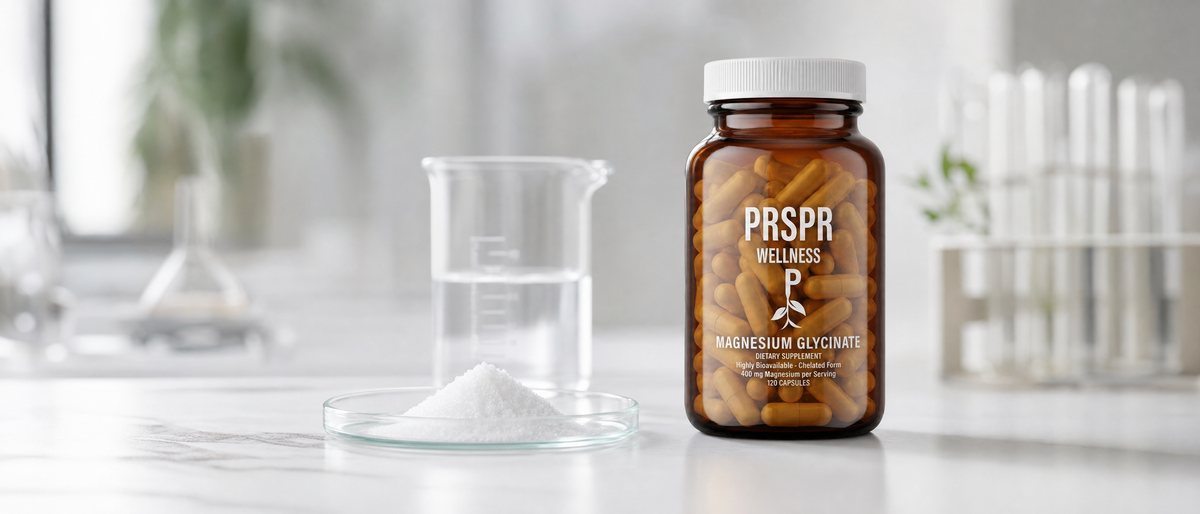
Our Magnesium Glycinate is a dietary supplement providing magnesium in glycinate form, labeled Magnesium Glycinate 400 mg. That is the composition as the live listing states it, and glycine is the half of that name this article has been about.
What we will add in our own voice is the quality story alone. It is made in a GMP-certified facility and third-party batch tested, so what is on the label is what is in the bottle.
If the 400 mg figure is your next question, what a milligram number on a mineral label counts takes it apart. Otherwise open the Magnesium Glycinate page and read the panel, browse the essential nutrients collection, or take the build-your-stack quiz.
Answer all five questions to unlock a clear wellness plan made around your goal, schedule, preferred supplement format, and biggest roadblock.
Get clarity on what matters most right now.
See the product and routine connected to your goal.
Simple next steps you can use right away.
Pick the one you would fix first if you could.
This helps us make the guide easier to follow.
Consistency beats the “perfect” routine you never follow.
Be honest. We’re building something you’ll actually use.
Your guide will include one simple way around it.
Answer two more questions to unlock your product starting point, five-step plan, two-week routine, and one practical tip for your biggest roadblock.
Enter your details to open your five-step plan.
Verified PRSPR customer reviews
Expires when you close this page
*Your personal credit for completing the quiz. It's applied automatically at checkout on one-time purchases and expires when the timer runs out.
View full product detailsEverything in your plan, together — one add to cart.
Expires when you close this page
*Your personal credit for completing the quiz. It's applied automatically at checkout on one-time purchases and expires when the timer runs out.
View full product details Mind vocabulary
What is cognition? You have probably seen the word "cognitive" printed on a label, in a headline, or in a product name, and kept scrolling. It is o...
 Biology vocabulary
What is metabolism? You see the word on labels, in gym talk and in nutrition headlines, almost always used as if it were a single setting. Read eno...
 Sleep vocabulary
What are sleep cycles? You hear the phrase on podcasts, see it on sleep trackers, and read it in articles that assume you already know what it mean...