
◎
Get clear
Get clarity on what matters most right now.

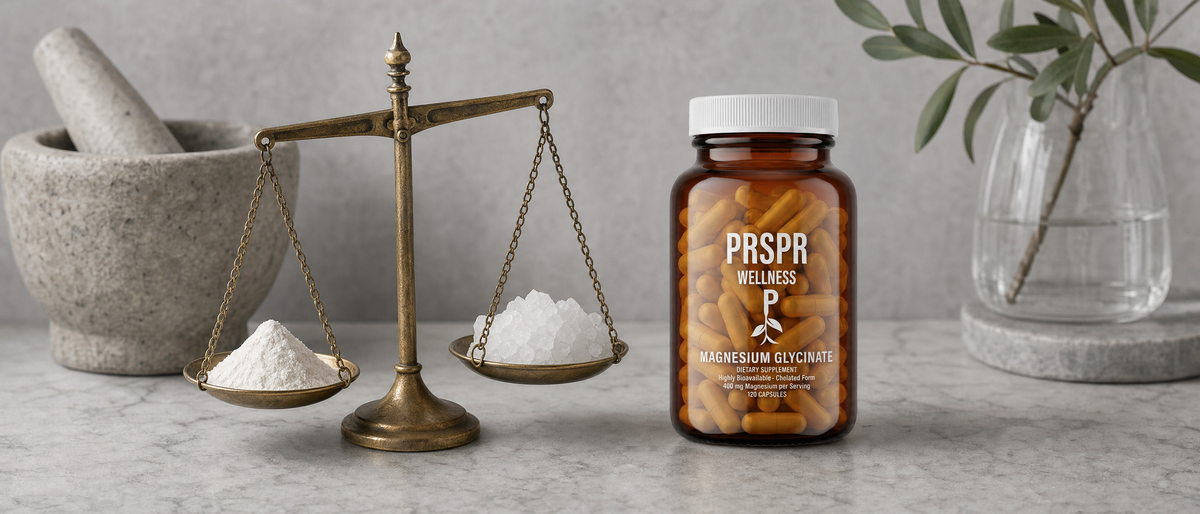
Put two bottles side by side. One is magnesium oxide and the panel says 400 mg. One is 400mg magnesium glycinate and the panel says 400 mg. Same number, same unit, same mineral named on both. They are not describing the same quantity of anything, and the label is technically correct in both cases.
This is one of the most searched confusions in the mineral aisle. Over the past week magnesium oxide 400mg benefits rose 160 percent in related queries. Magnesium oxide 400mg and magnesium oxide both ran at 100, 400mg magnesium glycinate at 94, magnesium glycinate 400 mg at 7, and magnesium oxide 400mg used for at 4.
This piece explains what a milligram figure on a mineral label is counting. It is arithmetic and labelling convention only. No dose is recommended here, no upper limit is stated, and nothing is said about how either compound behaves in a body. Those are questions for a qualified healthcare professional.
Start with the thing that makes this possible. Magnesium is a metal, and a supplement never contains the bare metal. It contains a compound in which magnesium is paired with something else.
Magnesium oxide pairs magnesium with oxygen. Magnesium glycinate pairs it with glycine, an amino acid, in a chelate structure. Those partners have wildly different weights. Oxygen is a single small atom. Glycine is a whole organic molecule with several atoms in it, and in a bisglycinate there are two of them.
So when a panel prints a milligram figure, the honest question is: milligrams of what. Milligrams of the whole compound, or milligrams of the magnesium inside it. Those are two different numbers for the same physical bottle, and the gap between them is large. Because the partner in an oxide is so light, the magnesium accounts for most of the compound's weight. Because the partner in a glycinate is so heavy, the magnesium accounts for a much smaller fraction of it.
The distinction has a name. The magnesium content on its own is called the elemental figure. The compound weight is just the compound weight. Any comparison between two mineral products that does not specify which one it is using is not a comparison at all.
This is not a magnesium quirk. The same arithmetic applies to every mineral sold as a compound, which is all of them. Zinc, iron, calcium and potassium products all carry a compound name and a figure, and in every case the compound has a weight that the mineral inside it does not. Learning the distinction once means you can read the entire mineral aisle, which is a better return than learning one bottle.
Here is the part that resolves the puzzle in the opening. Nutrition labelling conventions for minerals are built around the elemental figure. The number in the supplement facts panel, the one carrying the mineral's name and its percentage of a daily value, is meant to be the elemental amount, not the weight of the compound.
So a properly built panel that says magnesium 400 mg is telling you about magnesium the element. Two such panels are directly comparable regardless of which compound each product uses, and that is exactly what the convention exists to make possible.
Where it goes wrong is everywhere other than the panel. Product titles, front of pack copy, marketplace listings and search terms all use bare numbers with no such convention behind them. A title reading magnesium oxide 400mg might be describing the elemental content or the compound weight, and nothing in the title tells you which. That ambiguity is why magnesium oxide 400mg and 400mg magnesium glycinate can both be enormous search terms while meaning different things, and why the same figure appears across products that are not equivalent.
The practical rule is short. The panel is the source of truth. The title is a name, not a specification. If two products are being compared on a number that came from anywhere other than the supplement facts panel, the comparison is unreliable.
Here is the bridge. On a mineral label, a figure without a compound name and a compound name without a figure are both incomplete, and shoppers habitually read one and ignore the other.
Watch how the search terms behave. Magnesium oxide at 100 is a compound name with no number. Magnesium oxide 400mg at 100 is the same name with a number attached. 400mg magnesium glycinate at 94 puts the number first. Magnesium glycinate 400 mg at 7 is the identical query with the words in the other order, and the volume difference between those last two is enormous for what is semantically the same search.
That word order tells you something real. When the number leads, the searcher is treating the figure as the primary specification and the compound as a qualifier. When the name leads, they are treating the compound as primary. The far higher volume on the number first phrasing suggests most people are shopping by figure and treating the compound name as a detail, which is precisely backwards for reading a mineral label.
We are naming magnesium oxide here only because the article cannot be written without it. It is the comparison case that makes the arithmetic visible. It is not being presented as an alternative product and nothing here says which compound anybody should choose. We took a different cut at the same bottle in our piece on magnesium versus magnesium glycinate, which teaches a label reading method without ever explaining what the milligram figure counts. This article is the missing half of that one.
Our honest view is that the number on the front of a mineral bottle is close to meaningless on its own, and that the industry benefits from it staying that way.
A big number reads as more. It requires no explanation, it survives being glanced at, and it wins on a shelf. The compound name requires the shopper to know something. So the incentive across the whole category is to lead with the figure and let the name sit in smaller type, which produces exactly the confusion that puts these searches at the top of the list every week.
We would rather you read the panel and ignored the front. Find the mineral's own line, check whether it is telling you the elemental amount, look at the compound name beside it, and only then compare it to anything else. That is four seconds of work and it is the difference between comparing two products and comparing two pieces of typography.
Our Magnesium Glycinate is sold as 400 mg across 30 servings, and the panel names the compound alongside the figure rather than leaving you to infer it. It sits in our essential nutrients collection.
What we will state about it is what we can verify. It is manufactured in a GMP certified facility and third party batch tested, and the amounts are printed on the panel rather than hidden inside a proprietary blend. Clear amounts, no guesswork, which on this particular label means the number and the compound arrive together as one fact instead of two separate impressions.
If you would rather work out what belongs in your routine than compare figures across bottles that are not comparable, take the quiz and build your own stack.
Answer all five questions to unlock a clear wellness plan made around your goal, schedule, preferred supplement format, and biggest roadblock.
Get clarity on what matters most right now.
See the product and routine connected to your goal.
Simple next steps you can use right away.
Pick the one you would fix first if you could.
This helps us make the guide easier to follow.
Consistency beats the “perfect” routine you never follow.
Be honest. We’re building something you’ll actually use.
Your guide will include one simple way around it.
Answer two more questions to unlock your product starting point, five-step plan, two-week routine, and one practical tip for your biggest roadblock.
Enter your details to open your five-step plan.
Verified PRSPR customer reviews
Expires when you close this page
*Your personal credit for completing the quiz. It's applied automatically at checkout on one-time purchases and expires when the timer runs out.
View full product detailsEverything in your plan, together — one add to cart.
Expires when you close this page
*Your personal credit for completing the quiz. It's applied automatically at checkout on one-time purchases and expires when the timer runs out.
View full product details Electrolytes
Salt is having a comparison week. Searches for celtic sea salt vs himalayan pink salt are up about 70 percent, pink himalayan salt vs table salt is...
 Kids
KidsPick up a box of children's snacks and somewhere on the front there is a number with the letter g after it, next to the word fiber. It looks like o...
 Label Reading
It is printed on the front of a lot of mineral bottles and it is one of the least understood words in the supplement business. Chelated. Search int...