
◎
Get clear
Get clarity on what matters most right now.

"Antioxidant" is printed on juice bottles, face creams and supplement labels. It sounds like a health word. It started as a chemistry word, and it still is one. So what are antioxidants, really? Strip away the packaging and the answer is a sentence about electrons and oxygen, not a promise.
That gap between the lab meaning and the label meaning is what this piece is about. We define the word, define its partner term, free radical, name which vitamins official sources class as antioxidants, and settle how to say it out loud.
Plenty of people are asking right now. On Google Trends this week (US, past seven days, seed term "antioxidants"), "what are antioxidants" holds the top relative volume score of 100. "What is antioxidants" scores 88, "antioxidant" scores 27, "free radicals" scores 19, and "which vitamins are antioxidants" scores 12. Three searches are climbing fast: "antioxidants pronunciation" is up +300%, "definition of antioxidants" is up +100%, and "what are free radicals" is up +80%. Those scores are relative within the antioxidants seed, not absolute search counts.
Start with the dictionary, because the dictionary puts chemistry first. Dictionary.com's first sense of antioxidant is labeled "Chemistry" and reads "any substance that inhibits oxidation, as a substance that inhibits oxidative deterioration of gasoline, rubbers, plastics, soaps, etc." The Cambridge Dictionary's definition is just as plain: "a substance that slows down the rate at which something decays because of oxidization."
Notice the examples. Gasoline. Rubber. Plastic. Soap. The original home of this word is the materials shelf, not the vitamin aisle. An antioxidant, in its first meaning, is an ingredient a chemist adds so a product goes stale or brittle more slowly.
Dictionary.com also lists a second, separate sense labeled "Biochemistry." Two labeled senses for one word is the whole story in miniature: the same term now lives in two worlds, and the packaging usually borrows from the second one without telling you about the first.
The word is a stack of three pieces: anti, oxid, and ant. According to the Online Etymology Dictionary, "antioxidant" is formed from "anti-" plus "oxidant," and "oxidant" means "an oxidizing agent," recorded in English from 1859. So the literal definition of antioxidants is "against the oxidizers."
The Online Etymology Dictionary dates "antioxidant" as a noun to 1920, meaning "substance that inhibits oxidization." Dictionary.com places its first recording a little later, in 1925 to 1930. Either way, the word is roughly a century old.
If you typed "what is antioxidants," you are in good company: it is the second most searched phrase in this group. The word is a countable noun. One substance is an antioxidant; several are antioxidants. Dictionary.com also lists "antioxidant" as an adjective, "of or relating to an antioxidant," which is how you get phrases like "antioxidant compound."
You cannot define antioxidant without defining oxidation. The Online Etymology Dictionary traces "oxidation" to French, coined by the chemists Louis-Bernard Guyton de Morveau and Antoine Lavoisier, and dates it in English to 1791, with the original meaning "act or process of combining or causing to combine with oxygen."
Chemistry later widened that meaning. The scientific entry on Dictionary.com defines oxidation as "a chemical reaction in which an atom or ion loses electrons." Its cultural entry gives two everyday examples: burning is rapid oxidation, and rusting is slow oxidation.
That shift matters. Oxidation is no longer only about oxygen. It is about electrons moving from one place to another. Once you see it that way, the next term makes sense.
A free radical is defined by its electrons. Dictionary.com's American entry calls it "an atom or molecule that bears an unpaired electron and is extremely reactive." The Collins English Dictionary entry shown on the same page describes it as "an atom or group of atoms containing at least one unpaired electron and existing for a brief period of time before reacting to produce a stable molecule."
An unpaired electron is what it sounds like: an electron without a partner. That one detail is the entire identity of a free radical in chemistry. It is why the dictionaries describe these atoms and molecules as reactive and short-lived. They do not stay as they are for long.
The name is older than the modern definition. The Online Etymology Dictionary traces "radical" to the Latin radix, "root," and notes that the chemical sense of the noun dates to 1816.
For a long time, chemists doubted these particles could be isolated at all. According to a 2000 news release posted on EurekAlert, when the American Chemical Society designated the discovery a National Historic Chemical Landmark, University of Michigan chemist Moses Gomberg announced in 1900 that he had isolated an organic free radical, "a carbon molecule with an odd number of electrons." An odd number of electrons means at least one is left unpaired. That is the same definition the dictionaries give today.
This is a naming question, so it gets a named answer. MedlinePlus, from the U.S. National Library of Medicine, lists examples of antioxidants on its antioxidants page: beta-carotene, lutein, lycopene, selenium, vitamin A, vitamin C and vitamin E. The National Center for Complementary and Integrative Health names vitamins C and E and beta-carotene as antioxidants that are also available as dietary supplements.
So by name, the vitamins on those official lists are vitamin A, vitamin C and vitamin E. The rest of the MedlinePlus list is a mix of a mineral (selenium) and carotenoid pigments (beta-carotene, lutein, lycopene).
Notice which vitamins are not on those lists. Neither MedlinePlus nor NCCIH names vitamin D or vitamin K among its antioxidant examples. Vitamin D has its own naming story, which we told in our piece on why vitamin D is called the sunshine vitamin. A vitamin's name tells you its letter, not its category.
The rising pronunciation search has a quick answer. Dictionary.com gives the American respelling as an-tee-OK-si-duhnt, with a second accepted version, an-tie-OK-si-duhnt (the first syllable said like "ant" plus "eye"). The stress falls on "ok." The Cambridge Dictionary's U.S. entry marks the same stressed syllable.
For the plural, just add the "s": an-tee-OK-si-duhnts. For the partner term, Cambridge gives "free radical" as FREE RAD-ih-kul.
Here is the spine of the whole thing. "Antioxidant" is a category in chemistry, defined by a reaction. On a label, it gets used like a badge. Those are different jobs. The chemistry sense tells you how a substance behaves with oxidizers in a defined setting, like a tank of fuel or a sheet of rubber. The badge sense asks you to fill in the rest yourself.
The same thing happens with other lab words. "Oxidative," for example, sits next to "stress" in a phrase you have likely seen, and we covered the word "stress" in that phrase in our piece on one word doing two jobs. Label words are worth reading the way a chemist reads them, one part at a time. We did the same with "monohydrate" in our explainer on the second word on a creatine label.
In chemistry, an antioxidant is a substance that inhibits oxidation. Dictionary.com's chemistry sense gives gasoline, rubbers, plastics and soaps as examples of where they are used.
Free radicals are atoms or molecules with at least one unpaired electron. Dictionary.com and the Collins entry describe them as highly reactive and short-lived.
MedlinePlus lists vitamins A, C and E among its examples of antioxidants. NCCIH names vitamins C and E. Neither lists vitamin D or vitamin K.
We like words that can be traced back to a definition. "Antioxidant" can. It means "against the oxidizers," it came out of chemistry about a century ago, and its first dictionary sense still points at fuel and rubber.
So when you see the word on a label, read it the way a chemist would. Ask what is being named, by whom, and in which sense. A word with a clear definition deserves to be read clearly.
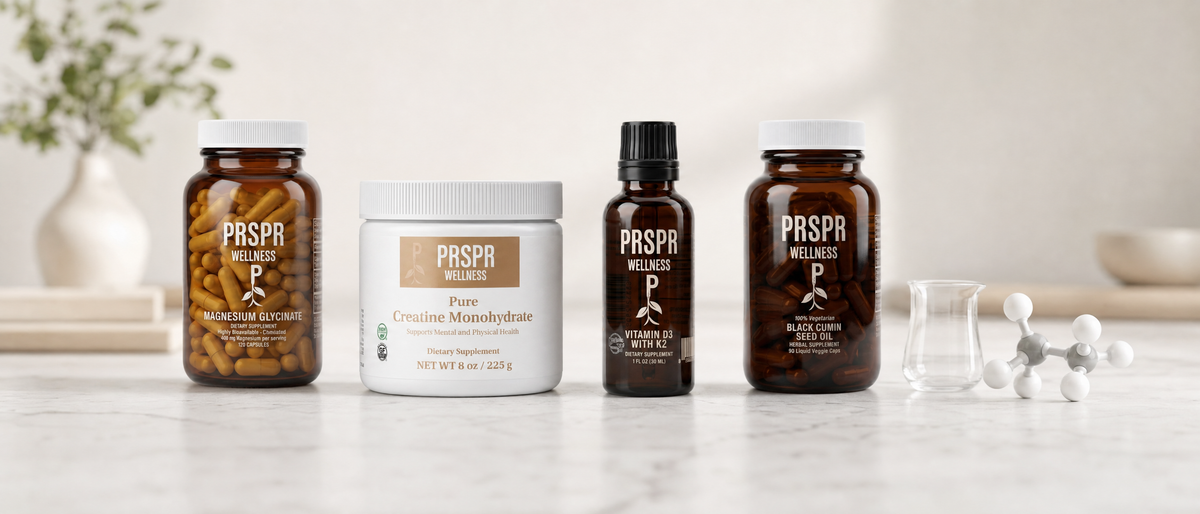
The Essentials Bundle is a bundle of four formulas. The listing names them: Magnesium Glycinate, Black Seed Oil (Nigella sativa), Vitamin D3 + K2 and Creatine Monohydrate. None of the four is vitamin A, C or E, the vitamins named on the MedlinePlus list above. The link to this article is vocabulary: these are the label words people search next to the word antioxidant.
Each formula in the Essentials Bundle is manufactured in a GMP-certified facility and third-party batch tested, so what's on the label is what's in the bottle.
You can read the full listing on the Essentials Bundle product page, or browse our Vitamins & Supplements collection. What any ingredient might do for you is a question for your healthcare provider. Want to see where it fits with everything else you use? Take the PRSPR Wellness quiz and build a stack around your own routine.
Answer all five questions to unlock a clear wellness plan made around your goal, schedule, preferred supplement format, and biggest roadblock.
Get clarity on what matters most right now.
See the product and routine connected to your goal.
Simple next steps you can use right away.
Pick the one you would fix first if you could.
This helps us make the guide easier to follow.
Consistency beats the “perfect” routine you never follow.
Be honest. We’re building something you’ll actually use.
Your guide will include one simple way around it.
Answer two more questions to unlock your product starting point, five-step plan, two-week routine, and one practical tip for your biggest roadblock.
Enter your details to open your five-step plan.
Verified PRSPR customer reviews
Expires when you close this page
*Your personal credit for completing the quiz. It's applied automatically at checkout on one-time purchases and expires when the timer runs out.
View full product detailsEverything in your plan, together — one add to cart.
Expires when you close this page
*Your personal credit for completing the quiz. It's applied automatically at checkout on one-time purchases and expires when the timer runs out.
View full product details Mind vocabulary
What is cognition? You have probably seen the word "cognitive" printed on a label, in a headline, or in a product name, and kept scrolling. It is o...
 Biology vocabulary
What is metabolism? You see the word on labels, in gym talk and in nutrition headlines, almost always used as if it were a single setting. Read eno...
 Sleep vocabulary
What are sleep cycles? You hear the phrase on podcasts, see it on sleep trackers, and read it in articles that assume you already know what it mean...