
◎
Get clear
Get clarity on what matters most right now.

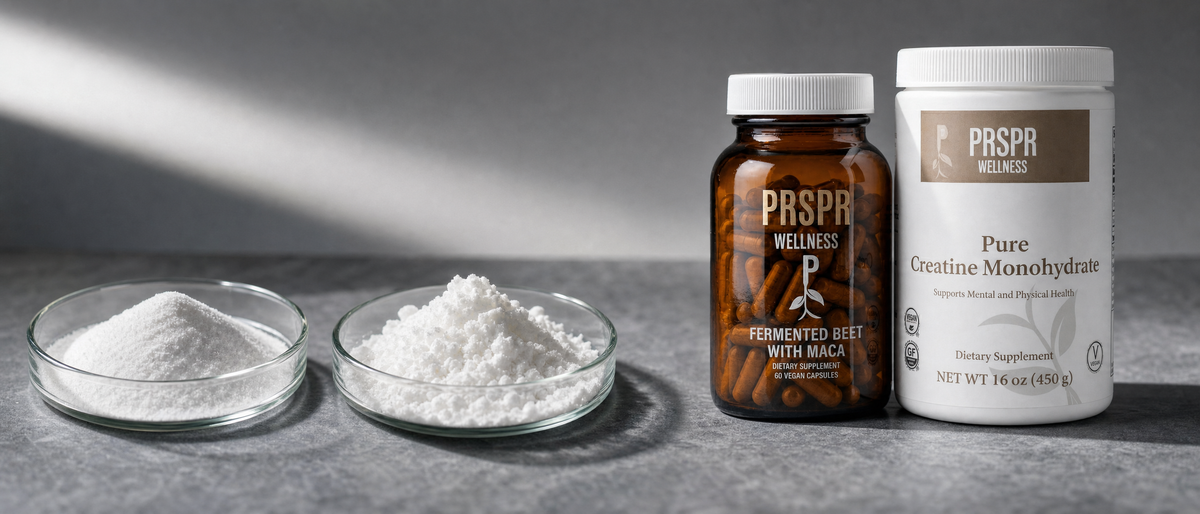
The fastest-rising creatine question in search right now is not about results. It is about manufacturing. What is creatine monohydrate made from is up about 130 percent, which is a very unusual thing for a supplement query to be doing. Right behind it: creatine monohydrate vs creatine hydrochloride up about 60 percent, creatine hydrochloride vs monohydrate up about 40, and creatine hydrochloride itself up about 40. On the volume side, what is monohydrate creatine holds 63 and creatine monohydrate vs creatine holds 62.
Read those together and a picture forms. People are not asking whether to buy creatine. They have decided that. They are standing in front of two tubs whose labels differ by one chemistry word, and they want to know what the word means and where the powder comes from.
This article answers exactly that and nothing more. What monohydrate names, what hydrochloride names, and how the raw material is actually produced. It does not compare the two forms on results. That would be a performance question, and performance questions belong with a qualified healthcare professional rather than a supplement blog.
Monohydrate is not a type of creatine. It is a description of how the creatine molecule is packaged in the crystal.
Hydrate, in chemistry, means water molecules are built into the crystal structure of a solid. Mono means one. So creatine monohydrate is creatine crystallized with one water molecule per creatine molecule locked into the lattice. That water is not moisture on the surface and it is not something that makes the powder damp. It is a structural part of the solid, and it is why the powder is stable and pours as a dry free-flowing crystal.
The practical consequence is arithmetic. Because that water is part of the weight, a gram of creatine monohydrate is not a gram of creatine. Roughly speaking, about 88 percent of the mass is creatine and about 12 percent is the bound water. Every reputable label accounts for this, and it is the reason the number on the front and the number in the panel sometimes look like they disagree when they do not.
This is the question that is moving fastest, and the honest answer is more boring and more reassuring than most people expect.
Creatine for supplements is synthesized chemically. It is not extracted from meat, despite creatine occurring naturally in meat and fish, because extracting it from animal tissue at the volumes the market needs would be absurd. The standard industrial route starts from two simple, cheap feedstock chemicals: sarcosine, a small amino acid derivative, and cyanamide. Those two are reacted together, and the product is crystallized out and purified.
So the answer to what is creatine monohydrate made from is: two basic chemical precursors, combined in a reactor, then purified and crystallized. The finished molecule is identical to the creatine your body already makes and the creatine present in food. Same molecule, different origin story.
That also explains the vegetarian and vegan labeling you see across the category. Because the synthesis route uses no animal-derived input, creatine monohydrate is generally suitable for both, and brands say so on the front panel.
Creatine hydrochloride, usually written creatine HCl, is the other suffix on the shelf, and it is a genuinely different kind of word from monohydrate.
A hydrochloride is a salt. When a molecule with a basic nitrogen site is treated with hydrochloric acid, it forms a salt of that acid, and the result is a hydrochloride. This is one of the most common tricks in chemistry for turning an awkward compound into a tidy, stable, water-soluble powder, which is why you see the word hydrochloride on so many things across pharmacy and supplement shelves.
So the distinction is this. Monohydrate describes water built into a crystal. Hydrochloride describes a salt formed with an acid. They are not two grades of the same idea. They are two different chemical descriptions that happen to occupy the same position on the label, which is exactly why the comparison searches exist.
They also differ in the arithmetic. A hydrochloride salt carries the mass of the acid component, just as monohydrate carries the mass of the water, so the fraction of the powder that is creatine differs between the two. Any comparison of scoop sizes across the forms has to account for that before it means anything.
The pattern here generalizes, and it is worth taking with you.
Supplement ingredient names are frequently two parts: the active molecule, then a word describing what it has been combined with to make it into a usable solid. Monohydrate, hydrochloride, citrate, glycinate, bisglycinate, sulfate, picolinate. Every one of those second words is telling you about form, not about the active substance.
Once you see that structure, a panel stops being a wall of chemistry and becomes a list of pairs. First word: what it is. Second word: how it has been made into a powder. We used the same reading on iron in the four iron salts and on magnesium in the magnesium comparison. Same grammar, different aisle.
We like that this cluster is dominated by a manufacturing question, because it is a sign of a market growing up.
For years the loudest creatine searches were about outcomes. Now the fastest riser is what is creatine monohydrate made from, which is a supply-chain question. Somebody asking that has moved past the marketing and gone looking for the process. That is the right instinct, and it is the instinct that makes a label useful instead of decorative.
What we would add is that the second word deserves the same treatment as the first. If you are going to look up where the creatine came from, look up what the suffix is doing too. It takes about a minute and it permanently changes how you read a shelf. We ran the numbers side of this in how to read a creatine label, and covered the search spike that pulled a lot of people into this category in the creatine and DHT explainer.
Our Nature's BBL Deluxe is a two-part set: Pure Creatine Monohydrate in a 90 count, plus Fermented Beet and Maca capsules. The creatine in it is creatine monohydrate, which is the form this whole article has been describing, and the label says so in the plain chemistry word rather than a proprietary name.
The one thing we will state in our own voice is how it is made. GMP-certified facility, third-party batch tested, so the panel and the powder agree. No guessing, no filler, no house-invented ingredient names.
If you want to check that for yourself, that is the point. Read the Nature's BBL Deluxe page and look at how the creatine is named, compare it against the rest of the bundles collection, or take the build-your-stack quiz if you would rather start from a routine.
What is creatine monohydrate made from?
It is chemically synthesized, typically from sarcosine and cyanamide, then purified and crystallized. It is not extracted from meat, and the standard route uses no animal-derived input.
What is monohydrate creatine?
Creatine crystallized with one water molecule bound into each unit of the crystal structure. The water is part of the solid, which is why a gram of the powder is roughly 88 percent creatine by mass.
Answer all five questions to unlock a clear wellness plan made around your goal, schedule, preferred supplement format, and biggest roadblock.
Get clarity on what matters most right now.
See the product and routine connected to your goal.
Simple next steps you can use right away.
Pick the one you would fix first if you could.
This helps us make the guide easier to follow.
Consistency beats the “perfect” routine you never follow.
Be honest. We’re building something you’ll actually use.
Your guide will include one simple way around it.
Answer two more questions to unlock your product starting point, five-step plan, two-week routine, and one practical tip for your biggest roadblock.
Enter your details to open your five-step plan.
Verified PRSPR customer reviews
Expires when you close this page
*Your personal credit for completing the quiz. It's applied automatically at checkout on one-time purchases and expires when the timer runs out.
View full product detailsEverything in your plan, together — one add to cart.
Expires when you close this page
*Your personal credit for completing the quiz. It's applied automatically at checkout on one-time purchases and expires when the timer runs out.
View full product details Mind vocabulary
What is cognition? You have probably seen the word "cognitive" printed on a label, in a headline, or in a product name, and kept scrolling. It is o...
 Biology vocabulary
What is metabolism? You see the word on labels, in gym talk and in nutrition headlines, almost always used as if it were a single setting. Read eno...
 Sleep vocabulary
What are sleep cycles? You hear the phrase on podcasts, see it on sleep trackers, and read it in articles that assume you already know what it mean...