
◎
Get clear
Get clarity on what matters most right now.

What are nutrients? It sounds like a question from a middle school worksheet, and yet it is one of the most searched nutrition questions this week. People are typing it every way you can phrase it: as a definition, as a meaning, as a count of six, and as the setup for a macro calculator.
There is a good reason for that. "Nutrient" is one of the most common words on a supplement listing and one of the least defined. It gets used like everyone already agrees on what it means. This piece covers the vocabulary only: what the textbooks say a nutrient is, the six classes they teach, what "essential" means as a technical word, and where the line between macro and micro sits. Every fact below names the reference it came from.
First, the search data. According to Google Trends, for US searches over the past seven days related to the seed term "nutrients," the top related queries were "what is nutrients" at 100, "what are nutrients" at 87 and "essential nutrients" at 17. Further down the list: "nutrients definition" at 6, "what are the 6 nutrients" at 5, "nutrients meaning" at 5, and "definition of nutrients," "macro nutrients" and "micro nutrients" at 4 each. Among rising queries, "macro nutrients calculator" was up 80%.
A quick note on those numbers. Google Trends scores are relative within the seed term: 100 marks the most searched query in that set, and everything else is scaled against it. They are not search counts. A rising figure like +80% describes growth in searches over the period, not how many people searched. What the list shows is the shape of the curiosity: mostly people asking for a plain definition.
Start with the US National Library of Medicine. MedlinePlus, its consumer health reference, defines nutrients in its glossary of nutrition terms as "chemical compounds in food that are used by the body," and gives proteins, fats, carbohydrates, vitamins and minerals as examples.
The open textbook An Introduction to Nutrition by Zimmerman, hosted on LibreTexts, gives a nearly identical nutrients definition: "Nutrients are substances required by the body to perform its basic functions." The same chapter adds the part that matters for the word "essential," which we will get to below: nutrients must come from the diet because the body either does not make them or does not make them in large enough amounts.
So the definition of nutrients, across both references, has two parts. A nutrient is a chemical substance. And it comes in from outside, through food and drink. That is the whole core of the nutrients meaning. Everything else on this page is classification.
The definition also draws a line. The Zimmerman textbook notes that foods contain non-nutrients too, and it lists fiber, antioxidants, preservatives, colorings, flavorings and pesticide residues in that category. It also treats alcohol as a special case: a source of Calories that is "generally NOT considered to be a nutrient." In other words, "in food" and "nutrient" are not the same thing.
When people ask what are the 6 nutrients, they are asking about a classification that shows up in nearly every introductory nutrition course. StatPearls, the medical reference published on the NCBI Bookshelf at the National Library of Medicine, summarizes its chapter "Biochemistry, Nutrients" (Morris and Mohiuddin) by naming "six major classes of nutrients":
The Zimmerman textbook lists the same six. Note the word "lipids." The Zimmerman textbook writes the class as "lipids (fats)," so when a label says fat and a textbook says lipid, they are pointing at the same class. StatPearls also sorts two of the classes further: it describes vitamins as organic micronutrients, split into water-soluble and fat-soluble, and minerals as inorganic micronutrients. If you want the vitamin split in more detail, we covered it in our explainer on fat-soluble and water-soluble vitamins.
"Essential" is the most misread word in this vocabulary. In everyday English it means important. In nutrition it has a narrower technical meaning. The Zimmerman textbook puts it this way: nutrients must be obtained from diet "since the human body does not synthesize them, or does not synthesize them in large enough amounts."
That is the test. Essential nutrients are the ones the body cannot make, or cannot make enough of, so they have to come from outside. "Essential" describes where a nutrient comes from. It is not a ranking, and it is not a marketing adjective, even though it often gets used like one on a shelf.
The macro and micro split is about quantity, not importance. The Zimmerman textbook defines macronutrients as "nutrients that are needed in large amounts" and names three major classes: carbohydrates, lipids and proteins. StatPearls uses the same three and describes them as a source of energy.
Water is where the two references differ slightly in wording. StatPearls keeps water outside the macronutrient group and says it is "required in large amounts but does not yield energy." The Zimmerman textbook calls water a macronutrient "in the sense that you require a large amount of it," while noting it yields no calories. Same facts, different filing.
Micro nutrients are the other side of the split. The Zimmerman textbook describes micronutrients as nutrients "required by the body in lesser amounts" and says they include the essential minerals and vitamins. The World Health Organization uses the same framing on its micronutrients page, describing them as "vitamins and minerals needed by the body in very small amounts."
So "macro" and "micro" are prefixes about scale, large and small. They say nothing about which class matters more. The vitamin and mineral side has its own vocabulary trap, which we untangled in why vitamin and mineral are not the same word.
The rising search for a macro nutrients calculator makes sense once you see where calories come from. Of the six classes, only three carry food energy. The Zimmerman textbook gives the standard figures: carbohydrates provide 4 Calories per gram, proteins 4 and fats 9, while vitamins, minerals and water provide none. The same general factors appear in US labeling rules: the FDA's nutrition labeling regulation, 21 CFR 101.9, allows "the general factors of 4, 4, and 9 calories per gram for protein, total carbohydrate, and total fat."
That conversion is the engine of every macro calculator. In general terms, the tool takes a calorie figure and splits it into grams of carbohydrate, protein and fat, using those per-gram factors to translate between calories and grams. The calculator does arithmetic. The inputs, and the calorie figure itself, are where personal circumstances come in, and that part is a conversation for your clinician. We are not offering a calculator here, only the definition of what one does.
We think "nutrient" is a word that has drifted from its definition. On labels and listings it often reads like a quality, as if a nutrient were a kind of goodness. The textbooks are plainer than that. A nutrient is a chemical substance from food, filed into one of six classes, sorted by quantity into macro or micro, and called essential when the body cannot make enough of it.
That is useful when you read any supplement page. Ask which class a named ingredient belongs to. Ask whether "essential" is being used in its technical sense or as an adjective. Ask whether "macro" or "micro" is describing quantity or just sounding scientific. Those three questions turn a vague word back into vocabulary you can check.
The same habit applies to category words. "Prenatal" is another word that sounds like an ingredient and is not, which we covered in "prenatal" is a category, not an ingredient.
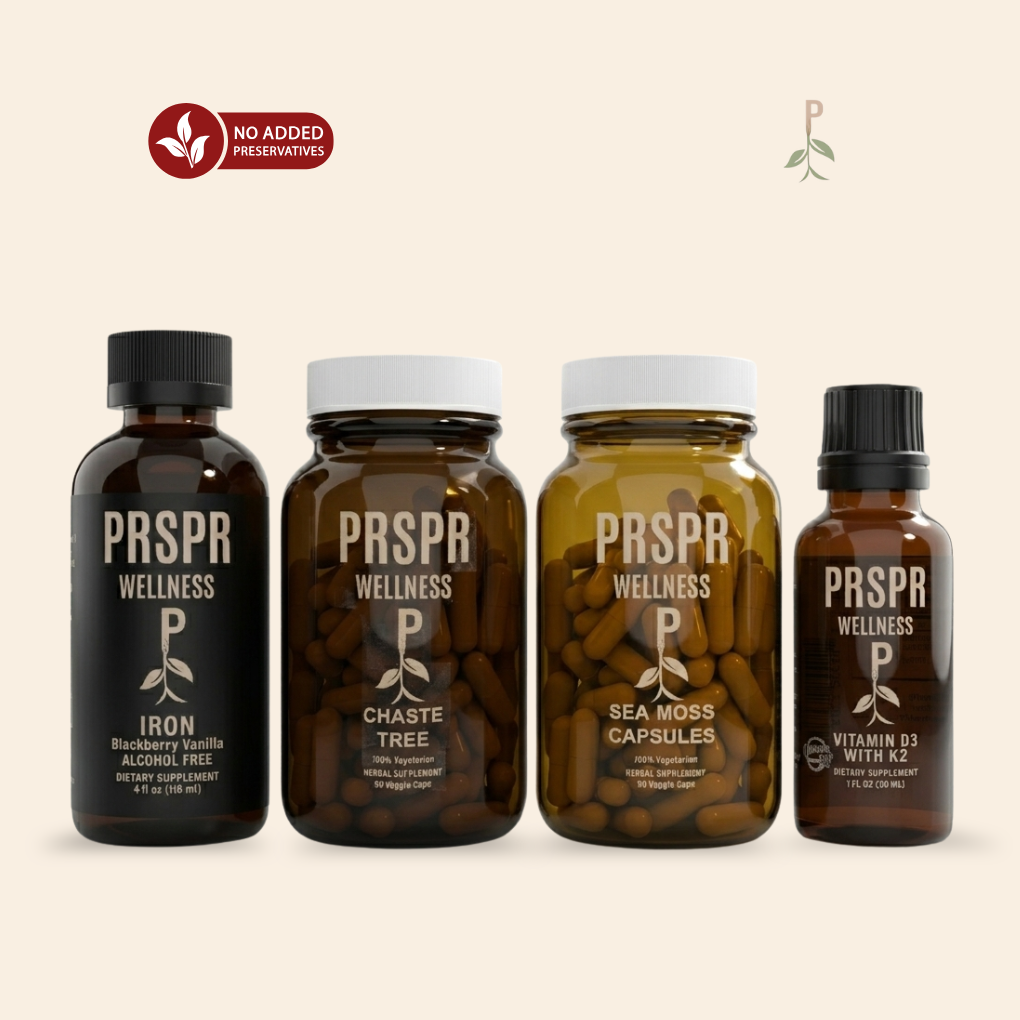
This topic comes from our own shelf. The Pre & Post Natal Bundle is a multi-product bundle, and "nutrients" is the word its listing leans on most. That is why we wanted the word defined here in its textbook sense.
Like everything we carry, it is made in a GMP-certified facility and third-party batch tested, so what's on the label is what's in the bottle. It sits with our other multi-product sets in the Bundles collection, at $144.76.
If you want to read the listing for yourself, see the Pre & Post Natal Bundle at PRSPR.
MedlinePlus defines them as "chemical compounds in food that are used by the body," with proteins, fats, carbohydrates, vitamins and minerals as examples. The Zimmerman nutrition textbook adds that they must come from the diet because the body does not make them, or does not make enough.
StatPearls on the NCBI Bookshelf names six major classes: carbohydrates, lipids, proteins, vitamins, minerals and water.
It is a technical term, not a compliment. Per the Zimmerman textbook, it describes nutrients the human body does not synthesize, or does not synthesize in large enough amounts, so they must come from the diet.
Quantity. The Zimmerman textbook defines macronutrients as those needed in large amounts (carbohydrates, lipids, proteins) and micronutrients as those needed in lesser amounts (vitamins and minerals). The World Health Organization describes micronutrients the same way.
Answer all five questions to unlock a clear wellness plan made around your goal, schedule, preferred supplement format, and biggest roadblock.
Get clarity on what matters most right now.
See the product and routine connected to your goal.
Simple next steps you can use right away.
Pick the one you would fix first if you could.
This helps us make the guide easier to follow.
Consistency beats the “perfect” routine you never follow.
Be honest. We’re building something you’ll actually use.
Your guide will include one simple way around it.
Answer two more questions to unlock your product starting point, five-step plan, two-week routine, and one practical tip for your biggest roadblock.
Enter your details to open your five-step plan.
Verified PRSPR customer reviews
Expires when you close this page
*Your personal credit for completing the quiz. It's applied automatically at checkout on one-time purchases and expires when the timer runs out.
View full product detailsEverything in your plan, together — one add to cart.
Expires when you close this page
*Your personal credit for completing the quiz. It's applied automatically at checkout on one-time purchases and expires when the timer runs out.
View full product details Mind vocabulary
What is cognition? You have probably seen the word "cognitive" printed on a label, in a headline, or in a product name, and kept scrolling. It is o...
 Biology vocabulary
What is metabolism? You see the word on labels, in gym talk and in nutrition headlines, almost always used as if it were a single setting. Read eno...
 Sleep vocabulary
What are sleep cycles? You hear the phrase on podcasts, see it on sleep trackers, and read it in articles that assume you already know what it mean...