
◎
Get clear
Get clarity on what matters most right now.

Type "best prenatal" into a search bar and look at what comes back. Not one product category with a clear winner. A wall of things that share a word and very little else.
That search sits at 100 on the relative interest scale, and it is not alone. "Best prenatal vitamins" sits at 99. "Prenatal vitamin" sits at 33, "good prenatal vitamins" at 30, and "what is prenatal vitamins" at 35. Sitting in the same result set are two phrases that are not category words at all: "d3 and k2 vitamin" at 100 and "iron liquid supplement" at 100. People are searching a shelf label and specific ingredients in the same breath, which is a good sign the shelf label is not doing its job.
Before anything else, the boundary on this piece. We are not going to say anything about pregnancy, postpartum, nutrient requirements, suitability, timing or dosage. Those are medical questions, they are unusually consequential ones, and they belong with your doctor or midwife. What follows is about a word.
Prenatal is a time word. It comes straight from Latin, "prae" meaning before and "natalis" meaning relating to birth. Before birth. That is the entire meaning of the term.
Read that again with a supplement label in mind, because the implication is larger than it looks. "Prenatal" describes when a product is intended to be used. It does not describe what is in it. It is a scheduling word that the industry has been using as though it were a formulation word, and that single slippage explains most of the confusion in the search list above.
Compare it with how the rest of the aisle is named. "Magnesium glycinate" names a compound. "Elderberry" names a plant. "Creatine monohydrate" names a molecule. Each of those words constrains what can be in the bottle. "Prenatal" constrains nothing at all. Two products carrying that word on the front can share not a single ingredient and both be labelled accurately.
This is why "best prenatal" is a question the category cannot answer. Best implies a ranking, a ranking implies a shared axis, and a shared axis requires the products to be comparable in the first place. When the only thing two products have in common is the occasion they are named after, there is nothing to rank. The search is reasonable. The category is what fails it.
You can see people working this out in real time in the data. The reason "d3 and k2 vitamin" and "iron liquid supplement" appear in the same result set at the same volume as the category term is that a good portion of searchers have already given up on the shelf word and moved to naming components instead. That is the correct instinct.
There is a second reason the category word survives despite explaining nothing, and it is worth naming. Shelf words are enormously useful to retailers. They group products that would otherwise have no natural home together, they let a shopper find an aisle without knowing any chemistry, and they create a search term that can be competed for. None of that is sinister. It just means the word was optimised for finding things, not for describing them, and it was never designed to carry the weight shoppers now put on it.
The practical consequence is a habit rather than a rule. When a product name describes an occasion, a life stage, or a person rather than a substance, treat the front of the pack as a signpost and go straight to the back. When a product name describes a substance, the front panel is already telling you something real. Sorting labels into those two piles takes no expertise at all and it changes how much attention each one deserves.
Which brings us to how this particular set is put together, and why it looks different from what most people picture.
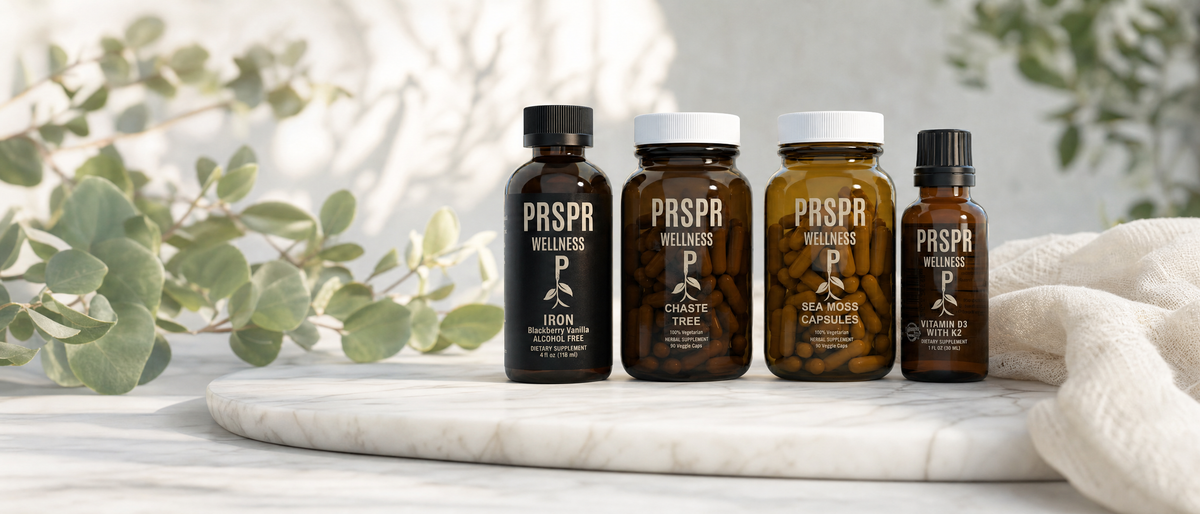
The mental image attached to the word "prenatal" is a single multivitamin. One bottle, one tablet, everything folded in. This bundle is not that. It arrives as four separate formulas in four separate bottles, among them a liquid iron preparation, a vitamin D3 with K2 dropper, and sea moss capsules. Four labels, four supplement facts panels, four things you can read individually. Check the current listing for the full set as it ships today.
That assembly is a deliberate trade and it is worth understanding both sides of it. A single combined tablet is simpler. One thing to remember, one thing to buy, one thing to swallow. Separate single-purpose bottles are less convenient and more transparent. You can see exactly what each component is, read each panel without anything being averaged into a blend, and evaluate them one at a time rather than as a package deal.
It also changes what the format conversation looks like. These four are not all the same shape. The iron is a flavoured liquid measured in fluid ounces, the D3 with K2 is a dropper bottle measured in millilitres, and the rest are capsules counted per bottle. Three different units of measurement in one box. Formats are not interchangeable, they store differently, and they get taken differently. A set assembled from four single-purpose products makes those differences visible where a single tablet would hide them.
None of that tells you whether any of it is appropriate for you. That question is not ours. What we are describing is how the box is constructed, which is a fact about the box.
Category words are the most under-examined thing in this entire industry, and "prenatal" is the clearest example of the problem.
It is a word that sounds like specification and functions like a shelf sign. Because it names a moment in someone's life rather than a formulation, it carries a weight of expectation that no ingredient list has actually earned. Shoppers reasonably assume it means something specific. It does not. And the gap between those two things is filled, in practice, by whatever the marketing decides to put there.
We would rather hand you the vocabulary than the reassurance. The word tells you when something is meant to be used. The back of the pack tells you what it is. Those are two different pieces of information and only one of them is a fact about the product.
And on this subject specifically, we would say something we do not say about most categories. Do not let a shelf word stand in for professional advice here. This is a period where nutrition is genuinely individual and genuinely consequential, and a category name on a box is not remotely equipped to carry that. Ask a clinician, then use the vocabulary to understand what they tell you.
Our Pre and Post Natal Bundle is built from four separate formulas rather than one blend, and that is a deliberate choice. Four labels means four things you can actually inspect.
Everything we make is manufactured in a GMP-certified facility and third-party batch tested. What is on the label is what is in the bottle. No guessing, no filler, no cutting corners. Where a category word tells you as little as this one does, the verifiable facts are the only ones worth anything.
If you want the components explained on their own terms, we wrote about how to read the chemistry words on an iron label, about what "D3 and K2" names part by part, and about what sea moss is. If a magnesium formula is part of what you are comparing, our piece on reading the magnesium forms covers that vocabulary. Our wellness quiz can help you narrow things down, and the bundle sits with the rest of our bundles. Talk to your clinician before you act on any of it.
Answer all five questions to unlock a clear wellness plan made around your goal, schedule, preferred supplement format, and biggest roadblock.
Get clarity on what matters most right now.
See the product and routine connected to your goal.
Simple next steps you can use right away.
Pick the one you would fix first if you could.
This helps us make the guide easier to follow.
Consistency beats the “perfect” routine you never follow.
Be honest. We’re building something you’ll actually use.
Your guide will include one simple way around it.
Answer two more questions to unlock your product starting point, five-step plan, two-week routine, and one practical tip for your biggest roadblock.
Enter your details to open your five-step plan.
Verified PRSPR customer reviews
Expires when you close this page
*Your personal credit for completing the quiz. It's applied automatically at checkout on one-time purchases and expires when the timer runs out.
View full product detailsEverything in your plan, together — one add to cart.
Expires when you close this page
*Your personal credit for completing the quiz. It's applied automatically at checkout on one-time purchases and expires when the timer runs out.
View full product details Electrolytes
Salt is having a comparison week. Searches for celtic sea salt vs himalayan pink salt are up about 70 percent, pink himalayan salt vs table salt is...
 Kids
KidsPick up a box of children's snacks and somewhere on the front there is a number with the letter g after it, next to the word fiber. It looks like o...
 Label Reading
It is printed on the front of a lot of mineral bottles and it is one of the least understood words in the supplement business. Chelated. Search int...