
◎
Get clear
Get clarity on what matters most right now.

What foods are fermented is sitting at a volume score of 100 in search this week. Right behind it, "what is fermented foods" is at 92, fermented food at 71, foods that are fermented at 39, list of fermented foods at 28, fermented vegetables at 19, and both fermented foods examples and fermentation at 17. Then come the two questions that make this cluster fun: are pickles fermented at 16 and is yogurt fermented at 14.
The same data is also full of searches asking what fermented foods do for the body. Those are questions for a qualified healthcare professional rather than for a company that sells a capsule, and this article does not go there.
What it does do is sort the aisle. Because the honest answer to half of these searches is "it depends on how it was made," and the words on the jar (fermented, pickled, brined, cultured) are not interchangeable. Each one names a different process. Learn the four and you can classify almost anything on the shelf.
Start with the word. According to the Online Etymology Dictionary, "ferment" comes through Old French from the Latin fermentum, a leaven, probably from fervere, "to boil, seethe." It is a word about seething and rising, and the precise modern definition came much later.
Here is that definition. In 2021 an international panel of scientists published a consensus statement on fermented foods in a Nature Reviews journal, and it defines them as "foods made through desired microbial growth and enzymatic conversions of food components."
Two words in that sentence do the sorting. "Microbial" means living microorganisms have to do the work; the statement says enzymes acting alone are not enough for a food to count. "Desired" means the growth is intended, which is what separates fermentation from spoilage. The microbes can be ones already present on the food or ones added on purpose.
So the test for what is fermented foods, in the grammar people actually type, is a process test. Did microbes transform this food as part of making it? If yes, it is a fermented food. If the sour taste, the tang or the preservation came from something else, it is not, however similar it looks.
This is the question that trips everyone up, because "pickle" names a result, not a method. The National Center for Home Food Preservation, based at the University of Georgia, says the many varieties of pickled and fermented foods are classified by ingredients and method of preparation, and it describes two very different routes to a sour cucumber.
So are pickles fermented? Some pickles are fermented foods. Others are vinegar-pickled vegetables that never fermented at all. The word "fermented" on a jar is a statement about method. Vinegar on the ingredient list tells you vinegar was used to acidify it, which is how quick pickles get their bite.
Here is the part that surprises people. Vinegar is itself a fermented product. The FDA's policy guide on vinegar defines cider vinegar as the product made by the alcoholic and subsequent acetous fermentations of apple juice. In plain terms, the juice is fermented to alcohol first, and then acetic acid bacteria, which the consensus statement names in vinegar making, carry it on to acetic acid.
And yet a cucumber sitting in vinegar is not a fermented food. The consensus statement addresses exactly this. It lists vegetables pickled in brine or vinegar as not fermented, and it says foods that merely contain a fermented ingredient, such as a salad dressing or mustard made with vinegar, do not meet the definition either. The microbes did their work on the apple juice, not on the cucumber.
Brine needs the same care. A brine is a salt solution, and salt turns up on both sides of the line: the preservation center's ingredient guidance calls for canning or pickling salt when making pickled and fermented foods alike. Quick pickles can sit in brine overnight and still not ferment. Sauerkraut and fermented dills spend weeks fermenting. So "brined" tells you what liquid a vegetable sat in. It does not tell you whether fermentation happened. For fermented vegetables, the process word has to be there.
Yes, and yogurt is the easiest food on this list to settle, because the United States has a written standard for it. Under 21 CFR 131.200, yogurt is the food produced by culturing dairy ingredients with a characterizing bacterial culture containing the lactic acid-producing bacteria Lactobacillus delbrueckii subsp. bulgaricus and Streptococcus thermophilus.
"Culturing" is the dairy aisle's word for fermenting. The standard also sets the order of operations: the dairy ingredients must be pasteurized or ultra-pasteurized before the culture is added, and the finished yogurt must have a pH of 4.6 or lower. So the bacteria go into already-heated milk, and the standard itself names them as lactic acid-producing bacteria.
The consensus statement draws a useful contrast. Some soft cheeses can be made by chemical acidification instead, and those are not fermented foods, even though they sit in the same case. Same aisle, same sourness, different process.
With the process test in hand, here are fermented foods examples drawn from the consensus statement and the preservation center, grouped by kind of food.
And the look-alikes that are not fermented foods: quick vinegar pickles, vegetables pickled in brine or vinegar, chemically leavened bread, chemically produced soy sauce, and dressings that simply contain vinegar.
One more thing the bread entry teaches. The consensus statement notes that some fermented foods are baked, pasteurized or filtered after fermentation, and that they still qualify. Fermented describes how a food was made, not what is in the package on the day you open it.
We think "pickled" is one of the least informative words in the grocery store. It tells you a vegetable ended up sour. It does not tell you how, and how is the entire difference between a fermented food and a vinegar one.
The better words exist. "Fermented" names a process. "Cultured" names a process. "Brined" names a liquid. A jar that uses the process word is telling you something checkable. A jar that only says pickled is leaving you to guess.
So when you are standing in front of two identical-looking jars, skip the front of the label and read the words that describe method. That is where the classification actually lives.
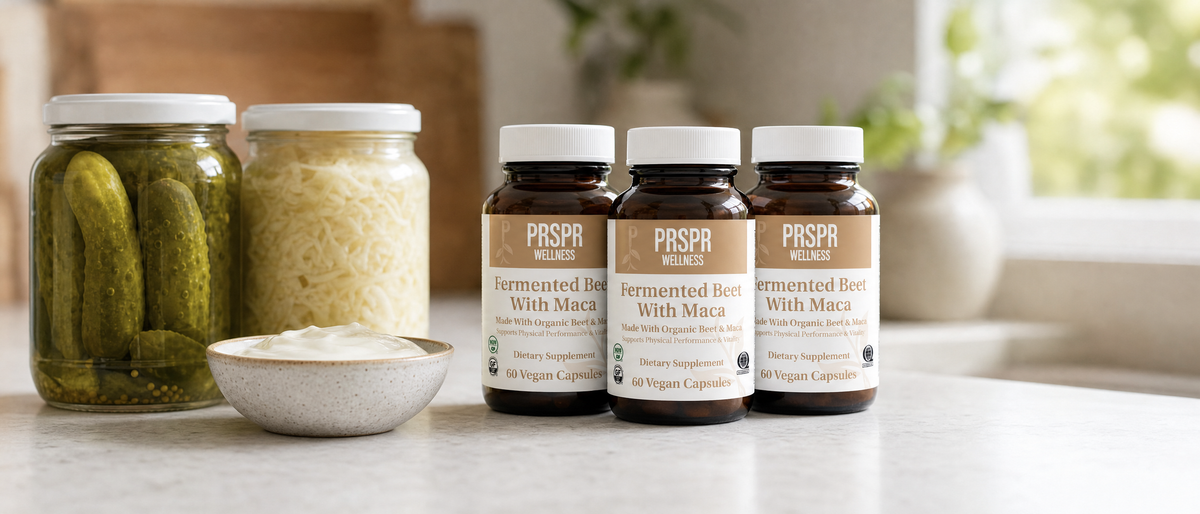
Our Fermented Beet Root & Maca 3 Pack Bundle is three of our Fermented Beet & Maca Capsules, built on beet root and maca. What the word fermented means on a capsule label rather than a grocery jar is its own subject, and we covered it in our beet root and maca label explainer.
It is made in a GMP-certified facility and third-party batch tested, so what is on the label is what is in the bottle.
If the pack size is your next question, our piece on what a three-pack actually buys you runs the arithmetic. Otherwise open the 3 Pack Bundle page and read the panel, or take the build-your-stack quiz.
Answer all five questions to unlock a clear wellness plan made around your goal, schedule, preferred supplement format, and biggest roadblock.
Get clarity on what matters most right now.
See the product and routine connected to your goal.
Simple next steps you can use right away.
Pick the one you would fix first if you could.
This helps us make the guide easier to follow.
Consistency beats the “perfect” routine you never follow.
Be honest. We’re building something you’ll actually use.
Your guide will include one simple way around it.
Answer two more questions to unlock your product starting point, five-step plan, two-week routine, and one practical tip for your biggest roadblock.
Enter your details to open your five-step plan.
Verified PRSPR customer reviews
Expires when you close this page
*Your personal credit for completing the quiz. It's applied automatically at checkout on one-time purchases and expires when the timer runs out.
View full product detailsEverything in your plan, together — one add to cart.
Expires when you close this page
*Your personal credit for completing the quiz. It's applied automatically at checkout on one-time purchases and expires when the timer runs out.
View full product details Mind vocabulary
What is cognition? You have probably seen the word "cognitive" printed on a label, in a headline, or in a product name, and kept scrolling. It is o...
 Biology vocabulary
What is metabolism? You see the word on labels, in gym talk and in nutrition headlines, almost always used as if it were a single setting. Read eno...
 Sleep vocabulary
What are sleep cycles? You hear the phrase on podcasts, see it on sleep trackers, and read it in articles that assume you already know what it mean...