
◎
Get clear
Get clarity on what matters most right now.

Spend ten minutes in gym content and you will hear someone say they are "doing a recomp." It sounds like a program or a product. It is neither. So what is body recomposition? It is a description of a change, and once you know the two words it is built from, the slang reads like a plain sentence.
The short version: body recomposition describes a shift in what a body is made of, not a shift in what it weighs. That distinction is the whole term.
Plenty of people are looking it up. On Google Trends this week (US, past seven days, seed term "body recomposition"), "how does body recomposition work" is up +120%. Among the top related searches, "what is body recomposition" scores 74, "body recomposition women" scores 39, "body recomposition female" scores 28, and "body recomposition meaning" and "body composition" each score 9. Those scores are relative within the body recomposition seed, not absolute search counts.
This piece is a vocabulary lesson. We start with the older term, body composition, then define recomposition, walk through how composition gets measured, and finish with why the phrase shows up so often in women's training content.
You cannot define recomposition without first defining body composition. In the open textbook Exercise and Nutrition by Markell, Peterson and Johnson (hosted on LibreTexts), body composition is described as the ratio of fat mass to fat-free mass.
Those two compartments are the key vocabulary:
That is why two people can weigh the same and still have different body composition. Weight is one number. Composition is a ratio.
Now put "re" in front of it. In a 2022 point-of-view article in the Revista Brasileira de Cineantropometria & Desempenho Humano, Fabricio Boscolo Del Vecchio defines body recomposition as the phenomenon in which body fat goes down and muscle mass goes up at the same time.
The phrase "at the same time" is what separates recomp from other fitness vocabulary. Two compartments move in opposite directions during the same stretch. "Body recomp" is simply the gym-floor clipping of the full term, the same way "pre" stands in for pre-workout.
If you remember one sentence, make it this: body recomposition means the ratio of lean mass to fat mass changes because both compartments change at once.
The rising search "how does body recomposition work" has a definitional answer, and it is mostly arithmetic.
Picture body weight as a sum: fat mass plus fat-free mass. If one number in a sum rises while the other falls, the total can stay flat, drift a little, or move either way, depending on the size of each change. The ratio between the two parts still shifts.
That is why the term exists. A bathroom scale reports the total. It does not report the parts. Recomposition is a word for a change the total can hide, which is why people who use the term care more about the ratio than about scale weight.
That is also where the definition stops. Del Vecchio's article frames recomposition as a phenomenon researchers observe and measure, and the term itself is descriptive. It names an outcome. It does not prescribe a method, and nothing in the word tells you how any particular person's composition will change.
If you want the training vocabulary that sits next to this term in gym content, our explainer on progressive overload and the five things you can add defines that principle, and our glute exercise glossary decodes names like hip thrust and RDL.
Because recomposition is defined by two compartments, the term only means something if those compartments can be estimated. Harvard T.H. Chan School of Public Health's Nutrition Source page on body fat describes the common methods. Here they are in plain terms, as that page describes them.
Dual energy X-ray absorptiometry, usually shortened to DEXA or DXA, uses two low-level X-ray beams to produce estimates of fat-free mass, fat mass and bone mineral density, according to the Harvard page.
Bioelectrical impedance analysis, or BIA, sends a small electric current through the body and measures resistance. The Harvard page explains that the current meets more resistance passing through body fat than through lean mass and water, and the reading is used to estimate composition.
A caliper measures the thickness of a pinch of skin and the fat beneath it at specific sites. The Harvard page lists the torso, thighs, front and back of the upper arm, and under the shoulder blade as examples.
Also called underwater weighing or densitometry. According to the Harvard page, a person is weighed on dry land and again while submerged in a water tank, and formulas are used to estimate body volume, density and body fat percentage.
The same page also describes air-displacement plethysmography, a small chamber that estimates body volume from air pressure differences, and notes that CT and MRI imaging are considered the most accurate methods for measuring fat and lean tissue. Del Vecchio's article lists several of these methods, including bioimpedance, DXA, air displacement plethysmography and magnetic resonance imaging, among the techniques used in recomposition research.
Each method is an estimate built on its own assumptions, which is why research papers name the method they used. The vocabulary point is simple: when someone reports a body composition number, the method is part of the meaning.
Two of the top related searches this week add a word: "body recomposition women" scores 39 and "body recomposition female" scores 28. Together they sit just behind the plain "what is body recomposition" in this week's data.
That tells you something about where the term travels. Recomp is common vocabulary in women's training content, the same corner of the internet that made glute exercise names and progressive overload familiar words. The definition does not change with the audience. Fat mass, fat-free mass and the ratio between them are the same terms whoever is searching. The searches simply show who is reaching for the word right now.
If you came here from that side of the internet, you have probably also seen creatine come up. Our piece on which foods contain creatine covers the vocabulary of where it is found in a regular diet.
Body recomposition is a change in the ratio of lean mass to fat mass, defined in Del Vecchio's 2022 article as body fat decreasing and muscle mass increasing at the same time. "Body recomp" is the short form.
As a term, it works by describing two compartments moving in opposite directions at once. Because body weight is the sum of fat mass and fat-free mass, the ratio can shift even when scale weight barely moves.
Body composition is the ratio of fat mass to fat-free mass at a point in time. Body recomposition is a change in that ratio over time.
We like "body recomp" because, for gym slang, it is unusually honest. It points at the ratio, not the scale. Two compartments, one ratio, and a prefix that says it changed.
So when you see the word, read it literally. It is a description, not a promise. And when someone attaches a number to it, ask the next good question: measured how?
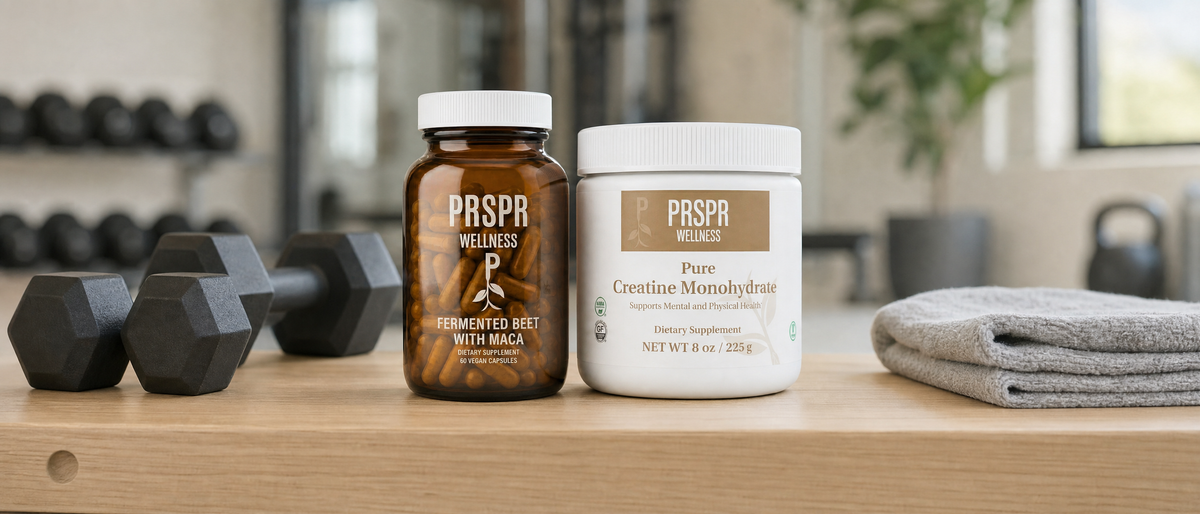
Natures BBL is a bundle that pairs two PRSPR formulas, according to its listing. The product images name the two components: Pure Creatine Monohydrate, an 8 oz (225 g) tub, and Fermented Beet with Maca, a bottle of 60 vegan capsules. The link to this article is the vocabulary of the training content where both creatine and the word recomp show up.
Each formula in the Natures BBL bundle is manufactured in a GMP-certified facility and third-party batch tested, so what's on the label is what's in the bottle.
You can read the full listing on the Natures BBL product page, or browse it in our Bundles collection. What any ingredient might do for you is a question for your healthcare provider. Want to see where it fits with everything else you use? Take the PRSPR Wellness quiz and build a stack around your own routine.
Answer all five questions to unlock a clear wellness plan made around your goal, schedule, preferred supplement format, and biggest roadblock.
Get clarity on what matters most right now.
See the product and routine connected to your goal.
Simple next steps you can use right away.
Pick the one you would fix first if you could.
This helps us make the guide easier to follow.
Consistency beats the “perfect” routine you never follow.
Be honest. We’re building something you’ll actually use.
Your guide will include one simple way around it.
Answer two more questions to unlock your product starting point, five-step plan, two-week routine, and one practical tip for your biggest roadblock.
Enter your details to open your five-step plan.
Verified PRSPR customer reviews
Expires when you close this page
*Your personal credit for completing the quiz. It's applied automatically at checkout on one-time purchases and expires when the timer runs out.
View full product detailsEverything in your plan, together — one add to cart.
Expires when you close this page
*Your personal credit for completing the quiz. It's applied automatically at checkout on one-time purchases and expires when the timer runs out.
View full product details Mind vocabulary
What is cognition? You have probably seen the word "cognitive" printed on a label, in a headline, or in a product name, and kept scrolling. It is o...
 Biology vocabulary
What is metabolism? You see the word on labels, in gym talk and in nutrition headlines, almost always used as if it were a single setting. Read eno...
 Sleep vocabulary
What are sleep cycles? You hear the phrase on podcasts, see it on sleep trackers, and read it in articles that assume you already know what it mean...