
◎
Get clear
Get clarity on what matters most right now.

Glute exercises are having a moment in search, and the words people are typing read like a gym floor plan. Under the broad search "glute workouts," hip abduction machine is rising +110%, romanian deadlift +90% and glute kickback +50%. Among the top searches, glute workouts for women carries a score of 84, glute exercises 63, glute bridges 36, glute muscles 34 and hip thrusts 13.
Look at the shape of that list. Three of the fastest risers are the names of specific moves or machines. The steady top searches are the category words around them. People are hearing these names in gyms, in videos and from friends, and then going home to find out what they actually mean.
So this is a glossary. We are going to name each move, say what the name refers to and quote how named fitness and anatomy references describe it. We are not going to hand you a program, and we are not going to tell you what any of it will do for you. How to train around an injury, or whether a move is safe for you, is a question for a qualified trainer who can watch you do it.
"Glutes" is gym shorthand for three separate muscles, and knowing all three makes every other term on this list easier to read.
Cleveland Clinic puts it plainly: you have three glute muscles, the gluteus maximus, the gluteus medius and the gluteus minimus. The names are a size ranking. Maximus is the biggest, medius the medium and minimus the smallest.
They are also stacked in layers. Cleveland Clinic describes the gluteus maximus as the big muscle inside each buttock, closest to the surface. The gluteus medius sits deeper, with its back part lying under the maximus. The gluteus minimus sits under the medius, and Cleveland Clinic calls it the deepest of the three.
Encyclopaedia Britannica adds the anatomy of what each one does as a joint action. It describes the major action of the gluteus maximus as extension of the thigh, as in rising from a sitting position. It describes the medius and minimus as muscles that abduct the thigh, which Britannica defines as pulling it laterally away from the midline of the body.
Hold onto those two words, extension and abduction. Almost every name in glute exercises is a way of describing one of them.
The first family of moves is about hip extension: the hips start bent and finish straight.
A glute bridge is done on the floor. ACE Fitness's exercise library starts you lying on your back in a bent-knee position, feet flat on the floor. From there, ACE describes pressing your hips up off the floor by contracting your glutes, then lowering back down slowly.
The name is descriptive. At the top, your body forms a span from shoulders to knees, like a bridge. ACE lists glute bridges with no equipment.
Hip thrusts are the bridge moved up onto a bench. ACE Fitness calls the barbell hip thrust "basically a glute or hip bridge exercise with external resistance," done lying face-up with the shoulders resting on a bench, knees bent and feet flat, with a barbell across the hips.
For a form cue, Cleveland Clinic's version has you rest your head, neck and shoulders on a workout bench and push your pelvis up to create a straight line from your knees to your shoulders. ACE also lists a bench version of the bridge, done with dumbbells resting on the hips, which is a close cousin under a different name.
So when you see "hip thrust" and "glute bridge" used almost interchangeably, that is why. Same motion, different starting height and load.
The romanian deadlift, usually shortened to RDL, is a standing hinge. NASM's exercise library starts it with feet hip-width apart and a barbell resting across the thighs, spine neutral.
NASM's cue is to hinge at the hips by pushing them backward while keeping a neutral spine and slightly bent knees, then drive the hips forward to stand upright. The key word is hinge. The knees stay soft but mostly still, and the hips do the travelling. NASM lists the hamstring group and the glutes as the primary muscles for the barbell version.
That hinge is the difference between an RDL and a squat. In a squat, the knees bend a lot and you sit down. In an RDL, the hips push back and the torso tips forward.
The second family moves one leg at a time, or moves the legs apart.
A glute kickback usually means an all-fours move where one leg presses back and up. ACE Fitness's library describes a version it calls quadruped bent-knee hip extensions: kneel with knees under hips and hands under shoulders, then squeeze the gluteus maximus to lift one leg while keeping the knee bent, moving only from the hip joint.
ACE's most useful cue is about the lower back. It says the height of the lift is set by your ability to keep the low back from moving, and it warns against letting the lower back sag. "Quadruped" is just the anatomy word for being on all fours.
The hip abduction machine is the seated gym machine with pads on the outside of your knees. Cleveland Clinic describes the seated abduction machine as one where you push your legs apart against weight resistance, and it names the gluteus medius and minimus as the muscles involved.
That is Britannica's definition of abduction turned into a piece of equipment: the thighs move away from the midline. Its neighbour on most gym floors, the adduction machine, runs the other way and squeezes the legs together. One letter apart, opposite directions.
Glute workouts for women is the biggest top search on this list, with a score of 84. It is worth noting what that tells you: it is how a lot of people phrase the question. It does not mean there is a separate set of moves.
Every reference we quoted above describes the same hip thrust, the same romanian deadlift and the same glute bridge for anyone who does it. The anatomy in Cleveland Clinic and Britannica is not written in two versions. The vocabulary is shared.
We made the same point about a supplement search in our piece on "creatine for women": the search can have a gender, but the label does not. Gym terms work the same way.
Here is where a glossary like this meets a product page.
Listings for gym-adjacent products use the same room's vocabulary: workouts, pre-workout, creatine, counts. Knowing the words for the moves lets you notice when a listing is describing a product and when it is describing a gym session. Those are two different things, and a good label reader keeps them apart.
The useful habit is to read a product listing for its nouns: what is in the box, in what form, in what count. If you want the vocabulary on the supplement side, we unpacked what the word means when a product skips the stimulant in what "pre-workout" means when there's no caffeine in it, and we compared formats in creatine powder or creatine capsules.
Whether any supplement is right for you, alongside any training, is a question for a qualified healthcare professional.
Learn the names before you learn the routine.
Half the confusion in glute exercises comes from the same move wearing three names. A hip thrust is a loaded bridge. A kickback is a quadruped hip extension. An abduction machine is a sentence of anatomy bolted to the floor. Once you can translate the gym word into the joint action, extension or abduction, the whole list gets shorter.
And when a question turns from "what is this called" to "should I be doing this," take it to a qualified trainer who can see your form. A glossary can tell you what a move is. It cannot watch you do it.
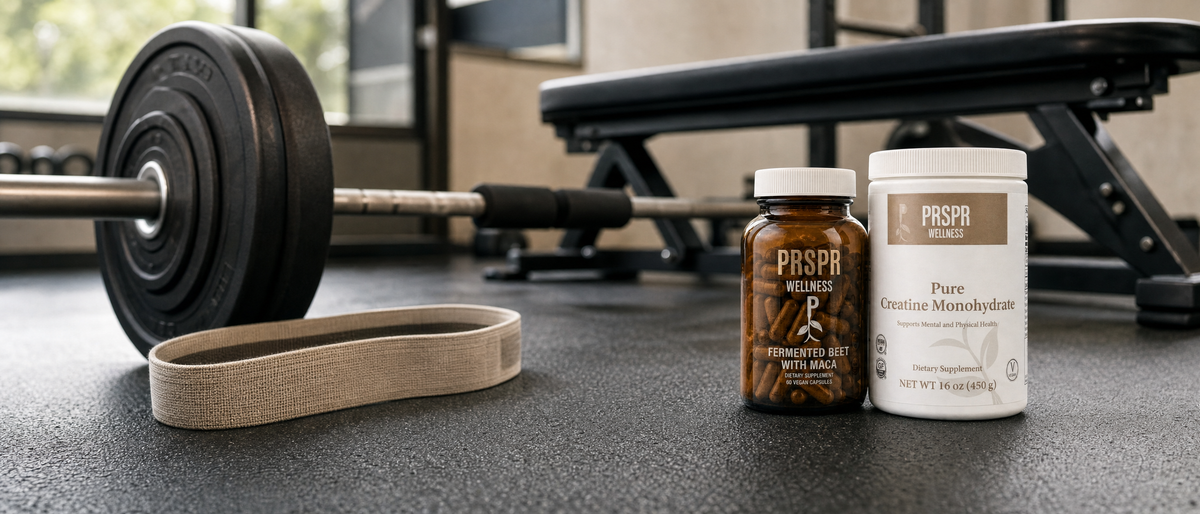
Nature's BBL DELUXE - Upgraded With A Full 90 Count Of Creatine is a bundle of two products we carry: Pure Creatine Monohydrate, in the full 90 count the name refers to, and Fermented Beet & Maca Capsules. The listing also notes no caffeine. That is what the bundle is, in the listing's own terms, and it is the whole of what we say about it.
What we will add in our own voice is how it is made. It is manufactured in a GMP-certified facility and third-party batch tested, so what's on the label is what's in the bottle.
If you want to read the listing for yourself, open the Nature's BBL DELUXE page, browse the rest of our bundles collection, or take the build-your-stack quiz to see where it fits alongside everything else we carry.
Answer all five questions to unlock a clear wellness plan made around your goal, schedule, preferred supplement format, and biggest roadblock.
Get clarity on what matters most right now.
See the product and routine connected to your goal.
Simple next steps you can use right away.
Pick the one you would fix first if you could.
This helps us make the guide easier to follow.
Consistency beats the “perfect” routine you never follow.
Be honest. We’re building something you’ll actually use.
Your guide will include one simple way around it.
Answer two more questions to unlock your product starting point, five-step plan, two-week routine, and one practical tip for your biggest roadblock.
Enter your details to open your five-step plan.
Verified PRSPR customer reviews
Expires when you close this page
*Your personal credit for completing the quiz. It's applied automatically at checkout on one-time purchases and expires when the timer runs out.
View full product detailsEverything in your plan, together — one add to cart.
Expires when you close this page
*Your personal credit for completing the quiz. It's applied automatically at checkout on one-time purchases and expires when the timer runs out.
View full product details Mind vocabulary
What is cognition? You have probably seen the word "cognitive" printed on a label, in a headline, or in a product name, and kept scrolling. It is o...
 Biology vocabulary
What is metabolism? You see the word on labels, in gym talk and in nutrition headlines, almost always used as if it were a single setting. Read eno...
 Sleep vocabulary
What are sleep cycles? You hear the phrase on podcasts, see it on sleep trackers, and read it in articles that assume you already know what it mean...