
◎
Get clear
Get clarity on what matters most right now.

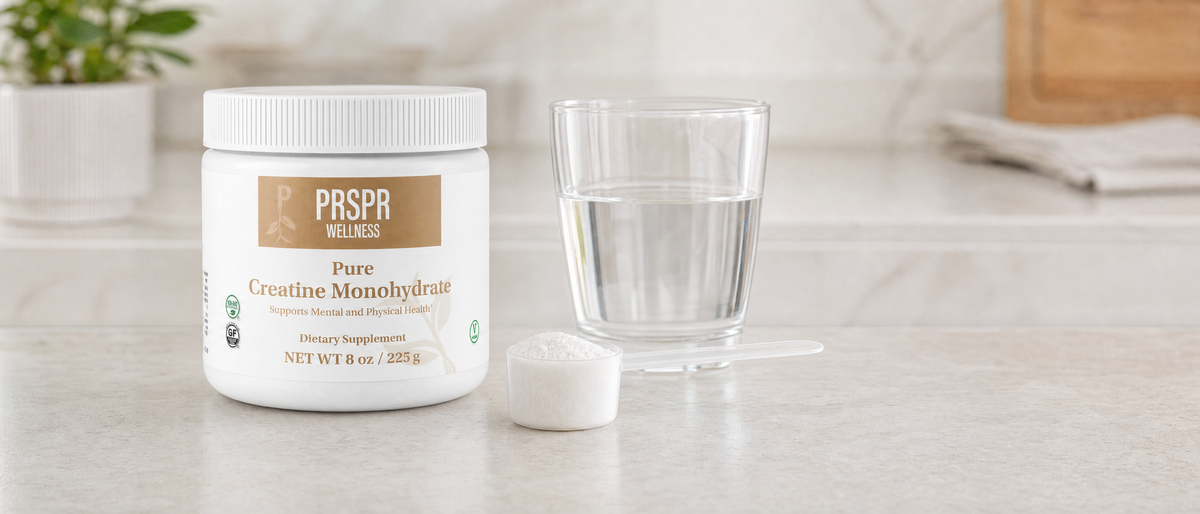
Creatine for women is holding a volume score of 53 this week. Creatine monohydrate for women is at 35. Both of them are substantial, both of them have been climbing for a while, and both of them are asking a question that the container cannot answer, because a tub of creatine monohydrate does not have a gender printed on it anywhere.
Around those two sit the definitional searches. What is creatine at 88, what is creatine monohydrate at 63, creatine vs creatine monohydrate at 63, taking creatine at 54. Creatine benefits and creatine monohydrate benefits are both live too. It is a shelf where an enormous number of people are still working out what the thing is, and a growing number are specifically asking whether it is for them.
This article is about that gap: what a single-ingredient label actually specifies, and the long list of things it deliberately says nothing about.
Creatine is a compound that occurs naturally in the human body and in some foods, notably meat and fish. It is not a vitamin, not a mineral, and not a herb. It is a nitrogen-containing organic acid that the body also makes for itself from amino acids, which puts it in an unusual category on a supplement shelf: a substance you already contain.
Creatine monohydrate is that compound in a specific crystalline form, bound with one molecule of water. Monohydrate says exactly that and nothing more. Mono is one, hydrate is water. It is a description of the molecule as packaged, which is why the answer to creatine vs creatine monohydrate is not a contest. Creatine is the category. Monohydrate is the named form, and it is the oldest and most widely sold one.
The reason the distinction matters on a shelf is the same reason it matters with magnesium, where we made the same argument about form words. A label that names its form is telling you what you are buying. A label that gives you only the category name is telling you less, and less is never the more transparent option.
Our tub is a single-ingredient product, and single-ingredient labels are the easiest kind to read because there is nowhere to hide. Here is what one actually states.
It states the compound, by its full form name. It states a net weight, which for our tub is 8 oz, or 225 g. It states a serving size and the amount of the compound per serving, so that the weight can be converted into servings. And it states the other ingredients, which on a genuinely single-ingredient product is a very short line.
That is the complete list of what the panel is responsible for. Notice what is not on it: no recommended user, no audience, no body type, no training style, no gender. Those things are absent because they are not properties of the compound. The tub is the same tub regardless of who reaches for it.
Net weight is the part most people skip and the part that matters most for comparing prices. Creatine is sold by mass, so two containers with identical front labels can hold very different amounts. Divide the weight by the serving size and you have the number of servings, which is the only figure that makes two products comparable.
Taking creatine, at 54, is worth separating from the rest of the list because it is a procedural search rather than a definitional or an outcome one. People asking it want to know what the routine looks like in practice: when, with what, how it is measured. That is exactly the kind of question the directions panel on your own container is written to answer, and the directions differ between products. Read the one you own rather than the one in a video.
Here is the bridge. If the label has no gender, why are so many people typing one into a search box every month? The answer is that they are not asking a chemistry question. They are asking a permission question.
This shelf has been merchandised toward one audience for decades. The packaging, the photography, the aisle placement and the surrounding marketing all pointed one way, and the effect of that is a large group of people who have every reason to be interested in a compound and no signal telling them it was meant for them. When there is no signal, people search for one. Creatine for women is what that search looks like.
So the honest answer to the query is not a formulation answer. It is that the compound is the compound, the label is the label, and the question of whether any specific person should take any specific supplement is a question for a doctor or a registered dietitian who knows their situation. That applies to creatine benefits and creatine monohydrate benefits too. Those are outcome searches, they are enormous, and we are not going to answer them in our own voice. What we can do is stop the packaging from being the reason someone thinks a question is not theirs to ask.
One practical note on the powder form itself, since it is the format most of this shelf uses. A powder is measured by scoop, and a scoop is a volume while the label states a mass. Those two agree only when the powder is level and settled, which is why the printed serving size in grams is the number that actually defines a serving. If you want to be precise, a kitchen scale settles it. If you do not, a level scoop is close enough for most people, and the label tells you which it assumed.
The silence of a good label is a feature and we do not say that often enough. A single-ingredient panel that lists one compound, one weight and one serving size is making a small number of checkable statements, and it is refusing to make any of the unfalsifiable ones. That refusal is what integrity looks like on a container.
The failure is upstream, in how the category was sold. A compound that occurs in the human body and in ordinary food got marketed as though it belonged to one demographic, and the search data is now full of people politely asking for permission to buy it. Nobody needs permission. They need a legible panel and a conversation with their own healthcare professional, and the second one is not our department.
Our Pure Creatine Monohydrate is a single-ingredient supplement made with creatine monohydrate, in an 8 oz / 225 g tub. One compound, named by its form, with the weight printed on the front. It is manufactured in a GMP-certified facility and third-party batch tested, so what is on the label is what is in the container. Clear amounts, no guesswork.
The panel is on the Pure Creatine Monohydrate page, and it sits with the rest of that shelf on our muscle and joint page. If a search box has not been much help so far, take the quiz and start from what you already take.
Answer all five questions to unlock a clear wellness plan made around your goal, schedule, preferred supplement format, and biggest roadblock.
Get clarity on what matters most right now.
See the product and routine connected to your goal.
Simple next steps you can use right away.
Pick the one you would fix first if you could.
This helps us make the guide easier to follow.
Consistency beats the “perfect” routine you never follow.
Be honest. We’re building something you’ll actually use.
Your guide will include one simple way around it.
Answer two more questions to unlock your product starting point, five-step plan, two-week routine, and one practical tip for your biggest roadblock.
Enter your details to open your five-step plan.
Verified PRSPR customer reviews
Expires when you close this page
*Your personal credit for completing the quiz. It's applied automatically at checkout on one-time purchases and expires when the timer runs out.
View full product detailsEverything in your plan, together — one add to cart.
Expires when you close this page
*Your personal credit for completing the quiz. It's applied automatically at checkout on one-time purchases and expires when the timer runs out.
View full product details Electrolytes
Salt is having a comparison week. Searches for celtic sea salt vs himalayan pink salt are up about 70 percent, pink himalayan salt vs table salt is...
 Kids
KidsPick up a box of children's snacks and somewhere on the front there is a number with the letter g after it, next to the word fiber. It looks like o...
 Label Reading
It is printed on the front of a lot of mineral bottles and it is one of the least understood words in the supplement business. Chelated. Search int...