
◎
Get clear
Get clarity on what matters most right now.

What is chloride? A lot of people are typing that exact question right now, and it is sitting inside a cluster of searches that all orbit one ordinary kitchen staple. Sodium chloride carries a volume score of 100 this week, sodium 96, what is chloride 58, what is sodium chloride 20, and chloride formula 15.
Read those in order and you can watch the curiosity move. It starts with the full chemical name for salt, drops to the first half of that name, then lands on the second half and asks what it actually is. Then it asks how chemists write it down.
That second half is the part nobody says out loud. You say "salt." You say "sodium." You almost never say "chloride," even though it is printed on mineral drink labels, on water quality reports and in every chemistry textbook. So people are looking it up.
We are going to stay on the chemistry and the naming, because that is what these searches are asking and because it is answerable from any standard reference. What chloride does in a body is a question for a qualified healthcare professional. We are not going to answer it in either direction.
Chloride is an ion. That is the plain answer, and every other part of this article hangs off it.
An ion is an atom, or a small group of atoms, that carries an electric charge. Atoms are normally neutral: the positive charge in the nucleus is balanced by the negative charge of the electrons around it. When an atom gains or loses an electron, that balance breaks, and the atom becomes an ion.
Chloride is what you get when a chlorine atom gains an extra electron. It now carries more negative charge than positive, so it is a negatively charged ion. Chemists call a negatively charged ion an anion, and a positively charged ion a cation. Chloride is an anion.
That single change matters more than it sounds. Chlorine and chloride share a name and a nucleus, but they behave like different substances. Chlorine, as an element on its own, is a reactive gas. Chloride is the stable, charged form that shows up bonded inside salts and dissolved in water. When a label or a textbook says chloride, it means the ion, not the gas.
The chloride formula is written Cl⁻. The Cl is the chemical symbol for chlorine, and the small minus sign raised after it marks the negative charge. That minus sign is the whole difference between the element and the ion on paper.
If you search chloride formula and get back a page of longer formulas, that is because chloride almost never travels alone. It is usually written as part of a compound, paired with a cation that balances its charge. Which brings us to the most famous pairing of all.
Sodium chloride is table salt. It is the chemical name for the white crystals in your shaker, and it is written NaCl.
The formula tells you what is inside. Na is the symbol for sodium (it comes from the Latin name for the element, which is why it does not start with S). Cl is chlorine, present here as chloride. Sodium gives up an electron and becomes a positively charged sodium ion. Chlorine takes one and becomes a negatively charged chloride ion. Opposite charges attract, and the ions lock together into a repeating crystal lattice. That lattice is the cube-shaped grain you see under a magnifying glass.
This is called an ionic compound: a substance held together by the attraction between oppositely charged ions rather than by shared electrons. Sodium chloride is the textbook example, and it is the reason the top search on this week's list is also the most basic.
Put sodium chloride in water and the lattice comes apart. The water pulls the ions away from each other, and you are left with sodium ions and chloride ions moving freely through the liquid. Chemists call any substance that splits into ions like this an electrolyte, because a solution full of free ions can carry an electric current. That is the chemistry definition of the word, and it is worth holding onto, because the same word is printed on the front of drink mixes.
Sodium, the second search on the list, is a separate element. As a pure metal it is soft, silvery and reactive enough that chemistry labs store it under oil. You will not find it in that form in a kitchen or on a supplement label. When a label or a food panel says sodium, it means the sodium ion, the same charged form you just watched break loose from a salt crystal.
So sodium and chloride are partners in salt, but they are not the same thing, and neither one is salt by itself. Salt is the compound. Sodium and chloride are the ions it is built from.
Merriam-Webster traces chlorine to the Greek word chlōros, meaning greenish yellow, after the colour of the gas. So the element is literally named for what it looks like.
Chloride takes that root and adds the ending "-ide." In the naming system chemists use, set out in IUPAC nomenclature, a simple negative ion made from a single element takes the "-ide" suffix. You already know the pattern from other words: oxide from oxygen, fluoride from fluorine, sulfide from sulfur, iodide from iodine. Chloride from chlorine is the same move.
That rule is why salt names read in a fixed order. The cation comes first and keeps its element name. The anion comes second and wears its "-ide." Sodium chloride. It is a short phrase that tells you both ions, and which one is carrying the negative charge.
We covered the same grammar from a different angle in our piece on why iron is sold as several different salts. There, the second word changed and the mineral stayed put. Here, the second word is the thing people are searching for.
Here is where this stops being a chemistry lesson and becomes a label-reading skill.
Mineral labels are usually written in ions, not compounds. Instead of naming the salt that went into the tub, they name the charged pieces: sodium, potassium, magnesium, calcium, chloride. It is the same convention a water quality report uses. Once you know that, a line reading "chloride" stops looking strange. It is the anion half of whatever salts went in, counted on its own.
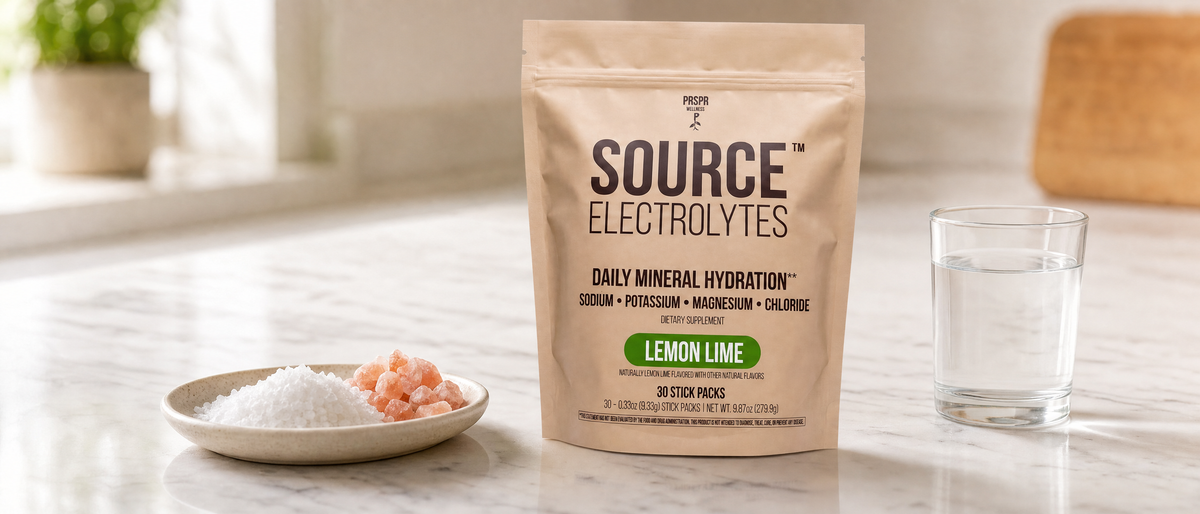
Our own Source Electrolytes listing reads exactly like that. It names chloride as its own item, next to sodium, and it also names Himalayan pink salt separately.
That second detail is worth slowing down on. Himalayan pink salt is a rock salt. Encyclopaedia Britannica describes rock salt as halite, the mineral form of sodium chloride. So a label can name the salt as a material, and also name sodium and chloride as ions, and both lines are describing chemistry that genuinely overlaps. If you want the material side of that story, our comparison of pink salt, sea salt and table salt goes rock by rock.
What the listing does not do is name which compound the chloride line comes from. It says chloride. It does not say sodium chloride, or any other chloride salt, beside it. So read it at its actual size: it tells you chloride is there, and it stops there. We are not going to fill that in by guessing.
For a full walk through every mineral line on a label like this, our guide to reading an electrolyte label as a chemistry list covers the whole panel. This piece zooms in on the one word that list tends to skip past.
Chloride deserves to be said out loud.
It is half of the most familiar compound in your kitchen, and it spends most of its life hidden behind the word "salt." That hiding is harmless at the dinner table. On a label, it costs you. If you do not know chloride is an ion, the word looks like an additive. If you do know, it reads like what it is: a plain, specific piece of chemistry.
We also think mineral labels would be better if they named the compound behind each ion line, not only the ion. An extra word turns "chloride" into a complete answer. That applies to our own listing, which names the ion and not the salt form. We would rather point at that gap ourselves than pretend the industry habit is good enough.
So here is the habit we want you to build. When you see an "-ide" on a label, name the element it came from, and ask what it is paired with. That question will make every mineral panel you pick up easier to read.
Source Electrolytes - Daily Mineral Hydration is a stick-pack electrolyte and trace mineral drink mix formulated with Vitamin C, calcium, magnesium, zinc, chloride, sodium, potassium, D-Ribose, taurine, Himalayan pink salt, L-theanine, and ConcenTrace® concentrated seawater. It has no added sugar and comes in Lemon Lime and Pink Lemonade. That is the listing's own description, and it is the whole of what we say the product is.
What we will add in our own voice is how it is made. Source Electrolytes is manufactured in a GMP-certified facility and third-party batch tested, so what is on the label is what is in the bottle. No guessing, no filler, no cutting corners.
If you want to see the chloride line for yourself, go to the source. Open the Source Electrolytes page and read the ingredient list as it is written, browse the rest of the vitamins and supplements collection, or take the build-your-stack quiz to see where it fits alongside everything else we carry.
Answer all five questions to unlock a clear wellness plan made around your goal, schedule, preferred supplement format, and biggest roadblock.
Get clarity on what matters most right now.
See the product and routine connected to your goal.
Simple next steps you can use right away.
Pick the one you would fix first if you could.
This helps us make the guide easier to follow.
Consistency beats the “perfect” routine you never follow.
Be honest. We’re building something you’ll actually use.
Your guide will include one simple way around it.
Answer two more questions to unlock your product starting point, five-step plan, two-week routine, and one practical tip for your biggest roadblock.
Enter your details to open your five-step plan.
Verified PRSPR customer reviews
Expires when you close this page
*Your personal credit for completing the quiz. It's applied automatically at checkout on one-time purchases and expires when the timer runs out.
View full product detailsEverything in your plan, together — one add to cart.
Expires when you close this page
*Your personal credit for completing the quiz. It's applied automatically at checkout on one-time purchases and expires when the timer runs out.
View full product details Mind vocabulary
What is cognition? You have probably seen the word "cognitive" printed on a label, in a headline, or in a product name, and kept scrolling. It is o...
 Biology vocabulary
What is metabolism? You see the word on labels, in gym talk and in nutrition headlines, almost always used as if it were a single setting. Read eno...
 Sleep vocabulary
What are sleep cycles? You hear the phrase on podcasts, see it on sleep trackers, and read it in articles that assume you already know what it mean...