
◎
Get clear
Get clarity on what matters most right now.

What is extra virgin olive oil is sitting at a volume score of 100 this week, the top of its cluster. Right behind it, three searches are tied at 82: organic extra virgin olive oil, extra virgin olive oil vs olive oil, and virgin vs extra virgin olive oil. Extra virgin cold pressed olive oil holds 37. The difference between extra virgin olive oil and olive oil sits at 31, and the difference between virgin and extra virgin olive oil at 30.
Read those together and they are really one question asked seven ways. People can see that the bottles on the shelf say different things, and they want to know whether the words mean anything.
They do. Extra virgin is not a mood or a marketing tier. It is a grade, defined in writing by an international standard-setting body, with a number and a tasting test attached. Once you know what the grade requires, every other olive oil label on the shelf gets easier to read.
The body that writes the definition is the International Olive Council, headquartered in Madrid. Its trade standard for olive oils and olive pomace oils, reference COI/T.15/NC No 3, reached its twentieth revision in November 2024.
The standard starts with a family called virgin olive oils. To belong to it, an oil has to be obtained from the fruit of the olive tree, Olea europaea, solely by mechanical or other physical means, under conditions, particularly thermal conditions, that do not alter the oil. The only other handling allowed is washing, decantation, centrifugation and filtration. No solvents, no refining.
Within that family, extra virgin olive oil is the top grade, and it has to pass two separate kinds of test.
Free acidity is a measure of fatty acids that are free in the oil rather than bound into its fat molecules. The standard also sets other chemical limits for the grade, but acidity is the one people quote.
The second test is the one that surprises people. A number from a lab is not enough to make an oil extra virgin. It also has to be tasted.
The council publishes its own method for this, the organoleptic assessment of virgin olive oil, reference COI/T.20/Doc. No 15. The method calls for a panel of between 8 and 12 tasters for each test, selected, trained and monitored by a panel leader. Samples are served in standardized, code-numbered tasting glasses kept at 28 degrees Celsius, plus or minus 2.
The tasters score named defects, and the method defines each one. Fusty or muddy sediment comes from olives that fermented while piled or stored. Winey or vinegary is what it sounds like. Rancid is the flavor of oils that have undergone an intense process of oxidation. Frostbitten olives, sometimes called wet wood, comes from fruit injured by frost on the tree. On the positive side the method names three attributes: fruity, bitter and pungent.
The panel's median is what counts. For extra virgin, the median defect has to be zero. That is why the grade is as much a sensory statement as a chemical one.
This is where the difference between virgin and extra virgin olive oil lives, and it is narrower than the names suggest. Both come from the same family and the same mechanical process. The difference is in the test results.
So a virgin olive oil is allowed a slight, panel-detectable defect and more free acidity. Below those two grades the standard lists ordinary virgin olive oil, up to 3.3 grams per 100 grams, which may only be sold to consumers where the country of sale permits it, and lampante virgin olive oil, which the standard places among oils that must be processed before consumption and describes as intended for refining or technical use.
The single most confusing word on the shelf is the plain one. Under the council's standard, the designation olive oil on its own belongs to a blend: refined olive oil combined with virgin olive oils, with free acidity of not more than 1.00 gram per 100 grams.
Refined olive oil is oil obtained from virgin olive oils by refining methods, and it is capped at 0.30 grams per 100 grams. So the difference between extra virgin olive oil and olive oil is not a matter of degree on one scale. One is an unrefined oil that passed a tasting panel. The other is a blend that contains refined oil by definition.
Two more details are worth knowing. Olive pomace oil, obtained by treating olive pomace with solvents or other physical treatments, cannot be sold under the name olive oil at all. And the council's list of designations for the label is short: extra virgin, virgin, ordinary virgin, refined, and olive oil. Words like light or pure are not on that list.
Organic extra virgin olive oil stacks two separate statements. Extra virgin is the grade described above, and the grade definitions say nothing about how the trees were farmed. Organic, on a US label, is governed by the USDA National Organic Program under 7 CFR Part 205 and describes how the product was produced and handled. One statement does not imply the other.
Extra virgin cold pressed olive oil is a similar stack. The council's grade definitions already require mechanical extraction under thermal conditions that do not alter the oil, so the word cold is not part of the grade. European Union rules go further and put a number on it. Under Commission Delegated Regulation (EU) 2022/2104, first cold pressing may appear only on extra virgin or virgin olive oils obtained below 27 degrees Celsius from a first mechanical pressing in a traditional hydraulic press, and cold extraction only on those oils obtained below 27 degrees by percolation or centrifugation of the paste.
So cold pressed is a temperature and method statement layered on top of a grade. Where a rule defines it, it means a specific thing. Where none does, the grade is still the part you can check.
Avocado oil is another oil pressed from fruit flesh, with a much younger grading vocabulary than olive oil's. We look at what unrefined, refined and a smoke point mean for it in avocado oil comes from the fruit, not the pit.
We think extra virgin is one of the most useful words in the whole grocery store, precisely because it is not ours to define. It comes with a free acidity limit, a named list of defects and a trained panel, and none of that is written by the company filling the bottle.
That is also why we care about a base oil being named by grade. An ingredient line that says olive oil could, under the council's own vocabulary, mean a blend containing refined oil. An ingredient line that says extra virgin olive oil points you to a specific, published set of tests. When a label gives you a grade, it is handing you something you can look up.
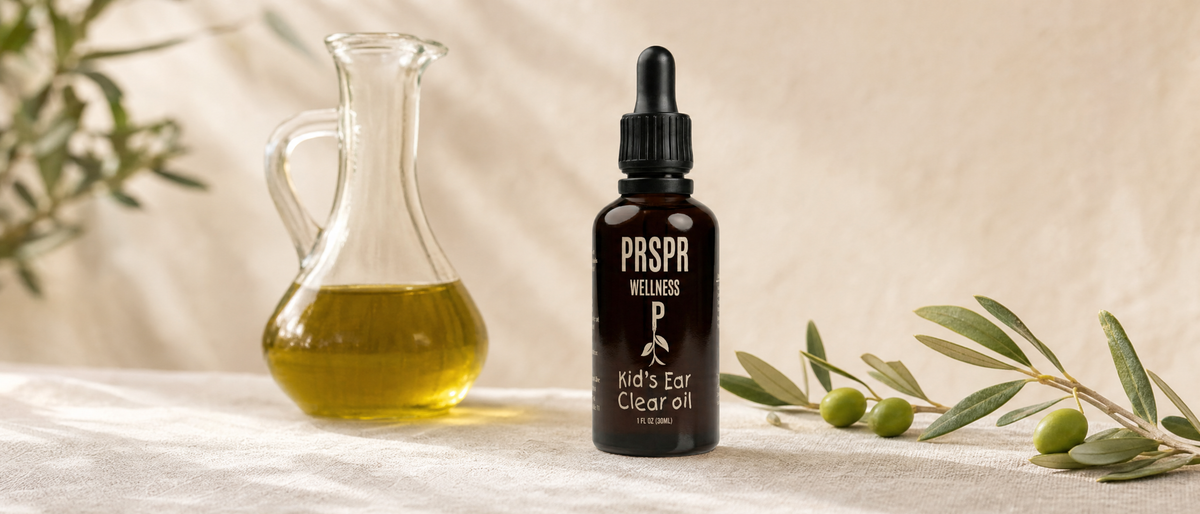
Our Kids Ear Clear Oil is, as its live listing puts it, organic, wild-harvested herbs combined with Extra Virgin Olive Oil. The base oil is named by its grade, which is exactly the label habit this article has been about.
What we add in our own voice is the quality story alone. It is made in a GMP-certified facility and third-party batch tested, so what is on the label is what is in the bottle.
For a piece about a plant rather than a grade, read mullein, a roadside weed with a very old job. Otherwise open the product page and read the listing, browse the women and children's health collection, or take the build-your-stack quiz.
Answer all five questions to unlock a clear wellness plan made around your goal, schedule, preferred supplement format, and biggest roadblock.
Get clarity on what matters most right now.
See the product and routine connected to your goal.
Simple next steps you can use right away.
Pick the one you would fix first if you could.
This helps us make the guide easier to follow.
Consistency beats the “perfect” routine you never follow.
Be honest. We’re building something you’ll actually use.
Your guide will include one simple way around it.
Answer two more questions to unlock your product starting point, five-step plan, two-week routine, and one practical tip for your biggest roadblock.
Enter your details to open your five-step plan.
Verified PRSPR customer reviews
Expires when you close this page
*Your personal credit for completing the quiz. It's applied automatically at checkout on one-time purchases and expires when the timer runs out.
View full product detailsEverything in your plan, together — one add to cart.
Expires when you close this page
*Your personal credit for completing the quiz. It's applied automatically at checkout on one-time purchases and expires when the timer runs out.
View full product details Mind vocabulary
What is cognition? You have probably seen the word "cognitive" printed on a label, in a headline, or in a product name, and kept scrolling. It is o...
 Biology vocabulary
What is metabolism? You see the word on labels, in gym talk and in nutrition headlines, almost always used as if it were a single setting. Read eno...
 Sleep vocabulary
What are sleep cycles? You hear the phrase on podcasts, see it on sleep trackers, and read it in articles that assume you already know what it mean...