
◎
Get clear
Get clarity on what matters most right now.

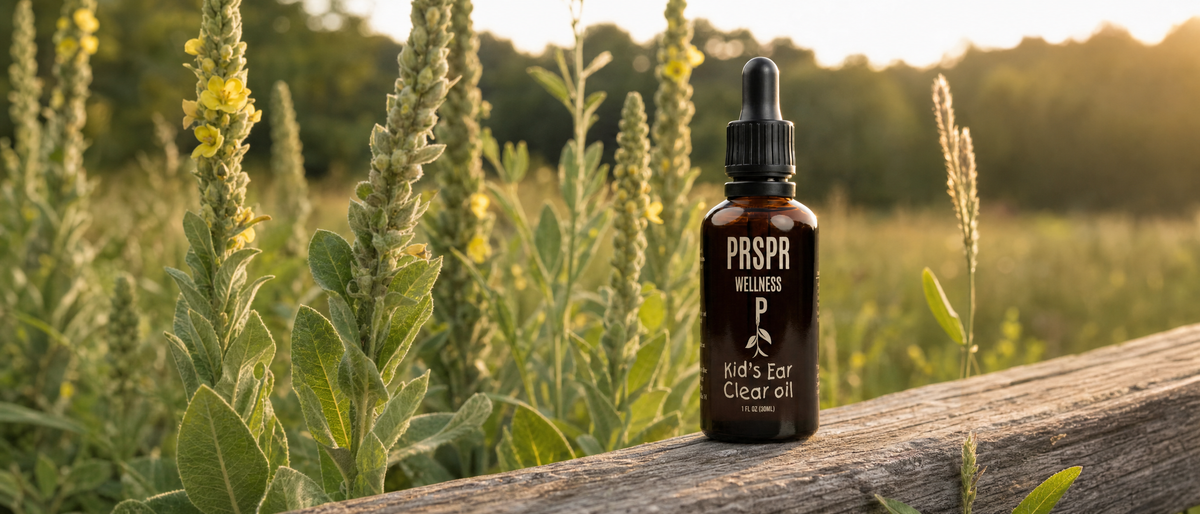
There is a plant growing on the verge of a road near you right now that is almost certainly two metres tall, covered in leaves like grey felt, and topped with a spike of small yellow flowers. Most people walk past it without registering it as anything. It has been deliberately harvested and infused into oil for a very long time.
Search interest is climbing. Over the past week, mullein leaf benefits rose 150 percent in related queries and mullein tea rose 50 percent. On the volume side, mullein garlic oil topped the group at 100, with mullein ear oil at 67, mullein garlic ear oil at 46, mullein benefits at 26 and mullein leaf at 25.
This is a piece about a plant and a preparation. What mullein is botanically, how an infused oil is made, and why mullein and garlic keep turning up in the same bottle. It describes no use, names no condition, and makes no claim about what any of it does.
Mullein is Verbascum thapsus, in the figwort family. It is a biennial, which means it lives for two years and does two entirely different things in each of them.
In its first year it produces only a low rosette of leaves flat against the ground. Those leaves are the famous part: large, oval, and covered in dense branching hairs that give them a soft grey green felted texture. The plant has picked up a long list of common names because of them, including flannel leaf, velvet dock and beggar's blanket, all describing the same tactile quality.
In the second year it sends up a single unbranched flowering stalk that regularly reaches two metres and occasionally more. That stalk carries small yellow five petalled flowers packed densely along its length, opening a few at a time over a long season rather than all at once.
It is native to Europe, north Africa and Asia, and it arrived in North America with European settlers, where it naturalised comprehensively. It favours exactly the ground nobody is managing: roadsides, railway embankments, gravel, quarry edges, disturbed soil after fire or construction. That is why mullein leaf as a search term is usually attached to foraging content. It is one of the easiest plants in the temperate world to identify and one of the most reliably available if you know what you are looking at.
An infused oil is not an essential oil and the two are made by completely different processes. Essential oils are produced by distillation or expression and are highly concentrated volatile compounds. An infused oil is much simpler and much older.
You take plant material and you steep it in a carrier oil. Olive oil is the traditional carrier across the whole Mediterranean and European herbal tradition, partly because it was the oil people had. The plant material sits in the oil, either warmed gently over a long period or left in sunlight for weeks, and compounds that are soluble in oil move out of the plant and into the carrier. Then the solids are strained out and what remains is the infusion.
The result is mostly carrier oil. That is the honest description of what an infused oil is: a carrier that has been in prolonged contact with a plant. Whether the flowers, the leaves or the root are used changes what goes in, and mullein preparations most often specify flowers, which are harvested a few at a time as they open across that long flowering season. It is slow work, and it is one reason mullein flower preparations have historically been made in small quantities.
Mullein tea, the other rising search here, is the water based version of the same idea. Water pulls out a different set of compounds than oil does, which is why herbal traditions maintain both preparations from the same plant rather than treating them as interchangeable.
Two practical properties follow from that method and both show up on labels. First, an infused oil has a shelf life governed mostly by the carrier rather than the plant, because a carrier oil goes rancid on its own schedule. Second, the strength of an infusion depends on ratio, contact time and temperature, none of which are standardised across the tradition. That is why a well made modern infusion prints its plant amounts per millilitre. It converts an old craft preparation into something you can actually compare between bottles.
Here is the pattern that explains the top search in this whole cluster. Mullein garlic oil at 100 is a bigger phrase than mullein oil on its own, and the pairing is not a modern marketing invention.
Garlic, Allium sativum, is one of the most widely used plants in recorded human history and has been prepared in oil for centuries across Mediterranean, South Asian and European traditions. Its compounds behave well in an oil infusion. Mullein flower and garlic bulb appear together in traditional herbal formularies long before either had a website.
The naming in search reflects that. Mullein ear oil at 67 and mullein garlic ear oil at 46 are format names, describing a dropper bottle of infused oil rather than the plant itself. They exist as search terms because that is the form the preparation is sold in, in the same way people search sesame oil rather than sesame.
What we are not doing, deliberately and completely, is telling you what any of that preparation is for. Mullein leaf benefits and mullein benefits are the two benefit shaped searches in this group and they are recorded here as things people type. We do not make claims about what it does, so we describe the plant and the preparation and stop. Anything to do with symptoms or with a child's health is a conversation for a qualified healthcare professional.
The thing we like about mullein is that it is completely unglamorous.
It grows in gravel. It is a weed by any ordinary definition, the kind of plant that colonises the ground after something has been dug up or burned. Its common names are about how the leaves feel, not about what anyone claims it can do. And it has been in continuous herbal use for centuries anyway, quietly, without ever having a moment.
That is a useful corrective to how wellness content usually works, where a plant needs an origin story involving a remote valley and a rare harvest before anyone will take it seriously. Some of the oldest preparations in the tradition are made from things growing by the side of a road. We took a similar view of another everyday plant in our piece on what elderberry actually is.
Our Kids Ear Clear Oil is an infused oil of exactly the kind described above. Its panel lists mullein flower at 83 mg per ml, coptis root at 66, garlic bulb at 33 and arnica flower at 14, in a base of extra virgin olive oil. It sits in our women's and children's health collection.
What we will state about it is what the panel states. The herbs are organic and wild harvested, the carrier is extra virgin olive oil, the amounts are printed per millilitre rather than hidden inside a blend name, and it is made in a GMP certified facility and third party batch tested. Clear amounts, no guesswork. Nothing further, and nothing about what it is for.
If you want help working out what belongs in your household routine, take the quiz and build your own stack.
Answer all five questions to unlock a clear wellness plan made around your goal, schedule, preferred supplement format, and biggest roadblock.
Get clarity on what matters most right now.
See the product and routine connected to your goal.
Simple next steps you can use right away.
Pick the one you would fix first if you could.
This helps us make the guide easier to follow.
Consistency beats the “perfect” routine you never follow.
Be honest. We’re building something you’ll actually use.
Your guide will include one simple way around it.
Answer two more questions to unlock your product starting point, five-step plan, two-week routine, and one practical tip for your biggest roadblock.
Enter your details to open your five-step plan.
Verified PRSPR customer reviews
Expires when you close this page
*Your personal credit for completing the quiz. It's applied automatically at checkout on one-time purchases and expires when the timer runs out.
View full product detailsEverything in your plan, together — one add to cart.
Expires when you close this page
*Your personal credit for completing the quiz. It's applied automatically at checkout on one-time purchases and expires when the timer runs out.
View full product details Electrolytes
Salt is having a comparison week. Searches for celtic sea salt vs himalayan pink salt are up about 70 percent, pink himalayan salt vs table salt is...
 Kids
KidsPick up a box of children's snacks and somewhere on the front there is a number with the letter g after it, next to the word fiber. It looks like o...
 Label Reading
It is printed on the front of a lot of mineral bottles and it is one of the least understood words in the supplement business. Chelated. Search int...