
◎
Get clear
Get clarity on what matters most right now.

Somebody tells you they lost three hours to a project and did not notice the time go. Somebody else says a musician was "in the zone" the whole second set. Both are reaching for the same idea, and more and more people want the proper name for it. So, what is flow state? It is a psychology term first, with a researcher, a definition and a chart behind it, and it was a term in academic journals long before it turned up on productivity blogs.
The search data this week shows how many people are asking. On Google Trends (US, past seven days), within the "flow state" seed, "state of flow" holds the top relative volume score of 100. "The flow state" scores 94, "what is flow state" scores 58, "what is the flow state" scores 49 and "what is a flow state" scores 46. Further down, "flow state meaning" scores 12, "flow state chart" scores 7 and "flow state definition" scores 5. These scores are relative within the seed, not absolute search counts. The pattern is clear, though: people are not asking how to buy flow. They are asking what the word means.
This piece covers the vocabulary: the dictionary definition, where the word came from, the chart psychologists draw, and why "in the zone" keeps showing up next to it.
Start with the most official source there is for psychology vocabulary. The APA Dictionary of Psychology, published by the American Psychological Association, defines flow as "a state of optimal experience arising from intense involvement in an activity that is enjoyable." Its examples are ordinary ones: playing a sport, performing a musical passage, writing a creative piece.
The same APA entry then lists the conditions that make up the state. According to the APA Dictionary, flow arises when a person's skills are fully used yet equal to the demands of the task, motivation comes from the activity itself, self-consciousness and awareness of time drop away, and the person has a sense of control, effortlessness and complete concentration on the here and now.
So the flow state definition, in its most formal version, has two halves. One half is a description of an experience: absorbed, unselfconscious, time slipping by. The other half is a condition about the task: the challenge matches the skill. Hold onto that second half, because it is the whole basis of the flow state chart further down.
The word belongs to one researcher. According to an obituary published by the Centre for the Understanding of Sustainable Prosperity (CUSP), written by Amy Isham and Tim Jackson, psychologist Mihaly Csikszentmihalyi coined the term "flow" to describe what he heard in interviews with artists, rock climbers, athletes, dancers, composers and chess players.
The same obituary explains the choice of word. One musician it quotes described the experience by saying "the music just flows out of itself." The everyday verb became the technical noun.
The dates matter, because the search results muddle them. The CUSP obituary lists two books: Beyond Boredom and Anxiety (1975) and Flow: The Psychology of Optimal Experience (1990). A 2020 review in Frontiers in Psychology by Sami Abuhamdeh cites the 1975 book as where Csikszentmihalyi first set out the concept. The APA Dictionary, for its part, attaches the term to the 1990 book, which is the one that carried the idea to a general readership.
The researcher's background is on record too. According to the University of Chicago's obituary, Csikszentmihalyi was born on September 29, 1934, earned his PhD at the University of Chicago in 1965, joined its faculty in 1969, and died in October 2021 at age 87. The same obituary says his flow studies drew on interviews with scientists, athletes, musicians, artists and business executives.
Abuhamdeh's review also credits Csikszentmihalyi and colleagues (1977) with pioneering the Experience Sampling Method, in which people are prompted at random points in the day to report what they are doing and how it feels. That method produced the data behind the later charts.
If you search "flow state chart," you get a square with two axes. One axis is the challenge of the task. The other is the skill of the person doing it. Everything on the chart comes from how those two line up.
The first version is a diagonal band. According to a 2022 scoping review of flow research in Frontiers in Psychology by Corinna Peifer and colleagues, Csikszentmihalyi's 1975 model placed a person in the so-called "flow channel" when their skills meet the challenges of the situation. Above the band, challenge outruns skill, which is where the title's word "anxiety" sits. Below it, skill outruns challenge: "boredom." The book title is the chart.
Later researchers added a threshold. According to a 2025 article in the Journal of Happiness Studies by Marcin Wojtasinski and colleagues, work using the Experience Sampling Method led to a Quadrant Model with four states: flow, anxiety, boredom and apathy. In that model, flow is the corner where both challenge and skill sit above the person's own average.
A 2019 paper in Frontiers in Psychology by Cowley and colleagues sums up the shift: the original channel allowed a match at any level, while the quadrant and octant models (Massimini and colleagues, 1988) said a match only counts once both challenge and skill pass a reference level.
The most detailed flow state chart splits the square into eight wedges. The same Journal of Happiness Studies article describes a Channel Model, also called the Experience Fluctuation Model and credited to Massimini and Carli (1988), with eight states or channels. Flow and apathy sit at opposite ends of it.
So if a chart you find has four boxes, it is the quadrant model. If it has eight slices radiating from the center, it is the eight-channel version.
Charts show the conditions. Lists show the experience. The literature has a few versions, and they overlap heavily.
The Peifer review lists nine characteristics that Csikszentmihalyi identified:
Shorter lists exist. The Cowley paper works from six features, among them total focus in the present moment, merging of action and awareness, loss of reflective self-consciousness, a sense of personal control and a distortion of temporal experience. Whichever list you read, the same core items keep appearing: absorption, a lost sense of self, and time behaving strangely.
People rarely say "I entered a state of flow" out loud. They say "I was in the zone." The two phrases come from different places.
"In the zone" is ordinary English. Merriam-Webster's entry for "zone" includes a sense defined as "a temporary state of heightened concentration experienced by a person," illustrated with sports quotes. "Flow" is the research term. EBSCO's Research Starters overview of flow psychology notes that some people refer to entering a state of flow as being "in the zone."
That is why the two sit side by side in search. The flow state meaning a psychologist uses and the sports-page phrase describe the same kind of experience, one with a formal definition and a chart, the other with a dictionary sense built from sports quotes.
Here is the angle this piece exists for. "Flow state" is a psychology term before it is a productivity buzzword. It has an author, a dictionary entry, a measurement method and a chart. A lot of what gets written about it online skips all four and treats "flow" as a mood you can order.
We traced a similar path in where the phrase "brain fog" came from, a phrase that also moved from one context into everyday speech. And we looked at how shelf vocabulary works in what goes into a "focus stack" besides caffeine, which is about words on labels rather than states of mind.
Keep the two vocabularies apart. A psychology term describes an experience people report. A product name describes what is in a bottle.
In the APA Dictionary of Psychology, flow is a state of optimal experience that arises from intense involvement in an enjoyable activity, when a person's skills are fully used and equal to the task.
It is the name psychologists use for being completely absorbed in what you are doing, to the point that self-consciousness fades and time seems to change speed. The everyday phrase for it is "in the zone."
Psychologist Mihaly Csikszentmihalyi, according to the CUSP obituary and the APA Dictionary. His books on it appeared in 1975 and 1990, per the CUSP obituary.
It plots challenge against skill. The original version draws a diagonal flow channel between anxiety and boredom. Later versions split the space into four quadrants or eight channels.
We like words that come with their receipts. "Flow" is one of them. You can open the APA Dictionary, read the definition, find the researcher who named it and look at the chart he and his colleagues drew.
So use the word the way it was built. When you read "flow," think of the definition: an absorbing activity, a challenge that matches your skill, time bending while you work. When somebody sells it to you as a switch you can flip, you now know that is not what the psychologists wrote.
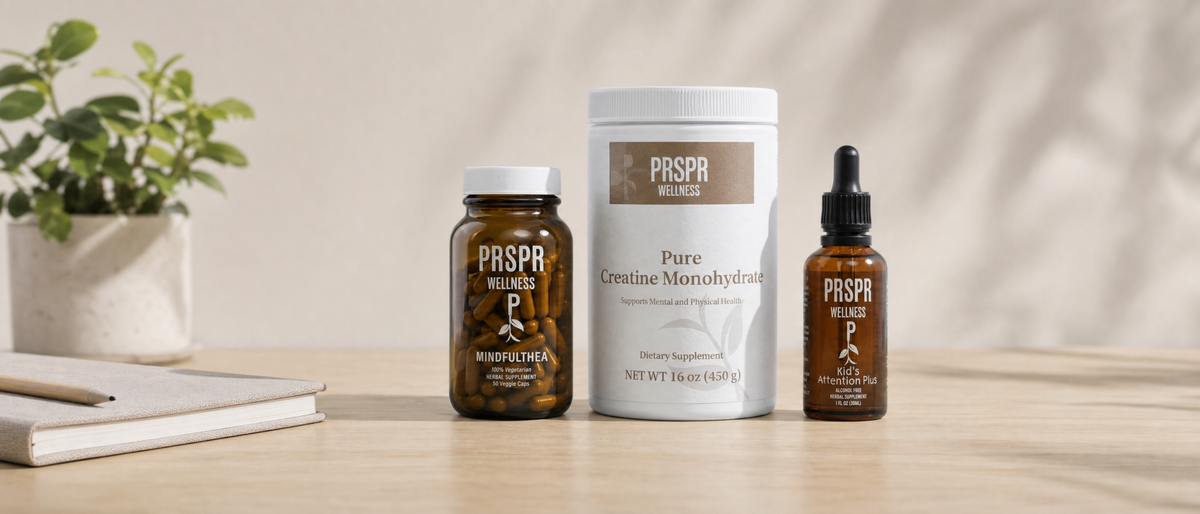
Our Energy & Focus Stack is a stack of three products: Pure Creatine Monohydrate, MindfulThea (L-Theanine) and Attention Plus. Each component has its own vocabulary, and we have covered some of it separately, including our explainer on L-theanine and the teacup it started in.
Every product in the Energy & Focus Stack is manufactured in a GMP-certified facility and third-party batch tested, so what's on the label is what's in the bottle.
You can read the full listing on the Energy & Focus Stack product page, or see it next to our other combinations in the Bundles collection. Want to know where a stack fits with what you already use? Take the PRSPR Wellness quiz and build a stack around your own routine.
Answer all five questions to unlock a clear wellness plan made around your goal, schedule, preferred supplement format, and biggest roadblock.
Get clarity on what matters most right now.
See the product and routine connected to your goal.
Simple next steps you can use right away.
Pick the one you would fix first if you could.
This helps us make the guide easier to follow.
Consistency beats the “perfect” routine you never follow.
Be honest. We’re building something you’ll actually use.
Your guide will include one simple way around it.
Answer two more questions to unlock your product starting point, five-step plan, two-week routine, and one practical tip for your biggest roadblock.
Enter your details to open your five-step plan.
Verified PRSPR customer reviews
Expires when you close this page
*Your personal credit for completing the quiz. It's applied automatically at checkout on one-time purchases and expires when the timer runs out.
View full product detailsEverything in your plan, together — one add to cart.
Expires when you close this page
*Your personal credit for completing the quiz. It's applied automatically at checkout on one-time purchases and expires when the timer runs out.
View full product details Mind vocabulary
What is cognition? You have probably seen the word "cognitive" printed on a label, in a headline, or in a product name, and kept scrolling. It is o...
 Biology vocabulary
What is metabolism? You see the word on labels, in gym talk and in nutrition headlines, almost always used as if it were a single setting. Read eno...
 Sleep vocabulary
What are sleep cycles? You hear the phrase on podcasts, see it on sleep trackers, and read it in articles that assume you already know what it mean...