
◎
Get clear
Get clarity on what matters most right now.

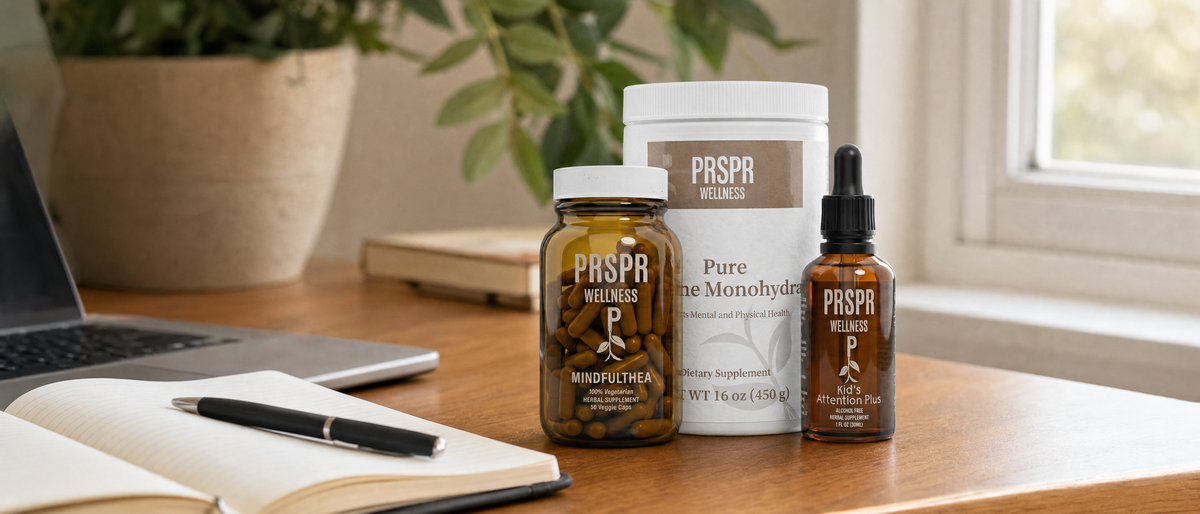
Ask what goes in a focus routine and almost everyone starts with caffeine. Then they stop, because after caffeine the vocabulary runs out fast.
Which is strange, because the category is enormous and growing. It is just that the words attached to it are vague. Memory supplements rose around 400 percent over the past week, the biggest move in this entire data set, and nootropics roughly doubled alongside it. Both are shelf words. Neither is an ingredient, a format or a dose.
So this is a piece about what those words are being used to mean, and what a focus set physically contains once you take the marketing language off it.
The rest of the search picture makes the same point. Best supplement for focus sits at the top of the category on volume, with best supplement for memory and focus further down the same list. Underneath the superlatives are the concrete searches: creatine monohydrate powder, what is creatine monohydrate, creatine vs creatine monohydrate and ginkgo biloba supplement. Notice the difference. The top of the list is people asking which is best. The bottom is people asking what things are. The second question is the one that can actually be answered, so that is the one we will take.
"Nootropic" has a specific origin. It was coined in the early 1970s by a Romanian chemist, Corneliu Giurgea, from Greek roots meaning roughly "mind" and "to bend." He invented it because he was describing a class of compounds and needed a category name that did not exist yet.
What happened next is the interesting part. The word escaped. It moved from pharmacology into internet forums, and from forums onto retail shelves, and every step it took it got broader. Today it is used for prescription compounds, for herbal extracts, for coffee with something added, and for drinks in cans. A word coined to name a narrow class now covers most of an aisle.
"Memory supplements" went the other direction. It was never a technical term at all. It is a retail phrase, built the way "hair, skin and nails" was built, by naming the reason someone might be shopping rather than naming what is in the box. That is why a 400 percent rise in the phrase tells you a lot about what people want and nothing whatsoever about what any given product contains.
The plants underneath the shelf words are much older than either of them. Ginkgo biloba is the last surviving species of an otherwise extinct order of trees, which is why it turns up in botany writing as a living fossil, and its leaves have been prepared and taken in China for centuries. Rhodiola grows in cold high-altitude places and has a long documented history of use across Scandinavia and Russia. Gotu kola appears in South Asian and Southeast Asian herbal traditions going back a very long way.
None of that history is a claim, and we are not presenting it as one. It is context. These are plants with names and records, and they were being written about by people who had never heard the word nootropic and would not have needed it.
The practical consequence: neither word tells you anything you can check. When you see either one, the useful move is to stop reading the front of the pack and turn it over.
Turn ours over and there are three objects, and they are not even the same kind of thing.
The first is a powder. Pure Creatine Monohydrate, a single-ingredient product, sold in a 16 oz tub with a scoop rather than in capsules. That is why creatine monohydrate powder is searched as its own phrase: the format is part of the product's identity, not an afterthought.
It is also why creatine vs creatine monohydrate is such a common search, and the answer is a naming answer rather than a comparison. Creatine is the general word. Monohydrate is a specific form of it, and the one that has been on shelves longest. So the two terms in that search are not really rivals. One is the family and one is a member, and a product that says what is creatine monohydrate on the label is being more specific than one that just says creatine.
The second object is capsules. MindfulThea, made with L-theanine, which is an amino acid found in tea leaves. We wrote a whole piece on where it comes from, because its history is genuinely older and stranger than the supplement aisle suggests.
The third object is a liquid in a dropper bottle. Attention Plus, a botanical liquid made with a blend of Ginkgo, Gotu Kola, Rhodiola, Licorice Root and Lobelia. Five plants, one bottle. That is where ginkgo biloba supplement connects to any of this: ginkgo is one name on a list of five, in one of three objects, in one set.
Three formats also means three different relationships with measurement, which nobody mentions. A powder is dosed by you, with a scoop, into whatever you are drinking. A capsule is dosed by the manufacturer and fixed before it reaches you. A dropper sits between the two. That is worth knowing before you own all three, because it is the difference between reading a number off a panel and counting one out yourself.
Which is the actual answer to the question in the headline. What goes into a focus set besides caffeine is a powder, an amino acid and a botanical blend, in three different formats, with nothing about any of them printed on the front of a box in the word "nootropic."
We are suspicious of any shelf word that gets more popular the vaguer it gets, and both of this week's risers qualify.
That is not a complaint about people searching them. Searching memory supplements is a completely reasonable thing to do when you do not yet know the vocabulary. It is the only phrase you have. The problem is on our side of the counter, where a brand can print a word like that and let the customer's own hopes fill in the rest, without ever making a statement anyone could hold it to.
So we would rather name the objects. A powder with one ingredient in it. Capsules made with an amino acid from tea. A dropper with five plants listed on the label. You can check every one of those sentences against the panel in about ten seconds, and that is the point.
If a product cannot be described that way, ask why not.
The Energy & Focus Stack is those three products together at $97.00: the creatine monohydrate powder, the L-theanine capsules and the botanical dropper. Three formats, three panels, three sets of directions.
We manufacture in a GMP-certified facility and batch test through a third party. That is why we can write an article that spends most of its length telling you to distrust front-of-pack language, and then print our own ingredient lists underneath it. What is on the label is what is in the bottle.
We also wrote about what the big creatine search spike earlier this month was actually about, if the powder is the part you are curious about.
Read the three panels on the Energy & Focus Stack page, or compare it against the other sets in our bundles. If you would rather assemble something around your own routine, take the quiz.
Answer all five questions to unlock a clear wellness plan made around your goal, schedule, preferred supplement format, and biggest roadblock.
Get clarity on what matters most right now.
See the product and routine connected to your goal.
Simple next steps you can use right away.
Pick the one you would fix first if you could.
This helps us make the guide easier to follow.
Consistency beats the “perfect” routine you never follow.
Be honest. We’re building something you’ll actually use.
Your guide will include one simple way around it.
Answer two more questions to unlock your product starting point, five-step plan, two-week routine, and one practical tip for your biggest roadblock.
Enter your details to open your five-step plan.
Verified PRSPR customer reviews
Expires when you close this page
*Your personal credit for completing the quiz. It's applied automatically at checkout on one-time purchases and expires when the timer runs out.
View full product detailsEverything in your plan, together — one add to cart.
Expires when you close this page
*Your personal credit for completing the quiz. It's applied automatically at checkout on one-time purchases and expires when the timer runs out.
View full product details Electrolytes
Salt is having a comparison week. Searches for celtic sea salt vs himalayan pink salt are up about 70 percent, pink himalayan salt vs table salt is...
 Kids
KidsPick up a box of children's snacks and somewhere on the front there is a number with the letter g after it, next to the word fiber. It looks like o...
 Label Reading
It is printed on the front of a lot of mineral bottles and it is one of the least understood words in the supplement business. Chelated. Search int...