
◎
Get clear
Get clarity on what matters most right now.

What is hydrochloric acid? It is one of the most searched chemistry questions in the country this week. In Google Trends' related searches (US, past seven days), "what is hydrochloric acid" holds a volume score of 100, the top of its list, and the bare abbreviation "hcl" is up +40%.
The same searchers are asking about the stomach. "What is stomach acid" scores 55, "hydrochloric acid formula" 33, "hydrochloric acid stomach" 26, "what acid is in the stomach" 24, and "stomach acid ph" 14.
Those searches meet on our shelf in a very specific place: the letters HCl in the name of a supplement. So this piece is a chemistry and label-reading explainer. It covers what hydrochloric acid is, what the stomach makes, how pH works, and what "HCl" usually means when it follows an ingredient name. Questions about any individual's stomach belong with a qualified healthcare professional, not with a blog post.
Start with the chemistry. Britannica describes hydrochloric acid as a solution of hydrogen chloride gas in water. The gas is the compound. The acid is that compound dissolved.
The 1911 edition of the Encyclopaedia Britannica described hydrochloric acid as "a compound of hydrogen and chlorine," and noted it was also "known in commerce as 'spirits of salts' and 'muriatic acid.'" Both older names still turn up, which is why a hardware store and a chemistry textbook can seem to be talking about different things when they are not.
The formula is short: HCl. One hydrogen atom, one chlorine atom. PubChem, the chemistry database run by the National Library of Medicine, lists the compound with the molecular formula written ClH and a molecular weight of 36.46.
That reversed order is just a database convention for sorting elements. In everyday writing, and on labels, you will see it as HCl, with a capital H, a capital C and a lowercase l. The lowercase l matters: "Cl" is the symbol for chlorine. Written "HCL" in all caps, as many labels and search boxes do, it means the same thing.
The Online Etymology Dictionary dates the word "hydrochloric" to 1815, defines it as "composed of chlorine and hydrogen," and notes that the name hydrochloric acid was proposed in 1814 by the chemist Gay-Lussac. Both halves are older words. According to the same source, "hydrogen" traces to the Greek hydor, "water," and "chlorine" to the Greek khlōros, "pale green," named for the gas's color.
Now the second cluster of searches. The answer to "what acid is in the stomach" is the same acid this article has been describing.
The Cleveland Clinic calls hydrochloric acid "the most powerful acid your stomach produces." Britannica describes gastric juice as a variable mixture of water, hydrochloric acid, electrolytes and organic substances, and says it is highly acidic because of its hydrochloric acid content.
So when people search "what is stomach acid," the chemistry answer is that stomach acid is largely hydrochloric acid, carried in a mixture called gastric juice.
The "hydrochloric acid stomach" search usually wants to know where the acid comes from. Britannica identifies parietal cells, also called oxyntic cells, as the source of hydrochloric acid in stomach juices, located in glands in the lining of the stomach. The NCBI Bookshelf's StatPearls reference agrees that hydrochloric acid, the main constituent of gastric acid, is secreted by parietal cells.
There is a neat piece of chemistry in the detail. StatPearls explains that the hydrogen and chloride parts are secreted separately and combine to form HCl. The formula from the section above is assembled on the spot.
pH is a scale for how acidic or basic a water-based liquid is. The U.S. Geological Survey explains that the range "goes from 0 to 14, with 7 being neutral," with lower numbers acidic, and that "each number represents a 10-fold change in the acidity/basicness of the water."
That second sentence is the one people miss. pH is logarithmic, so a liquid at pH 2 is not a little more acidic than one at pH 3. By the USGS explanation, it is ten times more acidic.
With that in hand, the stomach acid pH numbers read clearly. The Cleveland Clinic describes stomach acid as having a pH of one to two, "with zero being the most acidic level on the scale." Britannica gives gastric juice a pH of 1.5 to 2.5. The two ranges overlap and describe the same thing: a liquid near the acidic end of the scale.
These are chemistry figures, not personal ones. What a number means for any one person is a question for a qualified healthcare professional.
This is the bridge from the textbook to the bottle. When you see "HCl" after an ingredient name, it usually does not mean a spoonful of hydrochloric acid has been added. It usually names a salt form of that ingredient, called a hydrochloride.
Drugs.com explains that hydrochloride is made of hydrogen and chlorine and is used in producing many medications to make them stable and soluble, and notes that over 50% of drug molecules used in medicine exist as salts, most often hydrochloride, sodium or sulfate salts. It also points out that a medicine name with and without "HCl" on the end usually refers to the same compound.
Supplement labels use the same convention. PubChem lists "Betaine HCl," "betaine hydrochloride" and "betaine chloride" as names for one compound, with the formula C5H12ClNO2. It even lists an older Latin-style synonym, betainum muriaticum, which uses the old "muriatic" name for the acid.
So on a label, betaine HCl reads as betaine hydrochloride: betaine, in its hydrochloride salt form. That is a statement about chemistry and naming, and it is the whole of what the three letters tell you.
We think "HCl" is one of the most misread sets of letters on a supplement shelf. People see "acid" in the chemistry, see the letters on a bottle, and connect the two in ways the label never does. The label is doing something more ordinary. It is naming a salt form, the same way medicine labels have for a long time.
We also think the chemistry is worth knowing for its own sake. Hydrochloric acid is hydrogen and chlorine. The stomach's version is made by parietal cells and sits near the acidic end of a logarithmic scale. Those are good facts, and they are the kind a label reader can carry anywhere.
For the other words on labels like this one, our piece on why enzyme names end in "-ase" explains the enzyme half of the vocabulary, and our guide to bile salts covers another term that tends to raise eyebrows.
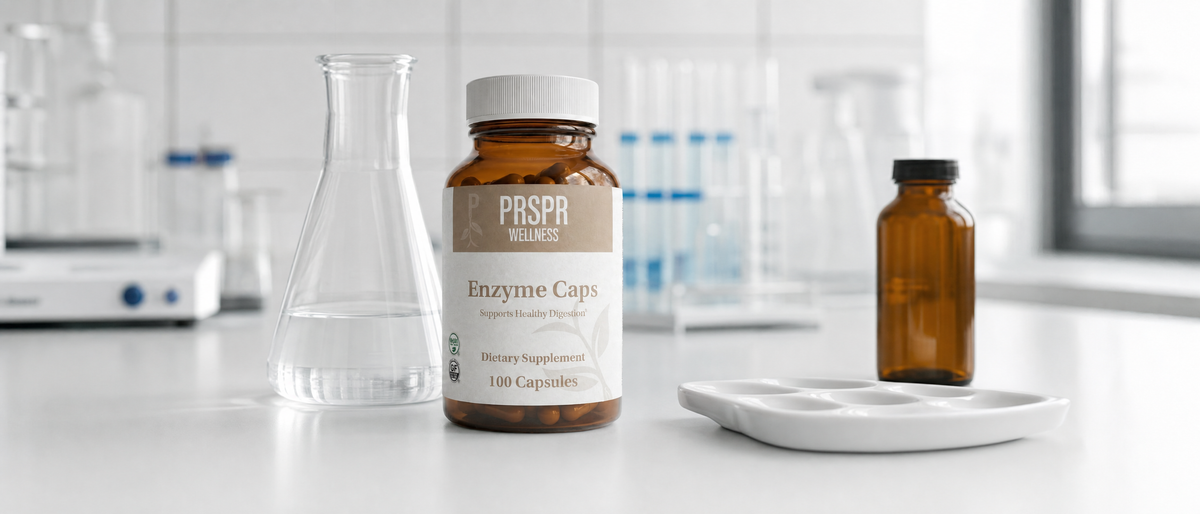
Which brings us to the product whose name started all this. PRSPR Enzyme Caps with Betaine HCL & Ox bile is, in the listing's own words, "a dietary supplement containing a blend of digestive enzymes. This product is designed for daily use as part of a balanced lifestyle."
The title names two ingredients directly, betaine HCl and ox bile. Read with the chemistry above, the first is betaine in its hydrochloride form. For the second, our piece on reading a digestive label walks through the ox bile vocabulary.
What we will add in our own voice is how it is made. It is manufactured in a GMP-certified facility and third-party batch tested, so what's on the label is what's in the bottle.
To read the full label yourself, open the Enzyme Caps product page, browse the rest of the vitamins and supplements collection, or take the build-your-stack quiz to see where it fits alongside everything else we carry.
Answer all five questions to unlock a clear wellness plan made around your goal, schedule, preferred supplement format, and biggest roadblock.
Get clarity on what matters most right now.
See the product and routine connected to your goal.
Simple next steps you can use right away.
Pick the one you would fix first if you could.
This helps us make the guide easier to follow.
Consistency beats the “perfect” routine you never follow.
Be honest. We’re building something you’ll actually use.
Your guide will include one simple way around it.
Answer two more questions to unlock your product starting point, five-step plan, two-week routine, and one practical tip for your biggest roadblock.
Enter your details to open your five-step plan.
Verified PRSPR customer reviews
Expires when you close this page
*Your personal credit for completing the quiz. It's applied automatically at checkout on one-time purchases and expires when the timer runs out.
View full product detailsEverything in your plan, together — one add to cart.
Expires when you close this page
*Your personal credit for completing the quiz. It's applied automatically at checkout on one-time purchases and expires when the timer runs out.
View full product details Mind vocabulary
What is cognition? You have probably seen the word "cognitive" printed on a label, in a headline, or in a product name, and kept scrolling. It is o...
 Biology vocabulary
What is metabolism? You see the word on labels, in gym talk and in nutrition headlines, almost always used as if it were a single setting. Read eno...
 Sleep vocabulary
What are sleep cycles? You hear the phrase on podcasts, see it on sleep trackers, and read it in articles that assume you already know what it mean...