
◎
Get clear
Get clarity on what matters most right now.

What are enzymes? A lot of people are typing some version of that question right now. "What is enzymes" carries a volume score of 80, what are enzymes 63, enzymes are proteins 21, function of enzymes 20 and what is an enzyme 13. Two searches are climbing: substrate is up +40%, and so is what type of macromolecule is an enzyme.
That second pair gives the game away. Substrate and macromolecule are classroom words. These look like the searches of someone reading a biology chapter, or a label, and hitting a term they cannot quite place.
Enzyme is one of those words everyone has heard and few people can define. It also comes with a naming system that, once you see it, makes a whole shelf of long words readable at a glance. Most enzyme names end in "-ase," and there is a real reason why.
We are going to stay on the vocabulary and the textbook biochemistry: what an enzyme is, what a substrate is, and how the names are built. What any enzyme does in a particular person is a question for a qualified healthcare professional, and we are not going to answer it here.
Encyclopaedia Britannica defines an enzyme as a substance that acts as a catalyst in living organisms, regulating the rate at which chemical reactions proceed without itself being altered in the process.
Start with the word catalyst. In chemistry, a catalyst is something that changes the rate of a reaction without being used up by it. The reaction happens, the products form, and the catalyst comes out the other side ready to do it again.
Then "in living organisms." Chemists use plenty of catalysts that have nothing to do with biology. An enzyme is the biological kind: a catalyst made by a living thing.
So if you searched what is an enzyme and want one line, here it is: an enzyme is a biological catalyst.
The function of enzymes search is best answered the same way a textbook answers it: at the level of chemistry, not at the level of a body. By Britannica's definition, the job of an enzyme is to govern the rate of a chemical reaction. That is the general function. Which reaction a given enzyme is involved in depends on the enzyme, and that is where the substrate comes in.
The word itself is younger than you might expect. The Online Etymology Dictionary credits the German physiologist Wilhelm Kühne with coining the German Enzym, from Greek en, "in," plus zymē, "leaven." Put together, the word means something close to "in leaven."
That is a kitchen word. Leaven is what makes bread dough rise, so the name of this piece of biochemistry points straight back to the bread bowl.
This is the climbing search that sounds most like a quiz question, and it has a quiz answer. Most enzymes are proteins.
A macromolecule is simply a very large molecule, and proteins are a classic example. Britannica describes a protein as a naturally occurring, extremely complex substance made of amino acid residues joined by peptide bonds. If you want the building blocks explained on their own, our guide to what amino acids are starts there.
The phrase enzymes are proteins sounds obvious today, but it had to be shown. Britannica's biography of the American biochemist James B. Sumner records that he crystallized the enzyme urease in 1926, becoming the first to crystallize an enzyme, an achievement that revealed the protein nature of enzymes. He shared the 1946 Nobel Prize for Chemistry with John Howard Northrop and Wendell Meredith Stanley.
There is one footnote worth knowing. Britannica notes that all enzymes were once thought to be proteins, but since the 1980s certain nucleic acids, called ribozymes or catalytic RNAs, have been shown to act as catalysts too. So the precise textbook answer is "most enzymes are proteins," with a small, famous exception.
Substrate is the other climbing search, and it is the key to reading enzyme names.
In biochemistry, the substrate is the substance an enzyme acts on. It is the starting material of the reaction the enzyme is involved in.
The Online Etymology Dictionary traces substrate to the Modern Latin substratum, "that which is laid or spread under," from the Latin sub, "under," and sternere, "to spread out, lay down." The picture is of something underneath, the base layer that the action happens on.
Britannica's explanation of the active site shows why the term matters. Only a certain region of an enzyme, called the active site, binds the substrate. The active site is a groove or pocket formed by the way the protein folds, and its shape and chemistry permit only a particular substrate to bind. That fit is what gives an enzyme its specificity.
Hold on to that idea: each enzyme fits a particular substrate. It is the reason the names work the way they do.
The "-ase" ending has a birthday. According to the Online Etymology Dictionary, the suffix comes from the ending of diastase, a name coined in 1833 by the French chemists Payen and Persoz, from the Greek diastasis, "a setting apart."
Britannica picks up the story from there. Diastase was the first enzyme name, proposed in 1833. Sixty-five years later, the French microbiologist and chemist Émile Duclaux suggested that all enzymes be named by adding "-ase" to a root indicative of the nature of the substrate. Britannica notes that a few older names never made the switch and still end differently, but that most enzyme names do end in "-ase."
Once you know Duclaux's rule, the names start translating themselves. Here are a few textbook examples, with their roots as the Online Etymology Dictionary and Britannica give them:
Each name is a short sentence in code. The front half tells you the substrate. The "-ase" tells you it is an enzyme. These are general examples from the textbook, not a list of anything in a particular bottle.
Today the naming is managed by the Nomenclature Committee of the International Union of Biochemistry and Molecular Biology (IUBMB). Its brief guide to enzyme nomenclature explains that each enzyme gets an EC number of four parts, and that enzymes were divided into six major classes by the type of reaction catalysed, with a seventh, the translocases, added in 2018.
The same guide says an enzyme's systematic name has two parts. The first names the substrate, or both substrates in a two-molecule reaction. The second part ends in "-ase" and indicates the kind of reaction. That is Duclaux's idea, formalized. It also lists reaction words that can appear in names, such as dehydrogenase, kinase and synthase. If that last one looks familiar, our explainer on what ATP synthase is takes one of those names apart.
This is where the vocabulary becomes a shopping skill. Enzyme supplements are a category, and their labels are one of the few places outside a biology class where you will see "-ase" words in print.
Use the rule. When a label names an enzyme, find the "-ase," then read the root in front of it. That root names the substrate the enzyme was named for. It is a naming convention, a way of telling one enzyme from another. It is not a statement about what happens in anyone's body, and a label that reads it that way is doing more than the word does.
The rule also helps with a label that names no individual enzymes at all. Some labels describe a blend in general terms. When that happens, the honest reading is the literal one: you know it is a blend of enzymes, and you do not know which ones from that sentence alone. Do not fill the gap with a guess.
Our own listing is written that way, and we will say so plainly. It describes a blend of digestive enzymes and does not name the individual enzymes, so neither will we. If the other words in the product's name caught your eye, our guide to the label terms around ox bile reads those words one at a time.
"-ase" is one of the most useful three letters in science vocabulary, and almost nobody is taught to read it.
It is a naming rule that simply worked. Duclaux proposed it, and it held. Because of it, you can walk up to a word you have never seen, spot the ending, and know you are looking at an enzyme and roughly what it was named after. That is a lot of information in one suffix.
We also think the word substrate deserves more airtime. It is the other half of every enzyme name, and without it the names are just noise.
So here is the habit we want you to build. When you see "-ase," split the word in two. Name the root. Then read the label at its actual size: a name tells you what an enzyme is called and why, not what it will do for you.
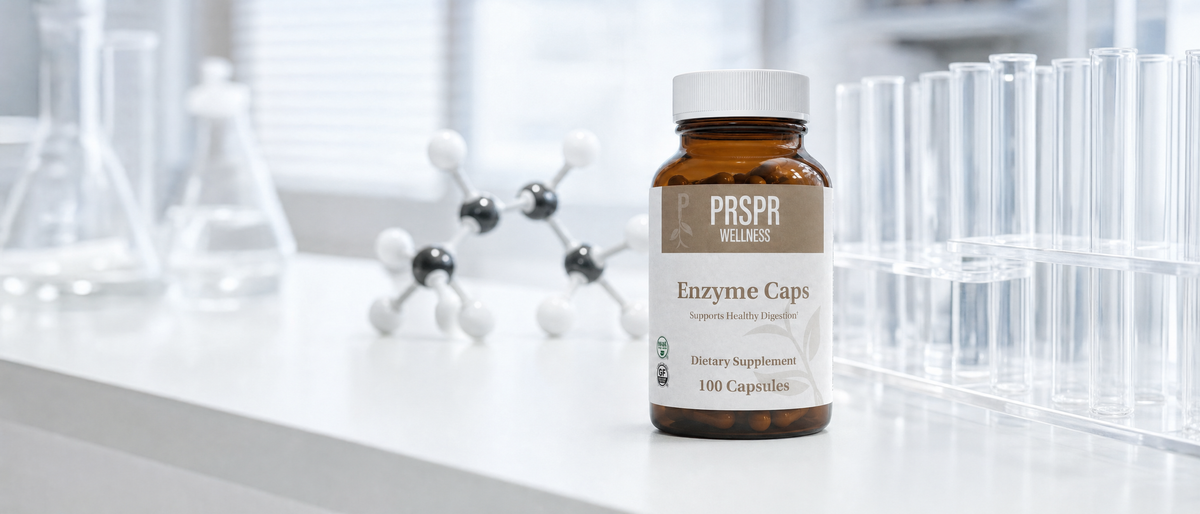
Enzyme Caps with Betaine HCL & Ox bile is a dietary supplement containing a blend of digestive enzymes. That is the listing's own description of what it contains, and it is the whole of what we say it is.
What we will add in our own voice is how it is made. Enzyme Caps are manufactured in a GMP-certified facility and third-party batch tested, so what is on the label is what is in the bottle. No guessing, no filler, no cutting corners.
If you want to read the label for yourself, open the Enzyme Caps page, browse the rest of the gut and digestion collection, or take the build-your-stack quiz to see where it fits alongside everything else we carry.
Answer all five questions to unlock a clear wellness plan made around your goal, schedule, preferred supplement format, and biggest roadblock.
Get clarity on what matters most right now.
See the product and routine connected to your goal.
Simple next steps you can use right away.
Pick the one you would fix first if you could.
This helps us make the guide easier to follow.
Consistency beats the “perfect” routine you never follow.
Be honest. We’re building something you’ll actually use.
Your guide will include one simple way around it.
Answer two more questions to unlock your product starting point, five-step plan, two-week routine, and one practical tip for your biggest roadblock.
Enter your details to open your five-step plan.
Verified PRSPR customer reviews
Expires when you close this page
*Your personal credit for completing the quiz. It's applied automatically at checkout on one-time purchases and expires when the timer runs out.
View full product detailsEverything in your plan, together — one add to cart.
Expires when you close this page
*Your personal credit for completing the quiz. It's applied automatically at checkout on one-time purchases and expires when the timer runs out.
View full product details Mind vocabulary
What is cognition? You have probably seen the word "cognitive" printed on a label, in a headline, or in a product name, and kept scrolling. It is o...
 Biology vocabulary
What is metabolism? You see the word on labels, in gym talk and in nutrition headlines, almost always used as if it were a single setting. Read eno...
 Sleep vocabulary
What are sleep cycles? You hear the phrase on podcasts, see it on sleep trackers, and read it in articles that assume you already know what it mean...