
◎
Get clear
Get clarity on what matters most right now.

What is ATP synthase is up 50 percent in search this week. Around it, the rest of the ATP cluster is holding steady: what is ATP energy is sitting at a volume score of 100, what is ATP used for at 34, what is ATP made of at 22, and both what is ATP used for in cells and what is ATP hydrolysis at 14.
That is a biology syllabus, typed into a search bar one question at a time. Some of it is homework. Some of it, we suspect, is people who read three capital letters on a supplement tub and wanted to know what they meant.
Either way, the questions deserve straight answers, because ATP is one of the most thoroughly understood molecules in biology. So this is ATP spelled out: what the letters stand for, what the molecule is built from, what hydrolysis and ATP synthase actually name, and why a molecule from a textbook keeps turning up in shelf language.
ATP stands for adenosine triphosphate, and the name is a parts list read left to right.
Once you can read that name, its relatives read themselves. Remove one phosphate and you have adenosine diphosphate, ADP. Remove another and you have adenosine monophosphate, AMP. StatPearls describes exactly that sequence, ATP to ADP to AMP to free inorganic phosphate.
The A in ATP is also an old friend. StatPearls notes that ATP is one of the four nucleotide triphosphate building blocks used to make RNA. The same adenine that sits in genetic material sits at the front of this molecule.
The history is short and well documented. According to the Nobel press release, ATP was discovered in 1929 and first synthesized chemically in 1948.
This is the biggest search in the cluster, and the answer is a metaphor biologists lean on. The Nobel press release says ATP has been termed the cell's energy currency, and that it functions as a carrier of energy in all living organisms, from bacteria and fungi to plants and animals.
A currency is useful because you earn it in one place and spend it in another. That is the job ATP does. In the press release's words, ATP captures the chemical energy released by the combustion of nutrients and transfers it to reactions that require energy. StatPearls places that readily releasable energy in the bond between the second and third phosphate groups.
The scale is the part that surprises people. The same press release states that an adult at rest converts a quantity of ATP corresponding to about half their body weight every day. StatPearls adds that ATP must be continuously replenished. It is made and spent all the time, which is why the questions about how it is made and how it is spent are the interesting ones.
Hydrolysis is another name you can read by its parts. The Online Etymology Dictionary gives it as "chemical decomposition by water," formed from hydro-, water, and the Greek lysis, "a loosening." So hydrolysis is a reaction in which water is used to break a bond.
ATP hydrolysis is that reaction applied to the outermost phosphate. Water breaks the bond holding the third phosphate group, the molecule becomes ADP plus a free inorganic phosphate, and, as the Nobel press release puts it, the energy released at the same time can be employed for other reactions. StatPearls describes the step from ATP to ADP as energetically favorable, meaning it runs downhill.
The reverse is the expensive direction. The press release describes it plainly: given an input of energy, an inorganic phosphate group can be bound to ADP to form ATP again. Spending is hydrolysis. Re-earning is synthesis. Which brings us to the enzyme doing the re-earning.
Start with the name. The Online Etymology Dictionary describes -ase as a word-forming element used in naming enzymes, taken from the ending of an early enzyme name, diastase. A synthase is an enzyme that synthesizes something. ATP synthase is the enzyme that builds ATP.
According to the Nobel press release, most ATP synthesis is carried out by ATP synthase, and the bulk of ATP is formed during cell respiration in mitochondria and photosynthesis in the chloroplasts of plants. The same enzyme exists in chloroplasts and bacteria.
Its structure is what makes the search worth answering. The press release describes two parts:
When hydrogen ions flow through Fo, a disc of subunits is forced to twist around. A central stalk, the gamma subunit, is attached to that disc and rotates with it, inside a ring of six subunits that cannot rotate. Because the stalk is asymmetrical, its turning forces the beta subunits in that ring to change shape, and it is on the beta units that ATP is actually made. In other words, ATP synthase is a rotary machine driven by a flow of charged particles.
That mechanism earned half of the 1997 Nobel Prize in Chemistry, awarded for the elucidation of the enzymatic mechanism underlying the synthesis of adenosine triphosphate. The other half went to the discovery of an enzyme with the opposite relationship to ATP, sodium, potassium-stimulated adenosine triphosphatase, which the press release says uses up a third of all ATP formed at rest.
The short list of what is ATP used for is long. StatPearls names ion transport, muscle contraction, nerve impulse propagation, substrate phosphorylation and chemical synthesis, along with intracellular signaling and DNA and RNA synthesis. The Nobel press release gives the plain-language version: building up cell components, muscle contraction, transmission of nerve messages and many other functions.
What unites them is the currency idea. StatPearls describes ATP hydrolysis as providing the energy for these processes, from active transport across membranes to assembling DNA and RNA. The cell earns ATP in one place and spends it in all of these.
Energy is a common word in supplement marketing, and ATP is the molecule that biology textbooks attach to that word. That makes it an easy borrow. Three capital letters sound like a specification, and a sentence with a molecule in it sounds like chemistry, whether or not it is.
The reading skill is simple. A molecule named in marketing copy and an ingredient named on the panel are two different kinds of statement. On a creatine product, the supplement facts panel names creatine monohydrate. ATP is a separate molecule with its own name, its own structure and its own enzyme, all of which you can now read for yourself.
We think ATP is one of the best words in biology and one of the most overworked words on a shelf. In a textbook it names a precise structure: adenine, ribose, three phosphates. On a tub it is usually set dressing.
The fix is not to avoid products that mention it. It is to know the molecule well enough that the word stops doing persuasive work. If you can spell out adenosine triphosphate, explain hydrolysis and describe a rotary enzyme, three capital letters will not impress you on their own.
And we would rather you learned that from a Nobel press release than from anyone's front label, including ours.
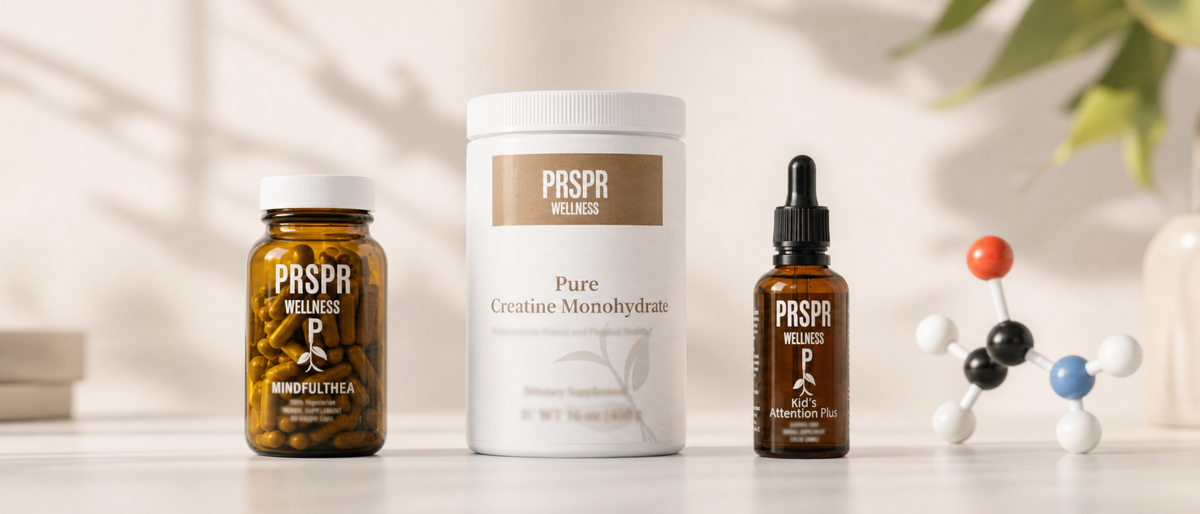
Our Energy & Focus Stack brings together three products: Pure Creatine Monohydrate, MindfulThea (L-Theanine) and Attention Plus. That is the lineup as the live listing states it.
It is made in a GMP-certified facility and third-party batch tested, so what is on the label is what is in the bottle.
If the second word on a creatine label is your next question, our explainer on monohydrate and hydrochloride covers the chemistry of the name, and our piece on focus-stack shelf words covers the rest of the vocabulary. Otherwise open the stack page and read each panel, browse the bundles collection, or take the build-your-stack quiz.
Answer all five questions to unlock a clear wellness plan made around your goal, schedule, preferred supplement format, and biggest roadblock.
Get clarity on what matters most right now.
See the product and routine connected to your goal.
Simple next steps you can use right away.
Pick the one you would fix first if you could.
This helps us make the guide easier to follow.
Consistency beats the “perfect” routine you never follow.
Be honest. We’re building something you’ll actually use.
Your guide will include one simple way around it.
Answer two more questions to unlock your product starting point, five-step plan, two-week routine, and one practical tip for your biggest roadblock.
Enter your details to open your five-step plan.
Verified PRSPR customer reviews
Expires when you close this page
*Your personal credit for completing the quiz. It's applied automatically at checkout on one-time purchases and expires when the timer runs out.
View full product detailsEverything in your plan, together — one add to cart.
Expires when you close this page
*Your personal credit for completing the quiz. It's applied automatically at checkout on one-time purchases and expires when the timer runs out.
View full product details Mind vocabulary
What is cognition? You have probably seen the word "cognitive" printed on a label, in a headline, or in a product name, and kept scrolling. It is o...
 Biology vocabulary
What is metabolism? You see the word on labels, in gym talk and in nutrition headlines, almost always used as if it were a single setting. Read eno...
 Sleep vocabulary
What are sleep cycles? You hear the phrase on podcasts, see it on sleep trackers, and read it in articles that assume you already know what it mean...