
◎
Get clear
Get clarity on what matters most right now.

People are typing "taurine what is" into search in exactly that order, and that string is sitting at a volume score of 100 this week. Taurine powder is up 40 percent. Taurine supplement sits at 43, taurine in energy drinks at 19, energy drink taurine and taurine what is it at 14 each, taurine vitamin at 12, taurine foods at 11, and is taurine caffeine at 10.
Read that list top to bottom and it sounds like one person thinking out loud. Somebody saw the word on a can, wondered what it was, and then asked the two questions the can itself raises. Is it caffeine? Is it a vitamin? Both are fair questions, because taurine tends to appear in the same small print as both.
The same cluster also carries searches about what taurine does in the body and whether it is bad for you. Those are questions for a qualified healthcare professional rather than for the company selling the stick pack, so we will leave them there.
What we can do is answer the questions that have textbook answers. What taurine is as a molecule, where the name comes from, why it is not caffeine, why it is not a vitamin, and which foods it has actually been measured in. Then we will explain why it is printed on the label of our electrolyte drink mix, a listing that names no caffeine at all.
PubChem, the chemistry database run by the US National Library of Medicine, lists taurine as 2-aminoethanesulfonic acid, with the molecular formula C2H7NO3S. That is two carbon atoms, seven hydrogens, one nitrogen, three oxygens and one sulfur. It is a small molecule, and the sulfur is the detail worth remembering.
The ChEBI chemical dictionary, which PubChem draws its descriptions from, classifies taurine as an amino sulfonic acid. Unpack that phrase and you get the structure. There is an amino group, built around nitrogen, at one end of a short two-carbon chain. There is a sulfonic acid group, built around sulfur, at the other end.
That is why you will see taurine loosely called an amino acid. It carries an amino group and an acid group, so the label fits in the broad sense. But it is not one of the twenty standard amino acids in the naming tables that biochemists use for protein building blocks. Those twenty carry a carboxylic acid group, built around carbon and oxygen, where taurine carries its sulfur-based one.
As a raw material, taurine is unremarkable to look at. PubChem's physical description records it as large white crystals or white powder. So taurine powder, the rising term this week, is simply what the compound looks like before it goes into anything.
The name is a lab record. According to the Online Etymology Dictionary, taurine comes from the Latin taurus, meaning bull, plus the chemical suffix -ine. It was so called because the compound was first found in ox bile, where a German chemist obtained it in the 1820s.
That is all the bull in the name means. Chemistry is full of names that preserve where a substance was first isolated, and this is one of them. The source in the name tells you the history of the discovery, not where a modern ingredient comes from and not anything about what is on a shelf today.
This is the question the energy drink association creates, and it has a clean answer. PubChem lists caffeine as 1,3,7-trimethylpurine-2,6-dione, with the formula C8H10N4O2. Eight carbons, four nitrogens, two oxygens, arranged as a purine, a compound built on two fused rings. There is no sulfur anywhere in it.
Put the two side by side and they do not share a formula, a structure or a chemical family. Taurine is a short chain with a sulfonic acid group. Caffeine is a ring system from the purine family. They are two separate ingredients that happen to be printed on the same kind of can.
That is where searches like taurine in energy drinks and energy drink taurine come from. When two words keep appearing in the same small print, people start to file them as one idea. Sharing an ingredient list does not make two ingredients the same thing, any more than citric acid and sugar are the same thing because they share a soda label.
The label habit worth building here is to read each ingredient as its own line. If caffeine is in a product, caffeine is its own entry. Taurine on a panel tells you taurine is there, and nothing else.
The vitamin question has an equally clean answer, because vitamins are a closed list. MedlinePlus, the consumer health reference from the National Library of Medicine, names 13 essential vitamins: vitamins A, C, D, E and K, and eight B vitamins, which are thiamine, riboflavin, niacin, vitamin B6, vitamin B12, pantothenic acid, biotin and folate.
Taurine is not on that list. The search term taurine vitamin most likely comes from where the word is printed, often a few lines away from vitamin C or a B vitamin on the same panel. Proximity on a label is not membership in a category. We made the same point about minerals in why vitamin and mineral are not the same word.
The same goes for the phrase taurine supplement. Supplement is a product category, not a chemical one. A taurine supplement is a product that lists taurine as an ingredient. The word tells you how the product is sold, not what the molecule is.
For taurine foods, the useful source is measurement rather than listicles. A 1990 study in the Journal of Parenteral and Enteral Nutrition measured the taurine content of 29 meats, nine dairy products and 48 plant foods, covering vegetables, nuts, seeds, fruits and legumes. It detected taurine in the meats and dairy products, and did not detect it in the plant foods tested.
ChEBI's description points the same way, calling taurine an abundant component of fish- and meat-based foods. So the short version of the food record is that taurine turns up in animal foods and was not found in the plant foods that study measured. We are leaving amounts out, because a food-composition figure is only worth printing when it comes from a database we can point you to.
Taurine is one line on this label. Potassium is another, and it comes with a food story of its own that the search data has plenty to say about. We lined up the database figures in which potassium rich foods top the list.
Taurine is the clearest example we know of an ingredient whose reputation comes from the company it keeps. Most people who know the word learned it from a can, and the can taught them to file it next to caffeine. The chemistry files it somewhere else entirely.
We think that is worth correcting, because it is a label-reading problem, not a trivia problem. If you judge an ingredient by its most famous neighbor, you will misread every panel it appears on. The fix is dull and reliable: look up the compound, not the context. A formula and a name history will tell you more about a word on a label than any product it is famous for.
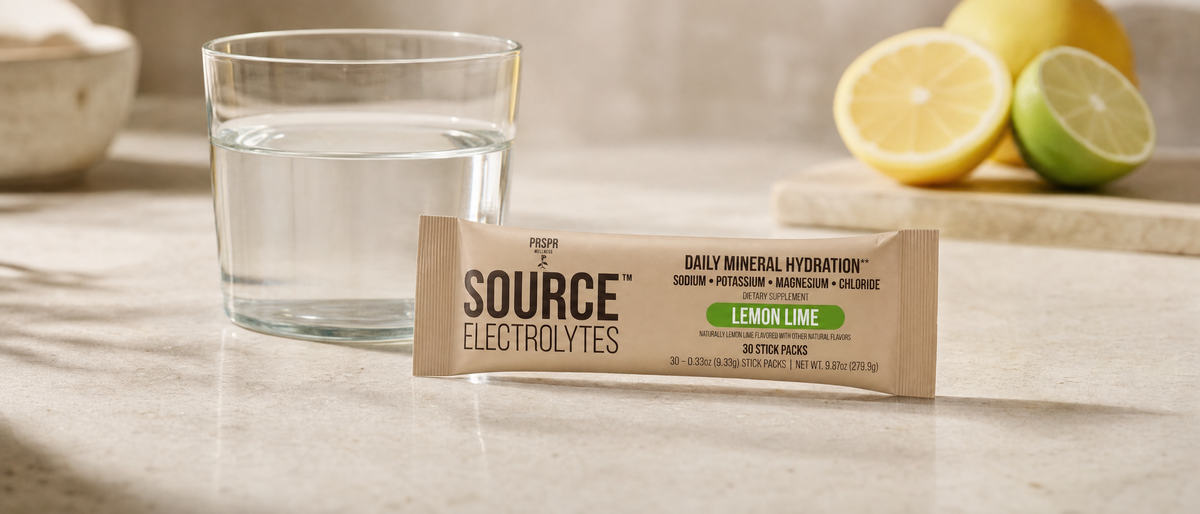
Our Source Electrolytes is a stick-pack electrolyte and trace mineral drink mix made with vitamin C, calcium, magnesium, zinc, chloride, sodium, potassium, D-ribose, taurine, Himalayan pink salt, L-theanine and ConcenTrace concentrated seawater, with no added sugar, in Lemon Lime and Pink Lemonade. That is the composition as the live listing states it. Taurine is one line of that list, and the listing names no caffeine.
What we will add in our own voice is the quality story alone. It is made in a GMP-certified facility and third-party batch tested, so what is on the label is what is in the pack.
If you want the rest of the panel decoded line by line, how to read an electrolyte label is the companion piece, and what D-ribose is doing on the label covers another single word from the same list. Otherwise open the Source Electrolytes page and read the panel yourself, browse the vitamins and supplements collection, or take the build-your-stack quiz.
Answer all five questions to unlock a clear wellness plan made around your goal, schedule, preferred supplement format, and biggest roadblock.
Get clarity on what matters most right now.
See the product and routine connected to your goal.
Simple next steps you can use right away.
Pick the one you would fix first if you could.
This helps us make the guide easier to follow.
Consistency beats the “perfect” routine you never follow.
Be honest. We’re building something you’ll actually use.
Your guide will include one simple way around it.
Answer two more questions to unlock your product starting point, five-step plan, two-week routine, and one practical tip for your biggest roadblock.
Enter your details to open your five-step plan.
Verified PRSPR customer reviews
Expires when you close this page
*Your personal credit for completing the quiz. It's applied automatically at checkout on one-time purchases and expires when the timer runs out.
View full product detailsEverything in your plan, together — one add to cart.
Expires when you close this page
*Your personal credit for completing the quiz. It's applied automatically at checkout on one-time purchases and expires when the timer runs out.
View full product details Mind vocabulary
What is cognition? You have probably seen the word "cognitive" printed on a label, in a headline, or in a product name, and kept scrolling. It is o...
 Biology vocabulary
What is metabolism? You see the word on labels, in gym talk and in nutrition headlines, almost always used as if it were a single setting. Read eno...
 Sleep vocabulary
What are sleep cycles? You hear the phrase on podcasts, see it on sleep trackers, and read it in articles that assume you already know what it mean...