
◎
Get clear
Get clarity on what matters most right now.

Take one slow breath. In the second or two it took, air traveled from the tip of your nose to microscopic sacs deep in your chest. If you have ever typed what is the respiratory system into a search bar and wanted the parts named, this is the walkthrough: every major part, in the order air reaches it, with a labeled table you can use as a text diagram.
You are not the only one asking. In Google Trends data for the US over the past 7 days, related searches to "respiratory system" were led by "the respiratory system" at a top score of 100, followed by "what is the respiratory system" at 43, "what is in the respiratory system" at 33 and "what is a respiratory system" at 30. "Respiratory system function" scored 18, while "function of respiratory system" and "lungs" each scored 16. "Respiratory system organs" and "what is the function of the respiratory system" each scored 11. The fastest riser was "respiratory system diagram unlabeled," up 170%. Those numbers are relative, not counts. Top scores are scaled so the most searched term equals 100, and the rising figure is growth over the previous period. Read together, they say people want the parts named and placed.
The respiratory system is the set of organs and passages that moves air into your body, brings it close to your blood, and moves it back out. If you want the short answer to "what is a respiratory system," that is it: an airway with a gas exchange surface at the end.
The NCI SEER Training Modules frame the respiratory system function in terms of supply and removal. Per their respiratory system introduction, body cells need a continuous supply of oxygen for the metabolic processes that keep you alive, and the system also removes the metabolic waste those processes make. SEER adds that the respiratory system helps regulate blood pH. So the function of respiratory system structures is not one job but three linked ones.
SEER breaks the overall process into four steps:
OpenStax Anatomy and Physiology 2e, section 22.1, splits the anatomy into two zones. The conducting zone is every structure that is not directly involved in gas exchange: it routes air, removes debris, and warms and humidifies what you inhale. The respiratory zone is where gas exchange actually happens. That second step, oxygen moving into the blood, hands off to the systems covered in our posts on the cardiovascular system and circulation.
So what is in the respiratory system? Follow one breath. Every fact below comes from OpenStax Anatomy and Physiology 2e, section 22.1, unless another source is named.
Air enters through the nares, the two openings framed by the alae, the flared sides of the nose. Inside, a septum of cartilage and bone divides the cavity. Each side wall carries three shelf-like conchae, superior, middle and inferior, that increase surface area and disrupt airflow so incoming air is cleaned and warmed. The smell-sensing olfactory epithelium sits deeper in the cavity. You can also breathe through your mouth, which joins the same path at the next stop.
The pharynx, or throat, has three regions. The nasopharynx is an airway only. The oropharynx, behind the mouth, is shared by air and food. The laryngopharynx sits below that and opens forward into the larynx and backward into the esophagus.
The larynx, or voice box, is built from three large cartilages: the thyroid cartilage in front (the largest), the epiglottis on top and the cricoid below, plus three smaller paired cartilages. The true vocal cords vibrate to produce sound. When you swallow, the epiglottis swings down to close the opening to the trachea.
The trachea, or windpipe, is formed by 16 to 20 stacked, C-shaped pieces of hyaline cartilage. Its back wall is closed by a membrane and the trachealis muscle. At its base is the carina, the point where it splits. Per the SEER Training Modules, that split happens at the level of the fifth thoracic vertebra.
The trachea divides into the right and left primary bronchi, which enter each lung at the hilum. Bronchi have cartilage for support. Bronchioles lack cartilage and have muscular walls instead. Bronchioles are about 1 mm in diameter, and each lung has more than 1,000 terminal bronchioles. The smallest, the respiratory bronchioles, lead into alveolar ducts.
The alveoli are the end of the line: tiny elastic sacs about 200 micrometers across. Type I alveolar cells, about 25 nanometers thick, make up as much as 97 percent of the alveolar surface. Type II cells secrete surfactant, which reduces surface tension. OpenStax Biology 2e, section 39.1, puts the count at roughly 300 million alveoli per lung, with a total alveolar surface area of approximately 75 square meters.
The lungs are the organs that hold the bronchial tree and alveoli. Per the SEER Training Modules, the right lung has three lobes and the left lung has two, and the left is longer and narrower, with a cardiac notch that makes room for the heart. Each lung is wrapped in a double-layered membrane called the pleura. Below them sits the diaphragm. OpenStax Anatomy and Physiology 2e, section 22.3, explains that when the diaphragm contracts it moves down toward the abdominal cavity, enlarging the chest cavity so air flows in. Normal exhaling is passive: the muscles relax and the tissue's elastic recoil pushes air out.
The rise in searches for "respiratory system diagram unlabeled" suggests a lot of people are filling in a blank worksheet. Here is the answer key as a text diagram, top to bottom. The upper and lower split follows the SEER Training Modules: the upper respiratory tract includes the nose, pharynx and larynx, and the lower respiratory tract consists of the trachea, bronchial tree and lungs.
| Part | Where it sits | Tract | What it is |
|---|---|---|---|
| Nose and nasal cavity | Front of the face, behind the nostrils | Upper | Entry point; conchae clean and warm the air |
| Pharynx | Behind the nose and mouth | Upper | The throat; three regions, partly shared with food |
| Larynx | Front of the neck, above the trachea | Upper | Voice box; holds the vocal cords and epiglottis |
| Trachea | Center of the neck into the chest | Lower | Windpipe; 16 to 20 C-shaped cartilage pieces |
| Primary bronchi | Chest, where the trachea splits | Lower | Two main branches, one to each lung |
| Bronchioles | Inside each lung | Lower | Small airways about 1 mm across, no cartilage |
| Alveoli | Ends of the bronchioles | Lower | Tiny sacs where gas exchange happens |
| Lungs | Either side of the heart in the chest | Lower | Three lobes on the right, two on the left |
| Diaphragm | Below the lungs, above the abdomen | Not an airway | Breathing muscle; contracts to pull air in |
Cover the right three columns and you have your own unlabeled version to quiz yourself with.
We think anatomy is easier to keep when you learn it as a route instead of a list. Nose, pharynx, larynx, trachea, bronchi, bronchioles, alveoli: say it once in order and you have the whole airway. Then add the two zones, conducting and respiratory, and the two tracts, upper and lower, and you can place any part someone names.
We also think vocabulary matters. When you know that the larynx is the voice box and the trachea is the windpipe, labels stop being jargon. That is why we write this body-systems series: plain names, real sources and nothing padded. The figures in this post are the ones we could check in OpenStax and the SEER Training Modules. Anything we could not verify, we left out.
The lungs get most of the attention, but the table shows how much happens before air reaches them. Most of the route is passageway. The part that does the exchange is a thin surface at the very end.
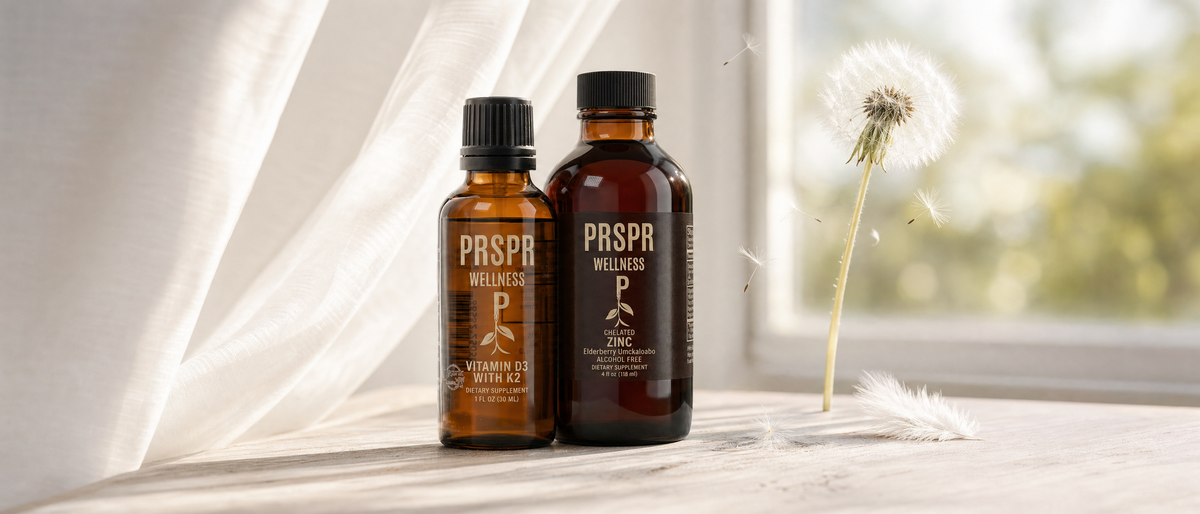
This post belongs to the same body-systems vocabulary series as our guide to the immune system, which we wrote alongside the Adult Immunity Bundle. The bundle is two products for $69.99: Chelated Zinc + Elderberry, a 4 fl oz alcohol-free liquid, and Vitamin D3 + K2 Plus MK7, a 1 fl oz (30 mL) dropper bottle.
Like everything we carry, both are made in a GMP-certified facility and third-party batch tested, so what's on the label is what's in the bottle. You can see the bundle with our other pairings in the bundles collection.
It is the chain of passages and organs, from the nose to the alveoli in the lungs, that moves air in and out and brings it close enough to your blood for gas exchange, with the diaphragm powering each breath in.
The nose and nasal cavity, pharynx, larynx, trachea, bronchi, bronchioles, alveoli and lungs, plus the diaphragm that powers breathing. The first three form the upper tract and the rest form the lower tract, per the SEER Training Modules.
Per the SEER Training Modules, it supplies body cells with the oxygen their metabolism needs, removes the metabolic waste that metabolism produces, and helps regulate blood pH.
Answer all five questions to unlock a clear wellness plan made around your goal, schedule, preferred supplement format, and biggest roadblock.
Get clarity on what matters most right now.
See the product and routine connected to your goal.
Simple next steps you can use right away.
Pick the one you would fix first if you could.
This helps us make the guide easier to follow.
Consistency beats the “perfect” routine you never follow.
Be honest. We’re building something you’ll actually use.
Your guide will include one simple way around it.
Answer two more questions to unlock your product starting point, five-step plan, two-week routine, and one practical tip for your biggest roadblock.
Enter your details to open your five-step plan.
Verified PRSPR customer reviews
Expires when you close this page
*Your personal credit for completing the quiz. It's applied automatically at checkout on one-time purchases and expires when the timer runs out.
View full product detailsEverything in your plan, together — one add to cart.
Expires when you close this page
*Your personal credit for completing the quiz. It's applied automatically at checkout on one-time purchases and expires when the timer runs out.
View full product details Botany
You pick up a fallen leaf on a walk, or you read a product label that says a botanical comes from a leaf, and you realize you do not have the words...
 Food Science
You are fine, you just ate, and then one specific food lands in your head and will not leave. Not food in general. That food. Researchers have a na...
 Fitness Terms
You have heard it from a coach, a gym sign-up form, a friend who just bought a set of dumbbells. Strength training. Resistance training. Hypertroph...