
◎
Get clear
Get clarity on what matters most right now.

Maybe it is a biology worksheet or a labeled chart on a clinic wall. Either way, you typed "what is the skeletal system" into a search bar and want a straight answer. Here it is, part by part, with the names that anatomy texts actually use.
Plenty of people are looking it up. According to Google Trends, for US searches over the past seven days related to the seed term "skeletal system", the top related queries included "the skeletal system" (100), "what is the skeletal system" (40), "skeletal system bones" (22), "skeletal system function" (22), "function of skeletal system" (20), "skeletal system cells" (19), "bones of the skeletal system" (17) and "skeletal system organs" (13). Among rising queries, "skeletal system key structures" was up 70% and "skeletal system with labels" was up 60%.
A quick note on those numbers. Google Trends scores are relative within each seed term: 100 marks the most searched query in that set, and the others are scaled against it. They are not search counts. A rising percentage measures growth in interest, not volume.
This piece sticks to plain anatomy and vocabulary: what belongs to the system, how bones are grouped and shaped, which cells live in bone tissue, how joints are classified, and what anatomy texts list as the system's jobs. Every definition comes with its source.
The clearest starting point is the National Cancer Institute's SEER Training Modules, an online anatomy course from the NCI. Its introduction to the skeletal system names four components: bones, cartilage, ligaments and tendons. The same page says the system accounts for about 20 percent of body weight.
So "the skeletal system" on a chart means more than bones alone:
Marrow sits inside bones rather than beside them, and it gets its own section below. If you searched "skeletal system organs," the SEER material answers with this parts list rather than a single organ: bones, cartilage, ligaments and tendons working as one system.
According to SEER's page on the divisions of the skeleton, "The adult human skeleton usually consists of 206 named bones." The module groups those bones into two divisions.
In SEER's scheme, the axial skeleton has 80 bones that form the vertical axis of the body: the bones of the head, the vertebral column, the ribs and the breastbone, or sternum. The appendicular skeleton has 126 bones: the free appendages (the upper and lower limbs) plus their attachments to the axial skeleton, which SEER calls girdles. Add the two and you get the 206 from the section above.
Anatomy texts also sort bones by shape. SEER's classification page lists four categories, and a fifth term, sesamoid, comes from the dictionary.
| Shape | Definition | Examples given | Source |
|---|---|---|---|
| Long | Longer than they are wide | Bones of the thigh, leg, arm and forearm | NCI SEER Training Modules |
| Short | Roughly cube shaped | Bones of the wrist and ankle | NCI SEER Training Modules |
| Flat | Thin, flattened and usually curved | Most bones of the cranium | NCI SEER Training Modules |
| Irregular | Fits none of the three categories above | Vertebrae and some skull bones | NCI SEER Training Modules |
| Sesamoid | Small bones formed in tendons | The patella (kneecap) | Dictionary.com |
The name sesamoid is a description. Dictionary.com defines it as "shaped like a sesame seed" and traces the word through Latin to a Greek term meaning like a sesame seed.
SEER describes bone as living tissue with its own cell types and two textures.
One memory trick: blasts build, clasts cut, and cytes are the settled residents. SEER's tissue page adds that an equilibrium between osteoblasts and osteoclasts maintains bone tissue.
SEER describes two textures. Compact bone is made of tightly packed units called osteons, or haversian systems, which together look like a solid mass. Spongy bone, also called cancellous bone, is lighter and less dense. It is built from plates called trabeculae and bars of bone, and its cavities hold red bone marrow.
The National Cancer Institute's Dictionary of Cancer Terms defines bone marrow as soft, spongy tissue with many blood vessels, found in the center of most bones, and names two types. Red bone marrow contains blood stem cells that can become red blood cells, white blood cells or platelets. Yellow bone marrow is made mostly of fat and contains stem cells that can become cartilage, fat or bone cells.
Where is the red marrow? SEER's introduction says that in adults, red marrow is limited to the spongy bone of the skull, ribs, sternum, clavicles, vertebrae and pelvis.
Searches for "skeletal system function" and "function of skeletal system" usually want the textbook list. SEER's introduction gives five, and here they are as the module describes them:
A joint, or articulation, is where bones meet. SEER's articulations page classifies joints by movement:
In a synovial joint, SEER describes articular cartilage on the bone ends, a joint cavity between them, and a dense fibrous capsule around the whole thing. The membrane lining that capsule secretes synovial fluid into the cavity for lubrication.
A chart with forty arrows is easier once you know which family each label belongs to. When you look for skeletal system key structures on a diagram, sort every label into one of these buckets:
Take the kneecap as a test case. On a labeled chart it is appendicular, and by Dictionary.com's definition it is sesamoid, a small bone formed in a tendon.
We like anatomy explained the way a good textbook does it: a short list of parts, each with a name and a plain definition. The skeletal system is a strong example. With four components, two divisions, five shapes and three cell names, most labeled charts read like a sentence instead of a puzzle. Every term above traces to a source you can check.
If you want more anatomy tours in the same style, read our plain anatomy tour of what the immune system is made of, which also visits marrow, our guide to what minerals are in nutrition, from major to trace, and our explainer on lean body mass vs skeletal muscle mass. Questions about your own body belong with a clinician.
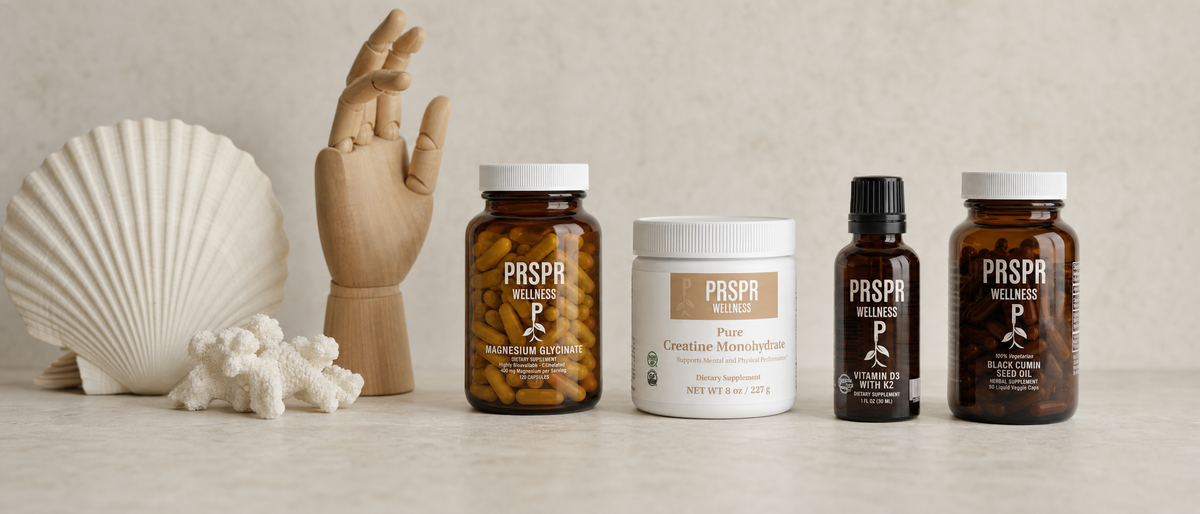
The Essentials Bundle is a four-product set: Magnesium Glycinate, Black Seed Oil (labeled Black Cumin Seed Oil), Vitamin D3 + K2, and Creatine Monohydrate (labeled Pure Creatine Monohydrate). It is listed at $109.99.
This article is about the body vocabulary people search for, not about any product. The bundle's listing is the place to read each of the four labels in full. Like everything we carry, it is made in a GMP-certified facility and third-party batch tested, so what's on the label is what's in the bottle. You can browse the rest of the range in our Vitamins & Supplements collection.
To read the full label, see the Essentials Bundle at PRSPR.
According to the NCI's SEER Training Modules, it is the body system made of bones, cartilage, ligaments and tendons, accounting for about 20 percent of body weight.
SEER groups the usual 206 named adult bones into the axial skeleton (80 bones: head, vertebral column, ribs, sternum) and the appendicular skeleton (126 bones: limbs and girdles).
SEER names osteoblasts (bone-forming cells), osteocytes (mature bone cells) and osteoclasts (cells that break down bone).
SEER lists support, protection, movement with muscles, mineral storage and blood cell formation, which takes place mostly in red marrow.
Per the NCI Dictionary of Cancer Terms, red marrow contains blood stem cells, while yellow marrow is made mostly of fat and contains stem cells that can become cartilage, fat or bone cells.
Answer all five questions to unlock a clear wellness plan made around your goal, schedule, preferred supplement format, and biggest roadblock.
Get clarity on what matters most right now.
See the product and routine connected to your goal.
Simple next steps you can use right away.
Pick the one you would fix first if you could.
This helps us make the guide easier to follow.
Consistency beats the “perfect” routine you never follow.
Be honest. We’re building something you’ll actually use.
Your guide will include one simple way around it.
Answer two more questions to unlock your product starting point, five-step plan, two-week routine, and one practical tip for your biggest roadblock.
Enter your details to open your five-step plan.
Verified PRSPR customer reviews
Expires when you close this page
*Your personal credit for completing the quiz. It's applied automatically at checkout on one-time purchases and expires when the timer runs out.
View full product detailsEverything in your plan, together — one add to cart.
Expires when you close this page
*Your personal credit for completing the quiz. It's applied automatically at checkout on one-time purchases and expires when the timer runs out.
View full product details Botany
You pick up a fallen leaf on a walk, or you read a product label that says a botanical comes from a leaf, and you realize you do not have the words...
 Food Science
You are fine, you just ate, and then one specific food lands in your head and will not leave. Not food in general. That food. Researchers have a na...
 Fitness Terms
You have heard it from a coach, a gym sign-up form, a friend who just bought a set of dumbbells. Strength training. Resistance training. Hypertroph...