
◎
Get clear
Get clarity on what matters most right now.

What is vitamin C? That exact question is climbing in search right now, up +40%, and it is sitting next to a set of steadier searches that tell you how people think about it. Vitamin C foods carries a volume score of 13 this week, vitamin C supplement 11, vitamin C food 10, vitamin C vitamins 9, and orange vitamin C 8.
Read that list as one person's train of thought and it makes sense. First the name. Then the fruit bowl. Then the bottle. Then, almost inevitably, the orange.
What nobody in that list is typing is the other name. Vitamin C has a chemical name, and it is printed on ingredient panels, cereal boxes and drink mix labels all the time. Most people read straight past it.
We are going to stay on the vocabulary, the chemistry and the food lists, because every piece of it can be checked in a standard reference. What vitamin C does in a body is a question for a qualified healthcare professional, and we are not going to answer it here in either direction.
The NIH Office of Dietary Supplements opens its fact sheet by saying that vitamin C is also known as L-ascorbic acid, and that it is a water-soluble vitamin that is naturally present in some foods, added to others and available as a dietary supplement. So "vitamin C" and "ascorbic acid" are two names for the same compound. One is the everyday label. The other is the chemistry name.
PubChem, the chemical database run by the U.S. National Library of Medicine, gives the molecular formula as C6H8O6. Six carbon atoms, eight hydrogen atoms, six oxygen atoms. That is the whole molecule. Merriam-Webster's entry for vitamin C gives the same formula and describes it as found in plants, especially fruits and leafy vegetables, or made synthetically. Same molecule, two routes to the jar.
The word "acid" in ascorbic acid is a chemistry category, not a warning label. It tells you how the molecule is classed, the same way the word tells you something about the citric acid or acetic acid you may have seen on other ingredient lists. On a panel, it is a naming convention first.
That also explains a second word you will see on labels: ascorbate. Merriam-Webster defines ascorbate as a salt of ascorbic acid. If you read our piece on why chloride is the other half of salt, the pattern will feel familiar. An acid can pair with a mineral to form a salt, and the salt gets its own name. So when a panel lists something ending in "ascorbate," it is still pointing at vitamin C, just in a paired form.
Water-soluble is a physical description: it dissolves in water. Merriam-Webster's definition is exactly that short. The opposite group is fat-soluble, meaning soluble in fats. Vitamin C sits on the water side of that line, as the Office of Dietary Supplements puts it.
Merriam-Webster traces ascorbic acid to a- plus the New Latin scorbutus, meaning scurvy, and dates the first known use of the term to 1933. The prefix a- is the same one you see in "asexual" or "achromatic," and Merriam-Webster defines it as not, or without.
The root goes back further. Merriam-Webster lists the adjective scorbutic, meaning relating to scurvy, from the New Latin scorbuticus, with a first known use in 1655. So the chemical name was assembled in the twentieth century from a Latin root English had been using since the 1600s.
Put the pieces together and "ascorbic" is a word built from a word for a historical illness, with a prefix meaning "without" bolted onto the front. That is a naming history. We are not going to turn a word's origin into a statement about bodies. The point for a label reader is simpler: the chemical name was coined on purpose, recently, and it carries its history in its spelling.
The name "vitamin" itself is younger than you might guess too. Merriam-Webster dates vitamin to about 1912, as an alteration of "vitamine," from the Latin vita, meaning life, plus the English word amine. Vitamin C as a term follows around 1920 by the same dictionary's dating.
And the chemistry earned recognition. NobelPrize.org records that the 1937 Nobel Prize in Chemistry was shared, with half going to Walter Norman Haworth "for his investigations on carbohydrates and vitamin C."
The NIH Office of Dietary Supplements lists the main vitamin C foods as fruits and vegetables, especially citrus fruits, red and green peppers, kiwifruit, broccoli, strawberries and Brussels sprouts. It adds that orange juice, grapefruit juice and tomato juice also contain large amounts, and that vitamin C is added to some breakfast cereals.
The same fact sheet includes a table of selected foods, drawn from USDA FoodData Central. Here is how the top of it reads, per serving:
Look at the first line. The single vitamin C food at the top of that table is not a citrus fruit at all. It is a half cup of raw sweet red pepper. The orange, the fruit behind every orange vitamin C search, comes in third as a whole fruit, behind a vegetable and behind its own juice.
Fame and rank are different lists. We made the same point about another mineral in why bananas are not the potassium champion. The food everyone pictures is rarely the one at the top of the database.
One more line from the Office of Dietary Supplements is worth knowing if you cook. It notes that vitamin C is water soluble and susceptible to heat, so cooking can reduce the vitamin C content of food. You can see that in the same table: raw broccoli and cooked broccoli are listed with different figures per half cup. A vitamin C food is not a fixed number. It depends on what you did to it.
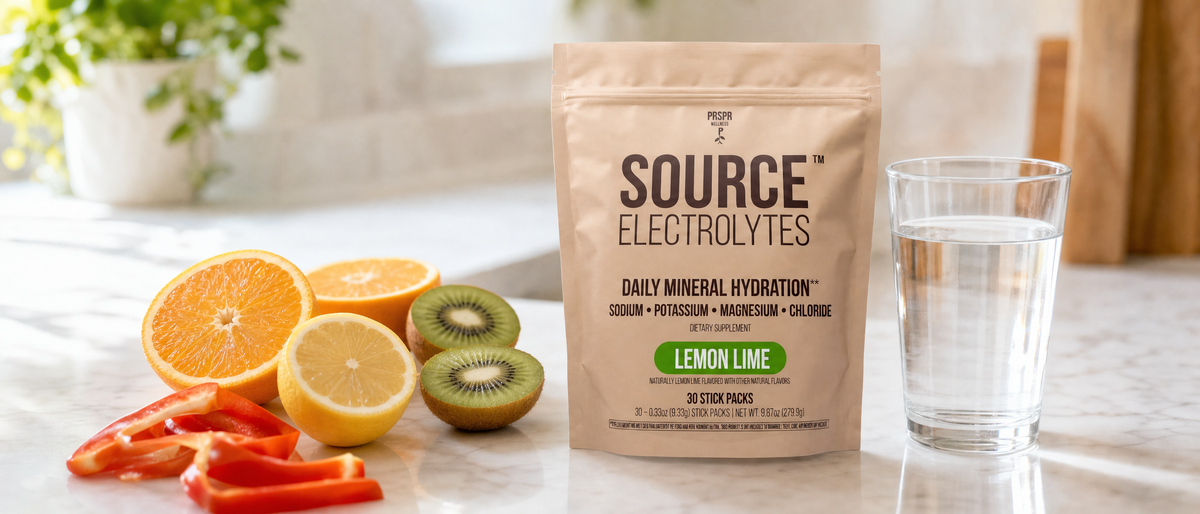
A vitamin C supplement is not only a tablet labeled vitamin C. The vitamin also turns up as one line among many in products built around something else. Our own Source Electrolytes is one of those. It is a mineral drink mix, and its listing names Vitamin C right at the front of its ingredient list, before calcium, magnesium, zinc, chloride, sodium and potassium.
So a mineral label can carry a vitamin. Electrolyte and mineral mixes are built around ions like sodium, potassium and chloride, and our guide to reading an electrolyte label as a chemistry list walks through those mineral lines one by one. Vitamin C is not one of those minerals. It is an organic molecule, C6H8O6, listed alongside them.
The listing names Vitamin C and stops there. It does not say whether that line is ascorbic acid or one of the ascorbate salts, and we are not going to guess. Read it at its actual size: vitamin C is in the ingredient list, by name.
The Office of Dietary Supplements notes that vitamin C in supplements can appear in several different forms, with ascorbic acid the most common. That is the reason it helps to know the vocabulary. If a panel says ascorbic acid, it is saying vitamin C. If it says something ascorbate, it is naming a salt of ascorbic acid. If it just says vitamin C, as ours does, it is using the everyday name.
Vitamin C is one of the best-known words in nutrition and one of the least understood names on a label.
People know the letter. They do not know the chemistry name, and so "ascorbic acid" on a cereal box or a drink mix can read like a mystery additive. It is not. It is the same vitamin under its formal name.
We also think the orange deserves a little less credit on the food side and a lot more credit on the marketing side. It is the image everyone reaches for, and a raw red pepper quietly sits above it in the government's own table. If a food list surprises you, that is a good sign you are reading the data instead of the picture.
And we would rather labels, ours included, told you the form, not just the letter. "Vitamin C" is accurate. "Vitamin C as ascorbic acid" would be complete. Our listing uses the short version, and we would rather say that plainly than pretend it tells you more than it does.
The habit we want you to leave with is this: when you see ascorbic acid or an ascorbate anywhere, translate it to vitamin C in your head, and keep reading.
Source Electrolytes - Daily Mineral Hydration is a stick-pack electrolyte and trace mineral drink mix formulated with Vitamin C, calcium, magnesium, zinc, chloride, sodium, potassium, D-Ribose, taurine, Himalayan pink salt, L-theanine, and ConcenTrace® concentrated seawater. It has no added sugar and comes in Lemon Lime and Pink Lemonade. That is the listing's own description, and it is the whole of what we say the product is.
What we will add in our own voice is how it is made. Source Electrolytes is manufactured in a GMP-certified facility and third-party batch tested, so what is on the label is what is in the bottle. No guessing, no filler, no cutting corners.
If you want to find the Vitamin C line for yourself, go to the source. Open the Source Electrolytes page and read the ingredient list as it is written, browse the rest of the vitamins and supplements collection, or take the build-your-stack quiz to see where it fits alongside everything else we carry.
Answer all five questions to unlock a clear wellness plan made around your goal, schedule, preferred supplement format, and biggest roadblock.
Get clarity on what matters most right now.
See the product and routine connected to your goal.
Simple next steps you can use right away.
Pick the one you would fix first if you could.
This helps us make the guide easier to follow.
Consistency beats the “perfect” routine you never follow.
Be honest. We’re building something you’ll actually use.
Your guide will include one simple way around it.
Answer two more questions to unlock your product starting point, five-step plan, two-week routine, and one practical tip for your biggest roadblock.
Enter your details to open your five-step plan.
Verified PRSPR customer reviews
Expires when you close this page
*Your personal credit for completing the quiz. It's applied automatically at checkout on one-time purchases and expires when the timer runs out.
View full product detailsEverything in your plan, together — one add to cart.
Expires when you close this page
*Your personal credit for completing the quiz. It's applied automatically at checkout on one-time purchases and expires when the timer runs out.
View full product details Mind vocabulary
What is cognition? You have probably seen the word "cognitive" printed on a label, in a headline, or in a product name, and kept scrolling. It is o...
 Biology vocabulary
What is metabolism? You see the word on labels, in gym talk and in nutrition headlines, almost always used as if it were a single setting. Read eno...
 Sleep vocabulary
What are sleep cycles? You hear the phrase on podcasts, see it on sleep trackers, and read it in articles that assume you already know what it mean...